
Clinical nurse specialists work across three spheres: direct patient care, nursing practice and the organization or system. They help explain how a CNS can address a clinical problem at the bedside and change the conditions that allowed it to recur.
The National Association of Clinical Nurse Specialists uses this framework in its practice resources. Its September 2026 statement update continues the emphasis on clinical expertise, nursing practice and organizational change.
Start with one patient-care problem
Consider a hypothetical hospital project addressing inconsistent medication information at discharge. This is an illustration of how to organize CNS work, not a report of a tested intervention or a treatment recommendation.
In the patient sphere, the CNS might help the team assess a complex patient's learning needs, identify conflicting instructions and coordinate appropriate expertise. The question is what this person needs for a safe, understandable care transition.
The work must remain within the CNS's preparation, legal authority and organizational permissions. The framework itself does not grant prescribing privileges.
Translate the problem into nursing practice
In the nursing-practice sphere, the same CNS might observe how nurses explain discharge information, ask where confusion arises and work with staff to evaluate an evidence-informed approach.
Possible activities include coaching, consultation, reviewing the quality of teaching materials and discussing difficult cases. An education session could be part of the work, but attendance alone would not demonstrate that practice changed.
For this example, the team could examine whether nurses consistently use the agreed process and whether patients can explain the relevant next steps. The measures should match the intervention rather than simply count meetings.
Address the organizational conditions
The systems sphere asks what the organization must change to support the work. In this example, contradictory electronic instructions, unclear responsibilities or missing access to language services could undermine individual teaching efforts.
The CNS might collaborate with pharmacy, informatics, nursing leadership and other stakeholders to investigate those barriers. Proposed changes should identify an accountable owner, resources, implementation steps and a way to detect unintended effects.
These activities connect back to the original patient problem. A new policy is an intermediate product, not proof of a better outcome.
Evaluate the combined contribution
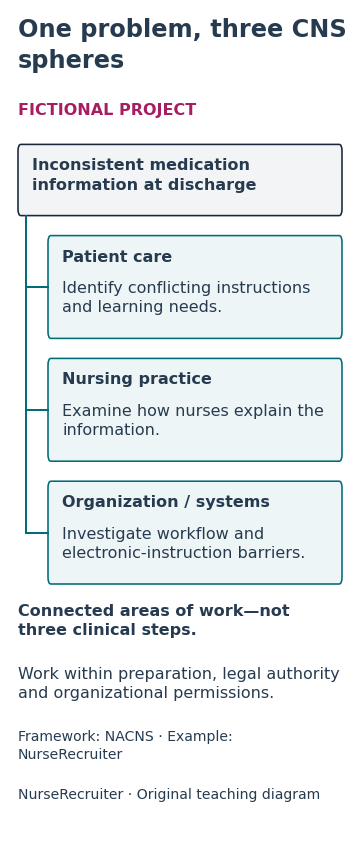
The same problem can call for contributions in all three spheres. These proposed activities are illustrative; the framework does not establish prescribing authority or prove that a project improves outcomes.
Before implementation, agree on baseline information, the population being assessed and how measures will be collected.
For the hypothetical discharge project, useful questions include:
- Are the intended steps being completed?
- Is the targeted information more consistent and understandable?
- Does the process create delays or additional work elsewhere?
- What other changes could explain the observed results?
Avoid attributing every improvement to one person or intervention. Describe the CNS's contribution within the team's work and acknowledge limitations in the evaluation.
Use the framework when assessing a role
Ask an employer for concrete examples of responsibilities in each sphere. Clarify access to clinical consultation, staff-development time, data, decision makers and implementation resources.
Review how performance will be assessed and whether the expectations match the available support. A role dominated by one activity may leave other intended responsibilities unexplained.
The broader clinical nurse specialist overview describes the credential and career. The spheres framework helps translate that role into a practical discussion about work, authority and outcomes.
Sources
- NACNS: Advocacy Toolkit (accessed 2026-09-17)
- NACNS: Fourth edition of the Statement on Clinical Nurse Specialist Practice and Education (accessed 2026-09-17) — Published September 1, 2026.