
Audit and feedback brings information about clinical practice back to the people who can act on it. Practice is measured over a defined period and compared with a standard or target; the results are then shared with clinicians or teams. The process differs from simply collecting data because recipients receive information intended to support a decision about their work.
Cochrane's 2026 review found that effects varied across studies. Most included studies involved physicians, although some involved nurses or pharmacists. Its synthesized evidence was current through June 2020. These limits matter when applying the findings to a nursing unit: a published average is not a promised result for a particular feedback program.
Make the report interpretable
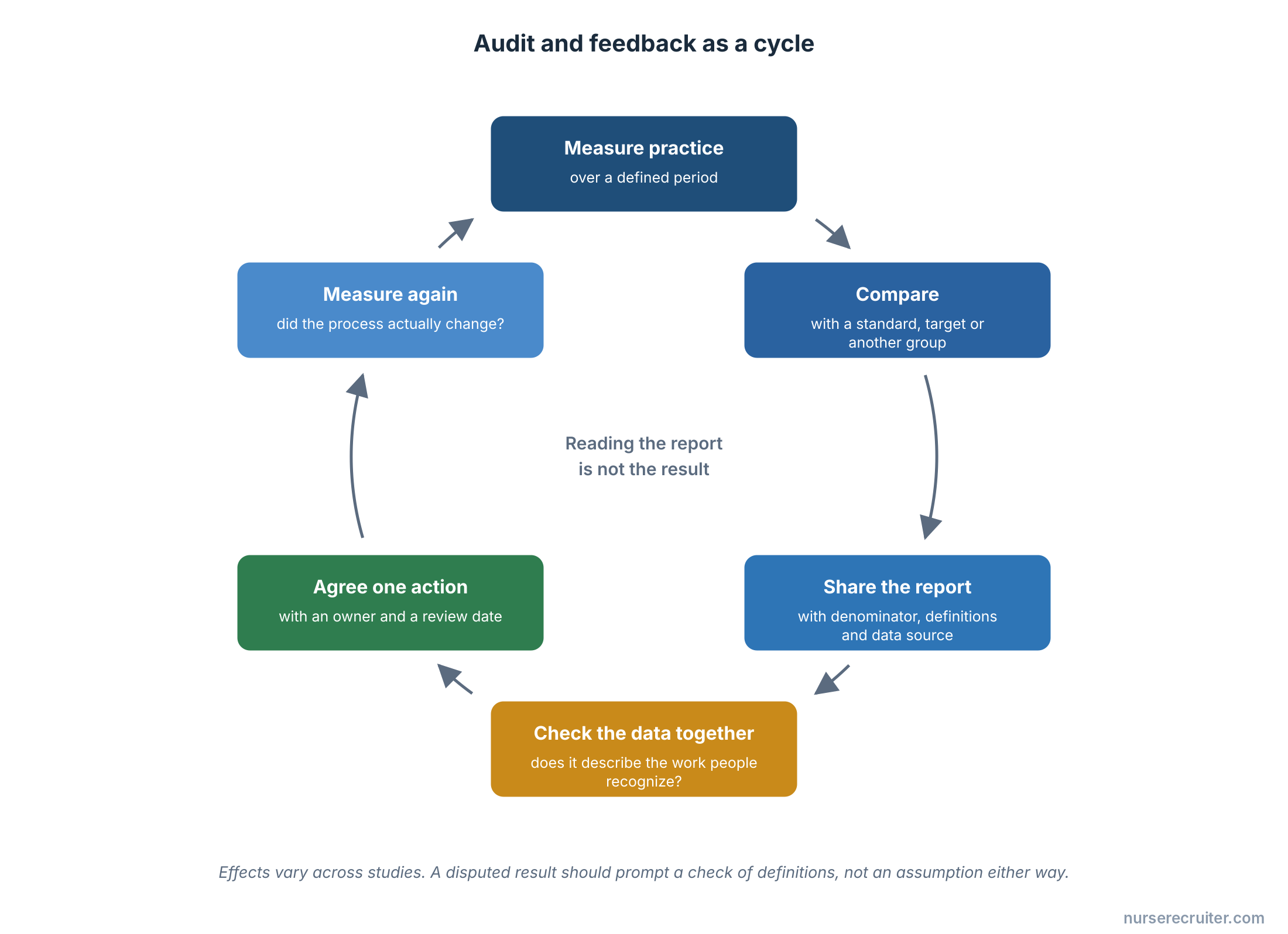
AHRQ's guidance on physician feedback reports describes sharing performance over a specified period, often with a comparator, to support assessment and improvement. It identifies several possible data sources, including records, observations, and surveys. Although physician-focused, these design questions can inform a nursing team's discussion.
For a practical report, state what was measured, who or what was eligible, the period covered, and the source of the data. Explain exclusions and missing information. A percentage without its denominator can hide a very small number of observations. Identify whether the comparator is a professional standard, a local target, or another group's performance; those comparisons answer different questions.
Invite recipients to check whether the data describe the work they recognize. A disputed result should trigger examination of definitions and extraction, not an automatic assumption that the result is wrong or that staff are resisting improvement. Selecting Quality Improvement Measures explains how clearer counting rules support that conversation.
Connect feedback with an action
AHRQ emphasizes that success depends on what happens after feedback, not merely whether the report was read. Cochrane's review also highlights helping recipients identify priorities and take action, while noting that the most effective design features require further confirmation.
As an application exercise, end a feedback discussion with one agreed problem to examine, an owner, and a date for reviewing the response. If the proposed action addresses a workflow barrier, identify who has the authority and resources to change that workflow. Keep the report's distribution appropriate to the local improvement purpose and information-handling rules.
Illustrative feedback conversation
Imagine a hypothetical audit of documented equipment-return destinations. Rather than circulating an unexplained completion percentage, a team could show the eligible requests, the missing-field definition, and examples with identifying details removed. Participants could then examine whether the field was absent, unclear, or completed somewhere the extraction missed.
The response might be a test of form wording or a correction to the audit method, depending on what the examination supports. Later measurement would address whether the selected response changed the intended process. Reading the dashboard is an activity; better information or a more reliable return process is the result the team would need to assess. Clinical Audit and Quality Improvement addresses the wider audit cycle.
After the first feedback cycle, consider how to sustain the practice change.
Sources
- Cochrane: Audit and Feedback, 2026 Review (accessed 2026-09-17).
- AHRQ: Physician Feedback Report Fundamentals (accessed 2026-09-17).