
AI documentation tools generate or transform text for the clinical record. Depending on the product, they may summarize information, convert speech into a draft, or propose wording based on existing material. A fluent draft is not evidence that its content accurately represents the patient's care.
For nursing, evaluation should focus on whether the tool preserves observations, attribution, timing, uncertainty, and the actions actually taken. The intended use should be defined before the tool is introduced into a live documentation workflow.
Understand what goes into the draft
Identify the input sources: audio, typed notes, structured EHR fields, or imported records. Determine whether the system uses information from the current encounter, prior encounters, or both. Review where those inputs are processed and stored through the organization's privacy and security process.
NIST's generative-AI profile identifies risks including false but confidently presented content, privacy problems, and harmful bias. These are general technology risks; they do not establish the error rate of a particular nursing product. Local evaluation is needed to understand how the risks appear in the proposed use.
Review clinical meaning, not just grammar
A review process should check whether a statement was added without support, whether a meaningful fact was omitted, and whether information was attributed to the correct speaker or source. Pay particular attention to negation, uncertainty, dates, medication names, and the difference between a plan and a completed action.
AHRQ's EHR safety primer warns that imported or copied content can propagate incorrect, outdated, or wrongly attributed information. An AI-generated summary can create a similar review problem even when its sentences are newly worded.
The organization needs to specify who reviews and finalizes the entry and how errors are corrected. Automation should not leave responsibility ambiguous.
Illustrative draft error
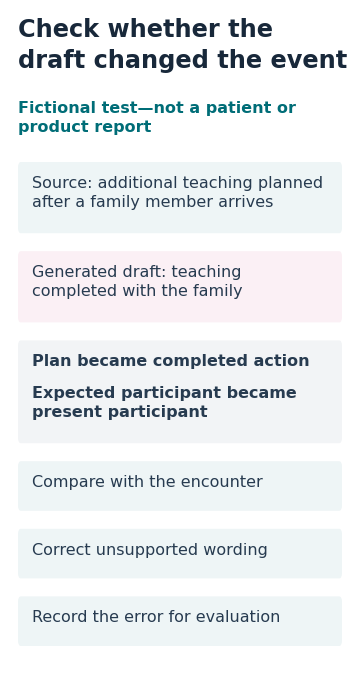
Fluent wording can change timing and meaning. This invented test does not estimate the error rate of any AI product.
In an illustrative test, the source material says that the nurse plans to provide additional teaching after a family member arrives. The generated note says that teaching was completed with the family. The wording is plausible but changes both the timing and the event.
The reviewer corrects the draft and records the error in the evaluation process. This example is not a report about a commercial product. It demonstrates why a grammatically polished note still needs comparison with the underlying encounter.
Evaluate the complete workload
Measure the time to review and correct, not only the time to generate a draft. Track clinically consequential omissions and unsupported additions separately from stylistic edits. Include different speakers, communication needs, clinical situations, and documentation types in testing.
The SAFER organizational-responsibilities guide calls for shared governance and monitoring of AI-enabled systems. A deployment plan should therefore include approved uses, restricted uses, staff training, incident reporting, and a way to suspend the feature if performance is unsafe.
The standard is a reliable clinical record, with identifiable human responsibility for its final content.
For a useful comparison with other structured note tools, see nursing documentation templates.
Related
Evaluating AI Tools for Nursing
Nursing Documentation Templates
Sources
-
NIST: Generative Artificial Intelligence Profile (accessed 2026-09-17).
-
AHRQ PSNet: Electronic Health Records (accessed 2026-09-17).
-
SAFER: Organizational Responsibilities (accessed 2026-09-17).