
Transfer center nurses coordinate requests to move patients between health facilities. They assemble clinical information, connect the referring and receiving clinicians, track the decision, and arrange the next handoff. A request for expert advice, acceptance by a physician, assignment of a staffed bed, and physical departure are four different events. A useful transfer record shows which have happened and who owns the next step.
The work behind an accepted transfer
From January 2019 through May 2023, a Southwestern U.S. academic trauma center accepted 61.7% of 26,020 eligible adult transfer requests from acute care hospitals. Consult-only calls were excluded. Counting arrivals would miss the work on more than a third of those requests, as well as the consultations. Requests handled, decisions reached and patients transported are three different workload measures for an RN transfer desk.
Pay
NurseRecruiter’s comparison of May 2025 BLS RN wages gives a general medical and surgical hospital benchmark of $48.18 an hour at the median. The middle half of all RN wages in those hospitals was $39.23–$57.21. A transfer center operated by a different organization may use another classification. These figures cover both bedside and non-bedside hospital RNs. BLS excludes overtime premiums and employer-paid benefits.
A transfer desk can cover several hospitals over one shift. Confirm whether nights, weekends, home-based coverage, and any continuing bedside requirement are included in regular hours or paid separately.
From the first call to arrival
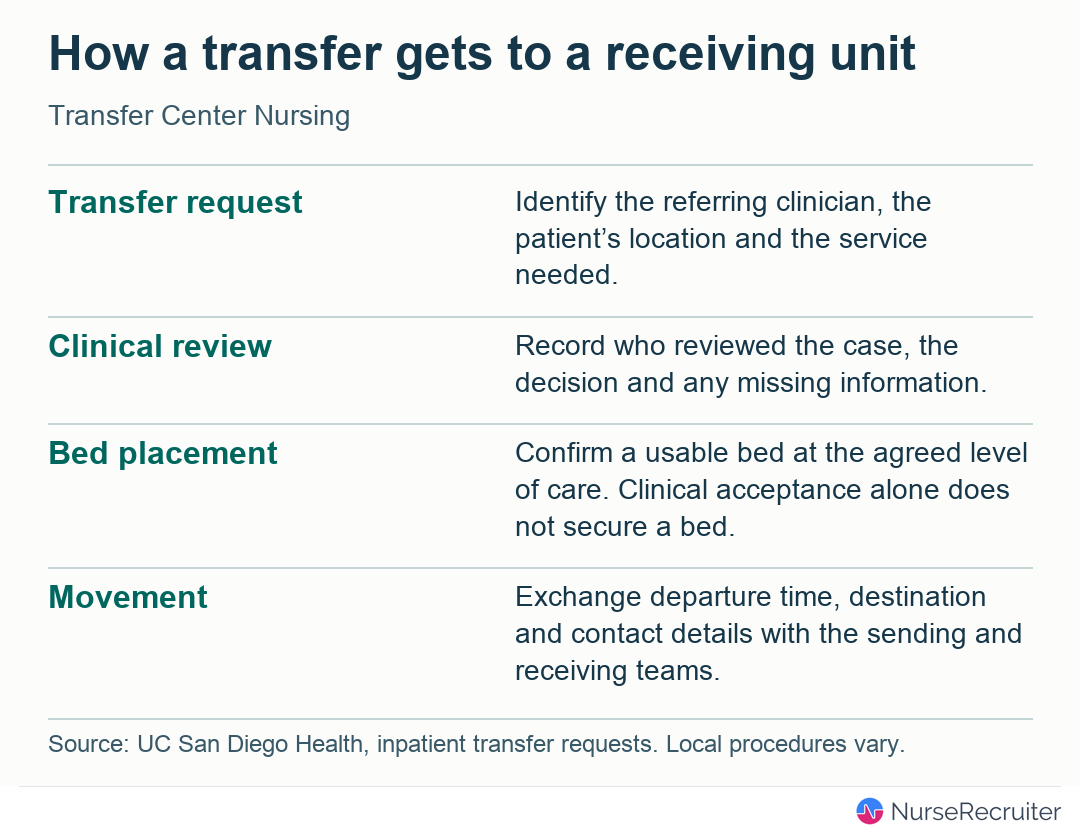
| Stage | What the center establishes |
|---|---|
| Request | Referring facility and clinician, callback number, patient identity, current location, reason for transfer, and service needed. |
| Clinical review | The appropriate receiving specialist receives the clinical picture. The center records decisions, requested information, and the clinician responsible for follow-up. |
| Placement | Bed management confirms the level of care and a usable destination. A physician’s acceptance can precede bed availability. |
| Movement | The sending facility, receiving unit, and transport service exchange the destination, departure estimate, records, and contact details needed for handoff. |
UC San Diego Health describes a 24-hour RN-staffed transfer center. Its RN evaluates requests with a physician, and the hospital identifies level of care, capacity, and the accepting doctor’s approval as distinct considerations. UC Davis Health offers referring clinicians both emergency consultations and assistance with urgent transfers. A conversation with a specialist can therefore be the desired outcome in its own right.
What remains the sending team’s responsibility
A transfer-center RN coordinates the call and escalates a change in condition to the responsible clinicians. The sending team remains responsible for care while the patient waits. Clinical responsibility during transport follows the arrangements for that transfer. Accepting a request does not give a receiving clinician physical control of a patient still at the referring hospital. The transport team needs its own clinical handoff.
Emergency requests may also trigger duties under the Emergency Medical Treatment and Labor Act. These can include screening, stabilization, and appropriate transfer, with accepting-hospital obligations in applicable circumstances. A routine inpatient bed inquiry and an emergency department request involving an unstabilized emergency condition cannot safely be treated as the same administrative transaction.
Workload and failure points
When the patient’s condition changes, update the required level of care and record who notified the receiving clinician, receiving unit and transport team. In a hypothetical case, the referring hospital has sent records and reached an accepting service, and an hour later the patient’s monitoring needs increase. A nurse working only from the original bed request could send transport to a destination that no longer matches the patient’s needs.
The number of completed transfers understates work if a center fields many consultations, repeated callbacks, or transfers delayed for capacity. In hiring, clarify who handles bed placement, who arranges transport, which nurses cover simultaneous calls, and who can escalate a prolonged wait. Warm handoffs and care coordination continue after the accepting decision.
Related articles
Sources
- UC San Diego Health, inpatient transfer requests (accessed 2026-11-18)
- UC Davis Health, transfers and emergency consultations (accessed 2026-11-18)
- CMS, Emergency Medical Treatment and Labor Act (accessed 2026-11-18)
- 42 CFR 489.24, Emergency Hospital Responsibilities (accessed 2026-11-18) — Screening, stabilizing treatment, transfer and recipient-hospital requirements.
- Bureau of Labor Statistics, May 2025 Occupational Employment and Wage Statistics, national industry-by-occupation wage tables (accessed 2026-11-18)
- BLS, May 2025 national industry-specific occupations and wages, downloadable data (accessed 2026-11-18)
- Emergency Department Boarding, Inpatient Census, and Interhospital Transfer Acceptances, JAMA Network Open, 2025 (accessed 2026-11-19)