
A nursing house supervisor is the nurse assigned operational responsibility across a hospital or facility during a shift. The role often covers nights, weekends, and holidays when unit and department leaders are off site. House supervisor, nursing administrative supervisor, and house manager can refer to similar jobs. The hospital’s delegation of authority determines which decisions the person on duty can actually make.
Pay
NurseRecruiter compiled these VA shift-supervisor schedules from the 2026 nurse locality workbook, which lists the shift-supervisor assignment separately from staff RN and unit-manager assignments. Both are series 0610, assignment 86, grade 02, effective January 11, 2026. Amounts are annual basic pay.
| Duty locations | Station / pay plan | Step 1 | Step 2 | Step 6 | Step 12 |
|---|---|---|---|---|---|
| Murfreesboro and Nashville, Tennessee | 626 / NG63 | $109,202 | $112,478 | $125,582 | $145,238 |
| Oceanside and San Diego, California | 664 / NT30 | $137,722 | $141,853 | $158,377 | $183,163 |
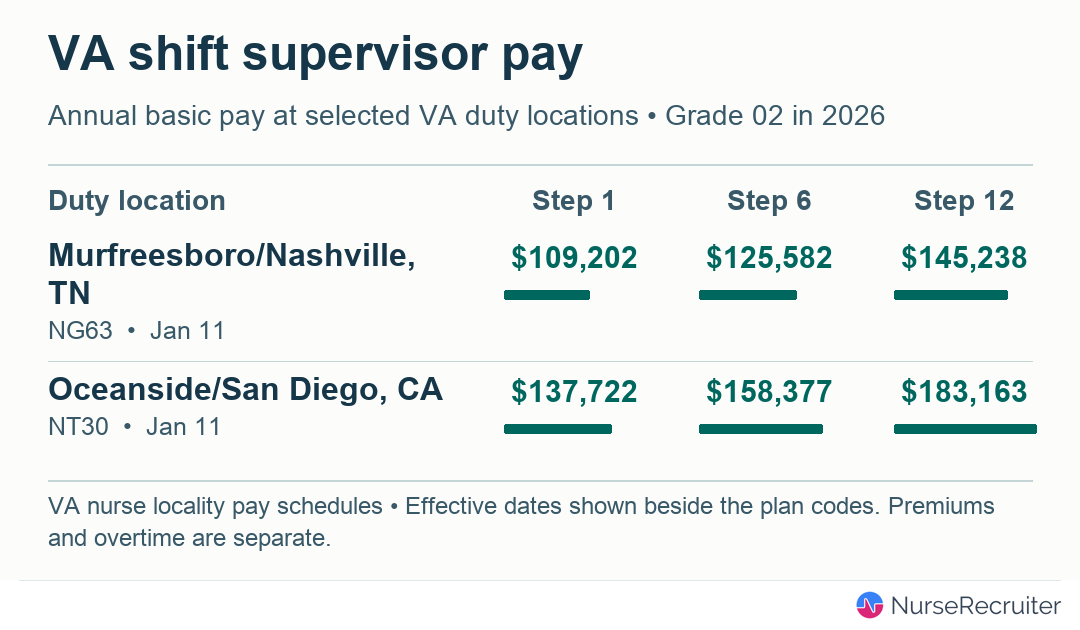
These are specific VA assignments. The schedules do not establish a national house-supervisor wage or include every possible shift and additional-coverage premium. A one-campus assignment and responsibility for several campuses can use the same title but carry different scope. Registered nurse pay provides broader labor-market comparisons.
Scheduled and actual hours
In HRSA’s 2022 U.S. nursing workforce survey, among full-time RNs without an APRN credential in the survey’s “middle management or administration, including house supervisors, directors and department heads” job-title group, 10.6% reported being scheduled for more than 40 hours a week, while 68% reported actually working more than 40 hours in their primary nursing job in 2021. The estimated share working more than 40 hours had a 95% confidence interval of 63.8% to 72.2%. A house supervisor’s coverage plan can identify who owns an unresolved placement or staffing call after the next supervisor arrives. The specialty survey notes explain which hours count.
Staffing, placement and escalation
Staffing. The supervisor combines reports from several units, including census, expected admissions, absences, staff qualifications, and patients needing enhanced observation. Moving an RN solves a numerical shortage only if the receiving unit can use that nurse’s skills and the sending unit can release them safely.
Placement and movement. An empty bed can be unavailable because of staffing, equipment, or the patient’s monitoring needs. The supervisor reconciles placement requests with unit capacity and coordinates with the transfer center, bed management, and unit leaders. A charge nurse sees the receiving team’s actual assignments. The house supervisor can see competing demands elsewhere in the hospital.
Escalation. The supervisor can organize resources for an urgent event, involve the administrator on call, and arrange the next operational decision. The supervisor’s administrative authority and the treating clinician’s responsibility for medical care remain distinct.
How authority varies
The University of Missouri System’s June 2026 University Hospital position description assigns the house supervisor operational and personnel responsibilities on evenings, nights, weekends, and holidays. It describes functional supervision across hospital departments during those periods. Its Missouri Psychiatric Center description adds behavioral escalation, patient movement, and defined incident-command duties pending arrival of the designated administrator. The two classifications illustrate differences in campus, staff and emergency responsibilities within one employer.
A hospital-wide supervisor can have functional authority on a shift without being every nurse’s manager for evaluations or discipline. Ordinary performance management, longer-term hiring, and the unit budget may sit with nursing management. The chain of command should identify who makes a disputed placement decision and who can authorize staff call-in or overtime.
What a supervisor hands over
An occupied-bed count does not show all the constraints on the next shift. A bed may lack the staff competency, equipment or monitoring needed for an incoming patient, or may already be reserved for a patient returning from a procedure. The supervisor checks those constraints with the charge nurses before confirming placement.
Hypothetical example: the emergency department has two admitted patients waiting and the census shows two unoccupied inpatient beds. One unit lacks a staff member with the required competency; the other bed is earmarked for a patient returning from a procedure. The supervisor verifies both constraints with the charge nurses, identifies available relief, and communicates the revised plan to the affected services. Marking both beds available would only hide the problem until handoff.
A shift handoff identifies unresolved staffing requests, placements awaiting a decision, the responsible person and the next review time. Patient acuity and staffing systems can support that review, but staffing numbers still need to be matched to skills and current clinical work. Transfer-center nursing addresses the related coordination between facilities.
Travel and per diem work
For a travel or interim house supervisor assignment, establish which campuses and shifts fall under the appointment and who can authorize staffing changes. For a per diem night, clarify bed-placement authority, the administrator on call and how unresolved staffing or transfer decisions pass to the day supervisor.
Related articles
- The Charge Nurse Role
- Nursing Management and Leadership
- Nurse Leadership Certifications
- Float Pools and Internal Resource Pools
- Transfer-Center Nursing
Sources
- 2026 Nurse Locality Pay Workbook (accessed 2026-11-18) — VA; assignment 86 schedules compiled by NurseRecruiter.
- University Hospital Nurse House Supervisor (accessed 2026-11-18) — University of Missouri System; June 2026 classification.
- Missouri Psychiatric Center Nurse House Supervisor (accessed 2026-11-18) — University of Missouri System; June 2026 classification.
- HRSA, 2022 National Sample Survey of Registered Nurses, public-use data and codebook (accessed 2026-11-19)