
Rapid response teams bring critical care expertise to hospitalized patients whose condition is deteriorating. Nursing roles include bedside recognition and escalation, response-team assessment, continued monitoring and transfer coordination. Some jobs include proactive rounds and staff education as well as emergency calls.
Nursing assignments and pay
A dedicated response nurse and an ICU nurse covering the response pager have different workloads. Shared coverage also requires another clinician to assume the responder's original patients. Backup covers simultaneous calls, transport and breaks.
NurseRecruiter's compilation of May 2025 BLS hospital RN wages gives an hourly median of $48.18, with the middle half earning $39.23–$57.21. These U.S. general medical and surgical hospital figures include many RN assignments; BLS does not identify rapid response nurses separately. They exclude overtime premiums, shift differentials and employer benefit costs.
The actual classification, any assignment differential and standby or callback terms determine compensation for the role. Carrying a pager during a paid shift differs from remaining available off duty.
Two hospital models
UK HealthCare describes adult rapid response nurses providing 24-hour coverage, responding to deterioration and rounding daily on patients transferred from intensive care to acute care. It also has a dedicated pediatric response team. Its published description states that rapid response nurses hold CCRN certification.
Texas Children's Hospital lists a medical provider, critical care nurse, respiratory therapist and nursing house supervisor in its response team. Families can activate the team for ongoing concerns or worsening condition; a family advocate follows up on their experience.
These examples show why staffing, patient age group and non-call duties belong in the job description. Critical care nursing provides the broader specialty context.
Responsibilities during a response
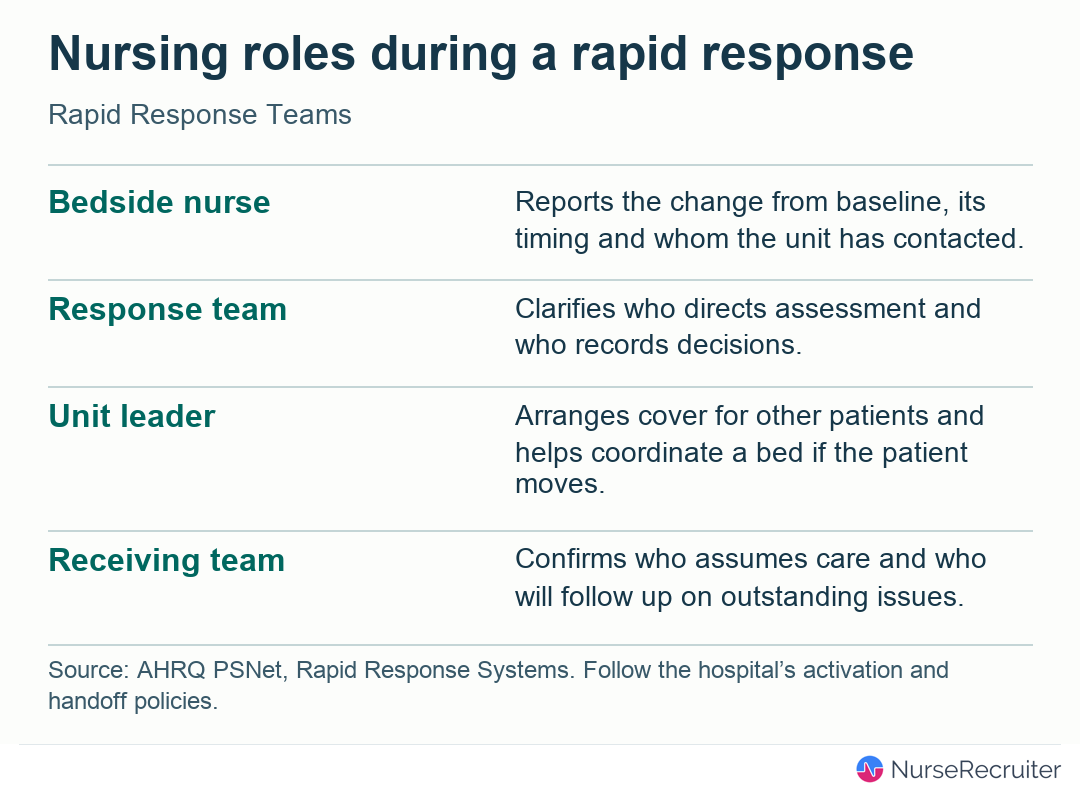
| Role | Work during the response |
|---|---|
| Bedside nurse | Reports the change from baseline, timing, observations and prior contacts |
| Response team | Assesses the patient, directs immediate actions, records decisions and determines the support needed |
| Charge nurse or supervisor | Arranges coverage for other patients and helps coordinate staffing or a receiving bed |
| Receiving team | Accepts responsibility for continued care and outstanding follow-up |
Activation and evaluation
The hospital defines who can call, the route for escalating concerns and which team responds. AHRQ distinguishes rapid response before cardiopulmonary arrest from the arrest team's function. Some hospitals allow patient or family activation.
Calling criteria typically combine physiologic thresholds with clinical judgment. AHRQ's example criteria include a heart rate over 140 or under 40 a minute, a respiratory rate over 28 or under 8, a systolic blood pressure above 180 or below 90 mmHg, and a staff member's significant concern about the patient's condition. A trigger recorded in the chart helps only if someone notices it and can reach the responders.
Calls per thousand admissions measure use of the system. They do not alone measure timely recognition or effectiveness, and a rise can follow a new family-activation policy or staff education about when to call. Case review can pair the activation reason and response time with disposition, repeat calls and unresolved problems. An ICU transfer may be an appropriate response to deterioration.
Related articles
Sources
- UK HealthCare: Rapid Response Nursing Teams (accessed 2026-11-18).
- Texas Children’s Hospital: family guide to the health care team and rapid response (accessed 2026-11-18).
- AHRQ PSNet: Rapid Response Systems, reviewed 2024 (accessed 2026-11-18).
- BLS: May 2025 industry-specific Occupational Employment and Wage Statistics (accessed 2026-11-18).
- BLS: OEWS wage definitions (accessed 2026-11-18).