
NurseRecruiter's analysis of federal IPEDS data finds that colleges and other reporting institutions in the 50 states and D.C. awarded 260,493 degrees and certificates in registered nursing and 54,421 in practical or vocational nursing from July 1, 2024, through June 30, 2025. Awards are assigned to the reporting institution’s state, not the graduate’s home or workplace. Online and multi-campus institutions may report awards centrally. These totals count credentials, not unique people or new RN licenses.
The national totals
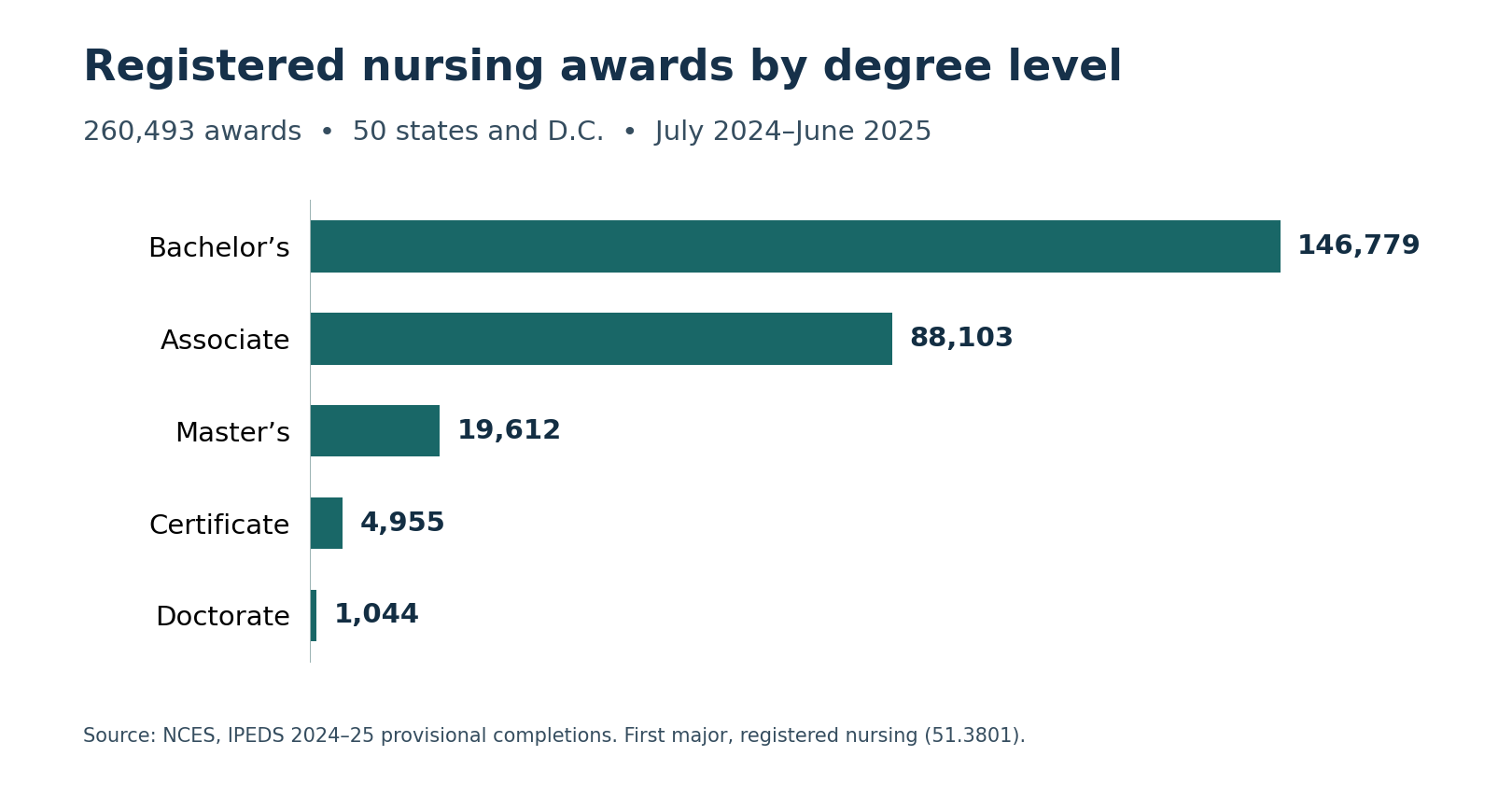
Bachelor’s degrees accounted for 146,779 registered nursing awards, followed by 88,103 associate degrees. Both can prepare students for entry into RN practice, but the bachelor’s figure also includes RN-to-BSN programs for people who already hold a license. The federal data combine the two routes. Schools also awarded 19,612 master’s degrees, 1,044 doctorates and 4,955 certificates in the registered nursing category.
The pattern differs in practical nursing. Of the 54,421 awards, 52,326 were certificates, 2,089 were associate degrees and six were bachelor’s degrees.
What stands out
Florida awarded the most registered nursing associate degrees (9,187). Its schools awarded 8,866 bachelor’s degrees. Texas led in bachelor’s degrees (12,392), followed by Minnesota (12,191). For practical nursing, California awarded 8,366 credentials, more than any other state.
The degree mix varies widely by state. Nationally, bachelor’s degrees made up 62% of associate and bachelor’s RN awards combined, roughly five for every three associate degrees; entry into practice and levels of nursing explain why both routes persist. Among states with more than 500 RN awards, that bachelor’s share ranged from 88% in Minnesota (97% in D.C.) to 41% in West Virginia and 43% in Mississippi. Because the bachelor’s count includes RN-to-BSN completions, a high share does not by itself mean most new nurses there enter with a BSN.
Volume does not track population closely. Minnesota (17,869 RN awards) ranks fourth and Utah (10,871) seventh, ahead of more populous states such as Pennsylvania and Georgia, largely on bachelor’s output. Since awards are counted where the institution reports, large online programs can lift a state’s total.
Practical nursing is concentrated differently. After California, Kentucky (5,366), Ohio (3,775) and Texas (3,757) awarded the most practical nursing credentials. In Iowa, practical nursing awards (2,691) exceeded registered nursing awards (2,249).
Shares and rankings are NurseRecruiter calculations from the table below.
By state
The first five columns add up to each state’s RN total. Practical nursing is counted separately. The last column counts institutions that conferred at least one award in registered nursing.
| State | Associate | Bachelor’s | Master’s | Doctorate | Certificates | RN total | Practical nursing | RN schools |
|---|---|---|---|---|---|---|---|---|
| 50 states and D.C. | 88,103 | 146,779 | 19,612 | 1,044 | 4,955 | 260,493 | 54,421 | 2,027 |
| Alabama | 2,205 | 2,343 | 1,617 | 0 | 70 | 6,235 | 1,771 | 40 |
| Alaska | 101 | 91 | 9 | 0 | 0 | 201 | 34 | 3 |
| Arizona | 1,931 | 6,624 | 791 | 8 | 54 | 9,408 | 429 | 35 |
| Arkansas | 1,282 | 1,422 | 164 | 0 | 0 | 2,868 | 794 | 35 |
| California | 6,610 | 10,564 | 1,165 | 35 | 401 | 18,775 | 8,366 | 151 |
| Colorado | 807 | 2,089 | 118 | 56 | 66 | 3,136 | 410 | 27 |
| Connecticut | 693 | 1,550 | 144 | 50 | 69 | 2,506 | 393 | 14 |
| Delaware | 305 | 439 | 18 | 0 | 18 | 780 | 74 | 5 |
| District of Columbia | 12 | 413 | 175 | 38 | 13 | 651 | 0 | 6 |
| Florida | 9,187 | 8,866 | 1,032 | 7 | 179 | 19,271 | 2,406 | 100 |
| Georgia | 1,905 | 3,378 | 718 | 7 | 823 | 6,831 | 808 | 58 |
| Hawaii | 155 | 386 | 68 | 0 | 2 | 611 | 87 | 8 |
| Idaho | 410 | 1,092 | 6 | 3 | 0 | 1,511 | 174 | 12 |
| Illinois | 2,579 | 9,927 | 2,264 | 0 | 22 | 14,792 | 1,255 | 82 |
| Indiana | 1,856 | 2,705 | 151 | 17 | 46 | 4,775 | 794 | 34 |
| Iowa | 1,184 | 1,063 | 2 | 0 | 0 | 2,249 | 2,691 | 35 |
| Kansas | 868 | 1,122 | 20 | 0 | 100 | 2,110 | 647 | 37 |
| Kentucky | 2,184 | 3,020 | 660 | 0 | 9 | 5,873 | 5,366 | 42 |
| Louisiana | 1,078 | 1,979 | 266 | 0 | 63 | 3,386 | 1,168 | 30 |
| Maine | 395 | 495 | 6 | 0 | 3 | 899 | 47 | 14 |
| Maryland | 1,614 | 1,486 | 493 | 6 | 2 | 3,601 | 343 | 28 |
| Massachusetts | 1,168 | 2,394 | 423 | 121 | 107 | 4,213 | 448 | 45 |
| Michigan | 2,200 | 3,215 | 184 | 64 | 1 | 5,664 | 1,040 | 58 |
| Minnesota | 1,637 | 12,191 | 4,038 | 0 | 3 | 17,869 | 763 | 48 |
| Mississippi | 1,420 | 1,074 | 6 | 0 | 0 | 2,500 | 790 | 24 |
| Missouri | 1,534 | 2,114 | 325 | 47 | 25 | 4,045 | 923 | 51 |
| Montana | 196 | 430 | 23 | 0 | 5 | 654 | 45 | 13 |
| Nebraska | 256 | 1,171 | 43 | 6 | 0 | 1,476 | 359 | 15 |
| Nevada | 476 | 1,475 | 148 | 0 | 0 | 2,099 | 93 | 14 |
| New Hampshire | 411 | 938 | 183 | 0 | 0 | 1,532 | 142 | 18 |
| New Jersey | 2,733 | 2,492 | 355 | 1 | 288 | 5,869 | 916 | 49 |
| New Mexico | 592 | 759 | 33 | 0 | 3 | 1,387 | 205 | 21 |
| New York | 5,731 | 6,706 | 310 | 7 | 84 | 12,838 | 2,230 | 109 |
| North Carolina | 2,929 | 3,466 | 128 | 10 | 50 | 6,583 | 867 | 89 |
| North Dakota | 276 | 505 | 98 | 10 | 1 | 890 | 197 | 13 |
| Ohio | 4,162 | 5,163 | 648 | 99 | 631 | 10,703 | 3,775 | 111 |
| Oklahoma | 1,304 | 1,652 | 54 | 0 | 0 | 3,010 | 1,165 | 29 |
| Oregon | 682 | 1,072 | 25 | 3 | 14 | 1,796 | 602 | 23 |
| Pennsylvania | 2,308 | 4,169 | 963 | 140 | 838 | 8,418 | 1,511 | 80 |
| Rhode Island | 378 | 452 | 0 | 0 | 0 | 830 | 258 | 6 |
| South Carolina | 1,512 | 1,592 | 38 | 0 | 52 | 3,194 | 406 | 37 |
| South Dakota | 199 | 595 | 20 | 14 | 0 | 828 | 255 | 11 |
| Tennessee | 1,791 | 3,024 | 240 | 0 | 8 | 5,063 | 1,472 | 47 |
| Texas | 6,945 | 12,392 | 138 | 0 | 605 | 20,080 | 3,757 | 118 |
| Utah | 1,994 | 8,685 | 101 | 91 | 0 | 10,871 | 522 | 18 |
| Vermont | 164 | 230 | 0 | 0 | 0 | 394 | 178 | 3 |
| Virginia | 2,915 | 2,893 | 296 | 5 | 300 | 6,409 | 1,793 | 64 |
| Washington | 1,750 | 1,705 | 220 | 171 | 0 | 3,846 | 271 | 41 |
| West Virginia | 1,234 | 841 | 89 | 0 | 0 | 2,164 | 326 | 25 |
| Wisconsin | 1,592 | 2,187 | 589 | 28 | 0 | 4,396 | 859 | 43 |
| Wyoming | 253 | 143 | 7 | 0 | 0 | 403 | 196 | 8 |
Method and workforce interpretation
The federal IPEDS Completions survey records the award, program and school. For this table, each award counts once under its first major. Registered nursing uses program code 51.3801, and practical or vocational nurse training uses 51.3901. Separately classified specialties, such as nurse anesthesia, fall outside these two codes. The figures come from the provisional 2024–25 release. NurseRecruiter joined the completions records to the 2025 institutional directory, limited the table to the 50 states and D.C., summed awards by level and counted institutions with at least one registered-nursing award. “RN schools” counts reporting institutions, not every teaching location or program track.
To estimate how many graduates might enter the workforce, start with a state board’s count of graduates from prelicensure programs. Then check how many took and passed the NCLEX for the first time. A degree, a license and a nurse taking a job in that state are three different events. NurseRecruiter's June 2026 report on the nursing pipeline compares enrollment with first-time pass rates and explains why the two measures alone cannot establish workforce growth. For what limits enrollment, see the nurse faculty shortage. For how employers measure how many hires stay, see nurse turnover and retention.
Employers using these figures for school outreach can use the new graduate recruiting guide to match graduation dates with interviews, orientation places and available preceptors.
Citing this study
Credit the findings to NurseRecruiter’s Nursing Degrees and Certificates by State, 2024–25 analysis, and link to this article. Underlying data: NCES IPEDS provisional completions records and the 2025 institutional directory. The figures count awards, not unique graduates or newly licensed nurses.
Related articles
Sources
- NCES, IPEDS data tools and downloads (listed in the dataset index 2026-11-19)
- NCES, IPEDS Completions, 2024–25 awards by program and award level (ZIP) (accessed 2026-11-18).
- NCES, IPEDS 2025 institutional directory (ZIP) (accessed 2026-11-18).
- NCES, IPEDS Completions data dictionary (ZIP) (accessed 2026-11-18).
- NCES, IPEDS data release schedule (accessed 2026-11-18).
- Nursing schools turned away 93,176 qualified applications in 2025 (accessed 2026-11-18) — enrollment capacity and first-time NCLEX pass-rate context for 2025.