
Informed consent is the process by which a patient receives relevant information and voluntarily authorizes an intervention. The practitioner performing the procedure is responsible for explaining it and obtaining consent; the nurse's role is to support that process: confirm the patient understands and agrees, witness the signature when asked, arrange interpretation, and tell the practitioner if the patient has questions, misunderstands or wants to change their mind. Nursing responsibilities also include patient education within the nurse's scope and documenting nursing observations. A signature alone does not establish understanding.
Nursing and practitioner responsibilities
AHRQ's hospital training distinguishes the practitioner responsible for consent from staff supporting the process. Its examples include nurses preparing patients through education and staff checking that required forms are present. A nurse practitioner responsible for an intervention may have a different role from an RN supporting the encounter. Applicable law, privileges and scope of practice determine those responsibilities.
| Work in the consent process | Distinction that matters |
|---|---|
| Patient education | Explaining information does not automatically make that staff member responsible for the entire consent process |
| Arranging communication support | Qualified interpretation and accessible information address barriers to participation |
| Witnessing a signature | The witness attests to what the form and applicable requirements specify; this is not a blanket certification of understanding |
| Identifying a concern | A specific misunderstanding, unanswered question or apparent pressure requires resolution by the appropriate clinician |
| Documentation | Record what was observed and communicated, including the response, without claiming to have witnessed another person's discussion |
A unit's consent workflow should answer, before a time-sensitive case arises: which professional answers unresolved questions about the intervention; how language or communication assistance is arranged; what happens when a patient changes their mind; who evaluates concerns about decision-making capacity; and how disagreement or suspected pressure is escalated. The applicable emergency process governs when consent cannot follow the routine pathway.
Common exam questions about the nurse's role in consent
Nursing exams, including NCLEX-style practice questions, test the same distinction. Typical questions and the reasoning behind the expected answers:
A nurse is discussing a surgical procedure with a client who has not yet provided informed consent. What is the nurse's appropriate role? To confirm the client has received and understood the practitioner's explanation, answer general questions within nursing scope, and witness the client's signature. The nurse does not explain the procedure's specific risks, benefits and alternatives in place of the surgeon.
The client signing a consent form asks what the surgeon will actually remove. What should the nurse do? Stop the signing and notify the surgeon or provider that the client needs more information. A signature from a client who does not understand the procedure is not informed consent.
When the nurse witnesses a consent form, what is the nurse attesting to? That the person who signed is the client (or authorized representative) and that the signature was given voluntarily, as the form and policy specify. It does not certify that the practitioner's explanation was adequate.
A client says they no longer want the procedure after signing. What should the nurse do? Treat it as a withdrawal of consent: do not proceed, notify the provider and document the client's statement.
A client has received sedating medication before signing. What should the nurse do? Hold the signing and notify the provider; the client's ability to understand and decide may be impaired. See decision-making capacity.
These answers reflect the usual hospital division of responsibility. Actual duties follow the facility's policy and state law.
Hospital requirements
Under Medicare's hospital surgical-services conditions of participation, a properly executed consent form must be in the chart before surgery, except in emergencies.
CMS's April 2024 guidance also addresses examinations or invasive procedures performed for education or training, including breast, pelvic, prostate and rectal examinations. The consent process must address applicable participation by other practitioners or students; permission for the expected operation should not be assumed to cover an unmentioned teaching examination.
These federal hospital requirements do not replace state law or establish a universal rule that every nurse can independently obtain every type of consent.
Understanding, capacity and authorization
AMA physician ethics guidance describes discussion of the intervention's purpose, benefits, burdens, risks and alternatives, including no treatment. It is physician guidance, not a nursing scope rule.
Teach-back can reveal a misunderstanding. If a patient says they signed because they believed a procedure was only a test, the substantive issue is the unresolved choice, not whether the form has a signature. Keep the check open rather than test-like: a person who feels tested may agree to avoid embarrassment. Invite the questions that matter to them, including what happens if they choose another option or do not proceed.
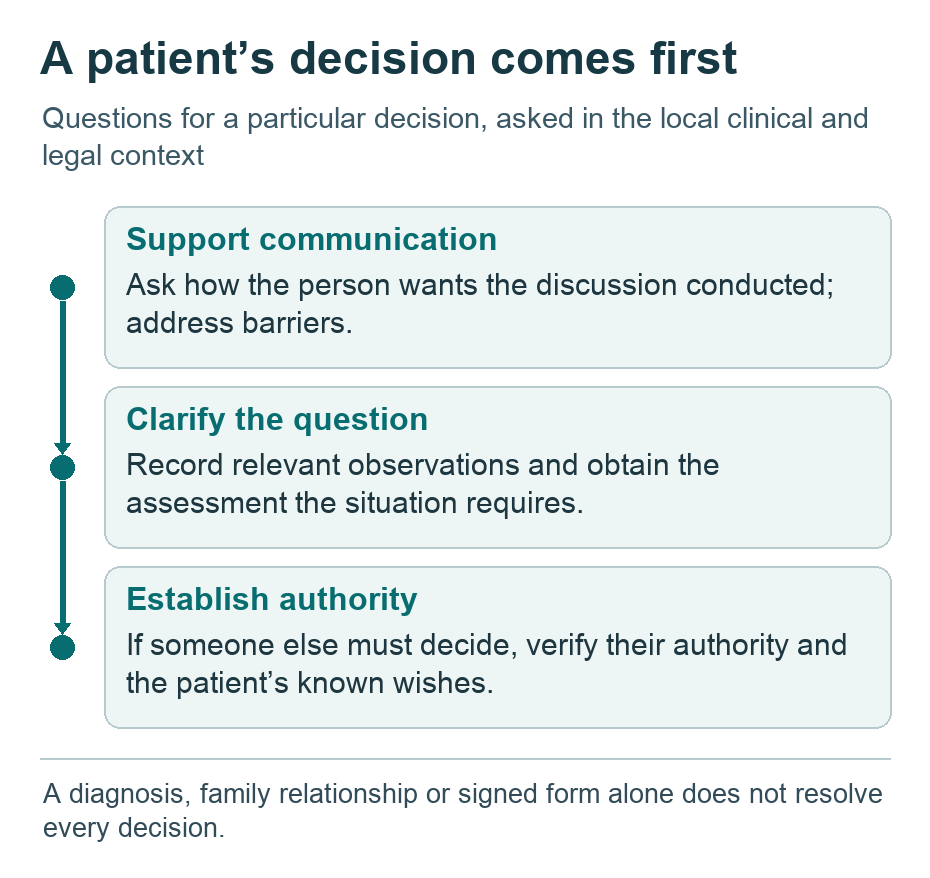
Decision-making capacity, communication access and a surrogate's authority are separate questions. Difficulty hearing, speaking English or reading a form is not itself a capacity determination. Nursing observations and the patient's own words help the responsible team address the actual problem. A delay in paperwork and genuine uncertainty about the patient's wishes are different problems and may need different escalation.
Related articles
- Decision-Making Capacity and Nursing Observations
- Surrogate Decision-Makers in Healthcare
- Teach-Back in Patient Education
- Working with Medical Interpreters
Sources
- Making Informed Consent an Informed Choice: Training for Health Care Leaders (accessed 2026-11-18) — AHRQ.
- 42 CFR 482.51: Hospital surgical services (accessed 2026-11-18).
- QSO-24-10-Hospitals: Informed consent guidance (accessed 2026-11-18) — CMS, April 2024.
- Informed Consent (accessed 2026-11-18) — AMA Code of Medical Ethics.
- Use the Teach-Back Method: Tool 5 (accessed 2026-11-18) — AHRQ.