
Home infusion nurses provide assessment, treatment, vascular-access care and teaching for patients receiving intravenous or subcutaneous therapy at home. Assignments may involve administering a treatment, monitoring a visit or preparing a patient or caregiver to give later doses. The work connects infusion nursing, pharmacy services and care in the home; device types, hospital and ambulatory infusion work and the CRNI credential are covered on the infusion page.
When the paid workday starts
Oregon Health & Science University’s 2023–26 nursing agreement addressed a recurring home-infusion question. Nurses without a single regular work site away from home were to clock in and out at home. The agreement also barred using mandatory on-call time to cover routine appointments. That distinction matters when reviewing a route. The hours spent on a visit, paid travel time and coverage for unscheduled problems all draw on the same nurse’s day.
Pay and workload
NurseRecruiter's compilation of May 2025 BLS industry wages provides two employer benchmarks. These figures cover all RN roles in each industry, not home infusion alone.
| U.S. employer industry | Middle half of RN hourly wages | Hourly median | Annual median |
|---|---|---|---|
| Home health care services | $37.62–$48.66 | $40.83 | $84,930 |
| Outpatient care centers | $39.39–$61.54 | $47.77 | $99,350 |
The range spans the 25th to 75th percentile. OEWS wages exclude overtime premiums, shift differentials and employer benefit costs.
Home infusion work includes time beyond drug administration: travel, initial assessment, teaching, access care, laboratory coordination and documentation. An hourly or per-visit rate therefore needs its paid-time rules, mileage terms and after-hours duties to support a meaningful pay comparison. Because the nursing service and the infusion pharmacy can be separate employers, a nurse searching NurseRecruiter or another job board by specialty and location may need to check which organization actually employs the nurse and sets those terms.
Division of work
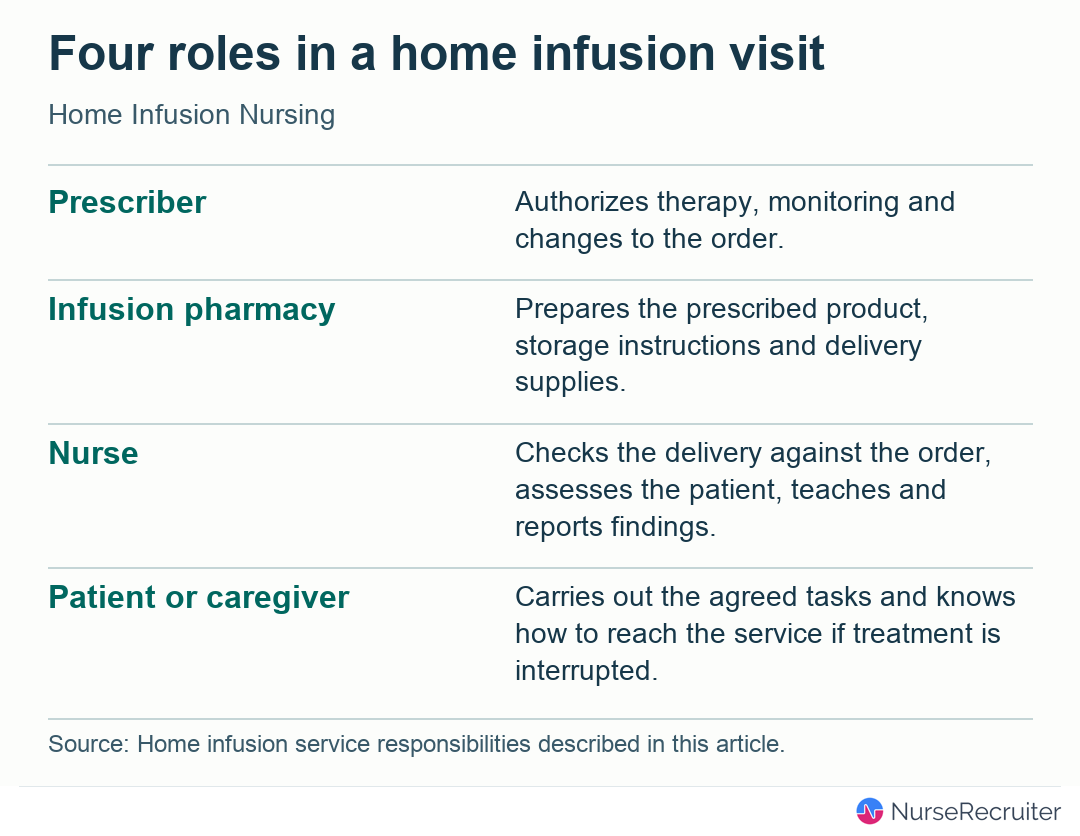
| Contributor | Main responsibilities |
|---|---|
| Prescriber | Orders therapy and monitoring, reviews findings and authorizes treatment changes |
| Infusion pharmacy | Reviews and prepares the product, coordinates storage and delivery, and supplies equipment and administration materials |
| Nurse | Assesses the patient and access site, checks orders against supplied treatment, teaches, documents response and reports findings |
| Patient or caregiver | Performs agreed tasks, stores supplies as instructed and contacts the service when treatment is interrupted |
Pharmacy and nursing can be separate organizations, so an order change sent to one may leave the other working from the old plan. A reliable handoff identifies who holds the current order, who will contact the patient and who is waiting for a laboratory result. Medication reconciliation and shared orders help both services act on the same treatment plan. Pending laboratory results need an identified reviewer and reporting route.
Visit responsibilities
An initial visit includes assessing the home setup and the patient's or caregiver's ability to use the equipment. Demonstration and observed return demonstration establish which tasks the person can perform; repeating instructions correctly is not the same as handling the supplied equipment. Teach-back checks understanding of instructions. The teaching record should show who actually performed each task and what remains for the next visit.
Later visits may include access-site assessment, dressing changes, ordered specimen collection, monitoring tolerance and further teaching, including retraining after a device or caregiver changes. A hospital infusion nurse can usually reach pharmacy and additional staff on the unit; in a home, those resources are often reached by phone. The service's workload also includes support between visits and coordination when supplies, orders or the caregiver change. Some infusion providers operate outpatient suites for treatment, catheter care and additional monitoring.
Medicare professional-service coverage
Medicare's home infusion benefit covers specified professional services for certain drugs and biologicals administered intravenously or subcutaneously through a durable-medical-equipment pump. Covered services include nursing, training, education and monitoring under a plan of care. This limited benefit is distinct from eligibility for a home health episode; an infusion performed at home does not by itself establish coverage.
Related articles
Sources
- BLS: May 2025 industry-specific Occupational Employment and Wage Statistics (accessed 2026-11-18).
- BLS: May 2025 OEWS wage definitions (accessed 2026-11-18).
- CMS: Home Infusion Therapy and Home IVIG Services (accessed 2026-11-18).
- National Home Infusion Association: Home and Alternate Site Infusion (accessed 2026-11-18).
- Oregon Nurses Association and OHSU, 2023–26 agreement, Memorandum of Understanding 4 on home infusion (accessed 2026-11-19)