
The Advanced Practice Registered Nurse Compact is an interstate agreement designed to let an APRN hold one multistate APRN license and practice in participating states in the same role and population focus. As of November 13, 2026, the 2020 compact is not operational. A nurse practitioner, nurse anesthetist, nurse-midwife, or clinical nurse specialist cannot use it to start practice across a state line.
Enactment and implementation
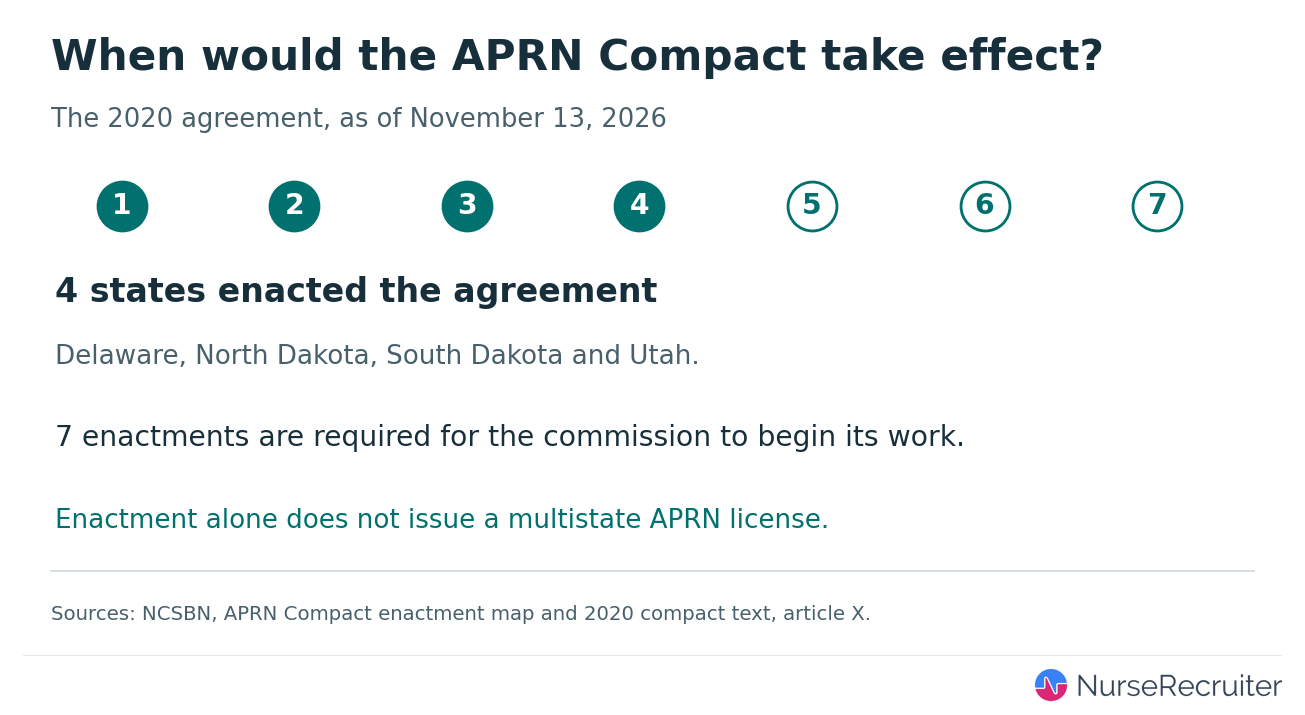
Delaware, North Dakota, South Dakota, and Utah enacted the 2020 compact. Article X requires seven enacting states before the agreement takes limited effect so a commission can convene and adopt operating rules. Enactment in the state where a nurse lives is therefore only one step. It does not issue a multistate APRN license. At its April 2026 APRN Roundtable, the National Council of State Boards of Nursing reported that its board had directed staff to work with nursing boards on a redesign. The provisions below describe the adopted 2020 text.
What the 2020 agreement would cover
- Home state and credential. The compact links the home-state multistate license to eligibility requirements, including national certification in the appropriate APRN role and population focus. It specifies at least 2,080 hours of APRN practice congruent with the applicant’s education and training.
- Remote-state practice. A compact privilege would extend the role and population focus on the home-state license. A family nurse practitioner would not gain authority to work as a nurse anesthetist by crossing a state line. APRN roles and population foci explains how the two qualifications fit together.
- Prescribing. The agreement separately addresses controlled substances. A clinician seeking that authority in a remote state would still have to meet that state’s applicable requirements. A multistate credential would not itself supply every controlled-substance authorization.
- Oversight. The home state would regulate the multistate license. A remote state could act on a privilege for practice within its jurisdiction. A privilege to practice and a facility’s decision to grant clinical privileges are different determinations.
Checking a cross-border job today
Consider an NP based in Delaware offered telehealth shifts caring for patients in another state. An existing Nurse Licensure Compact credential may establish multistate RN authority. The employer must separately verify APRN authority under the law of the state where the patient is located and the prescribing authority needed for the position. A posting that asks for a “compact license” should identify the profession and level of practice it means. NurseRecruiter's October 2025 report on the Nurse Licensure Compact draws the same line: that compact covers RNs and LPN/LVNs, so advanced practice nurses still need authority in each state where they practice.
The same distinction matters when moving states or accepting a temporary assignment. Identify the patient location, the work to be performed, the applicable board’s current requirements, and the employer’s credentialing and payer enrollment.
Related articles
- Nurse Licensure Compact
- APRN Roles and Population Foci
- APRN National Certification and State Licensure
Sources
- NCSBN, 2020 Advanced Practice Registered Nurse Compact, articles III, IV and X (accessed 2026-11-13)
- Delaware Code, Title 24, Chapter 19B, Advanced Practice Registered Nurse Compact (accessed 2026-11-13)
- NCSBN, South Dakota’s enactment and the other enacting states (accessed 2026-11-13)
- NCSBN, April 2026 APRN Roundtable legislative update transcript (accessed 2026-11-13)
- One license, 40 states: where the Nurse Licensure Compact stands after a big year (accessed 2026-11-18). NurseRecruiter, October 2025; NLC scope excludes APRNs.