
A nurse educator is a registered nurse whose job is teaching nurses or nursing students. Academic nurse educators teach for a school of nursing; employer-based educators, covered under nursing professional development, teach a healthcare organization's staff. An academic clinical nurse educator is the school-side role in practice settings: teaching and evaluating nursing students during clinical placements for an educational program. The work includes supervising a clinical group, overseeing students paired with preceptors, assessing performance, and making academic evaluations. Appointments range from full-time faculty positions to adjunct contracts for one course.
Faculty pay and adjunct contracts
NurseRecruiter compiled these May 2025 BLS estimates for postsecondary nursing instructors and teachers. They cover classroom, laboratory, and clinical instruction; they do not isolate adjunct clinical faculty.
| Employer industry | Nursing instructor and teacher jobs | Annual median wage |
|---|---|---|
| Colleges, universities, and professional schools | 51,650 | $81,420 |
| Junior colleges | 19,580 | $76,790 |
The American Association of Colleges of Nursing reported in May 2026 an average salary of $82,762 for master's-prepared nursing professors, and its October 2025 survey found a 7.2% full-time faculty vacancy rate. NurseRecruiter's June 2026 report on the nursing school pipeline compared that faculty average with pay for master's-prepared nurses in clinical practice and connected the gap to schools' limited capacity to teach qualified applicants. Nurse educator openings posted on NurseRecruiter are grouped under nurse education jobs.
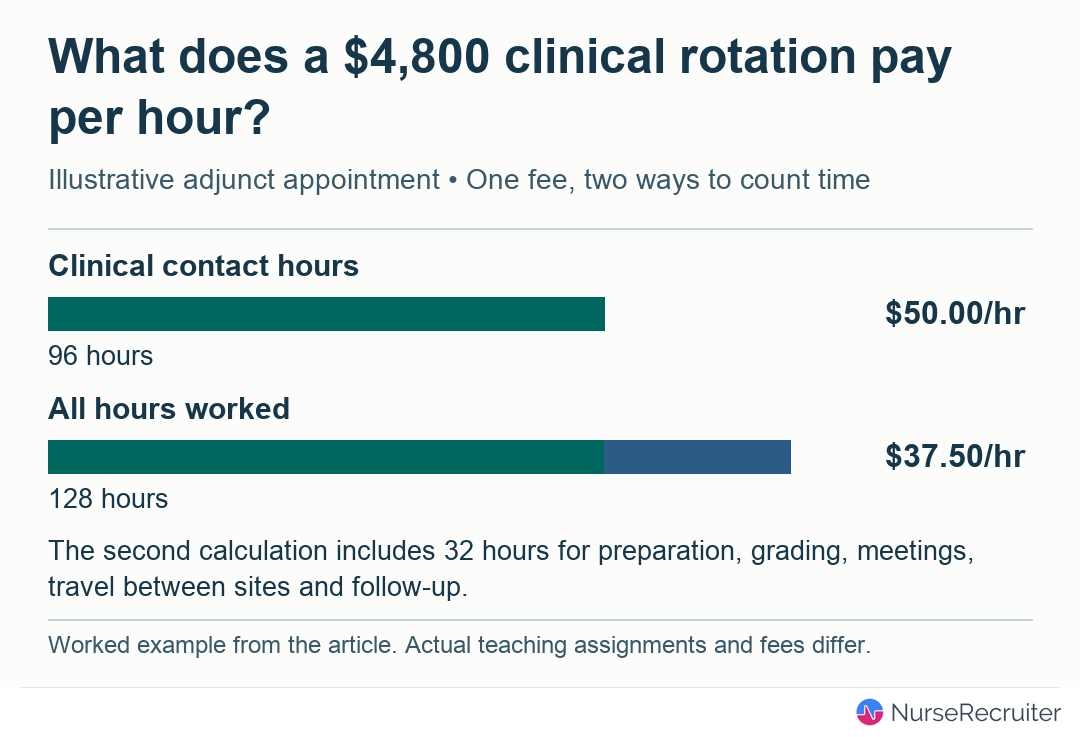
A course payment requires a different comparison: compensation divided by all required work hours. NurseRecruiter’s illustration below uses a hypothetical $4,800 contract.
| Work counted | Hours | Gross compensation per hour |
|---|---|---|
| Clinical contact time only | 96 | $50.00 |
| Contact time plus 32 hours of other required work | 128 | $37.50 |
The additional time could include preparation, grading, student conferences, meetings, and travel between assigned sites. The calculation describes one hypothetical contract, not a market rate. Student load, the teaching period, cancellation terms, and the duties included in the contract determine what the payment covers. The nurse faculty shortage page covers the wider faculty workforce.
Scheduled and actual hours
In HRSA’s 2022 U.S. nursing workforce survey, among full-time RNs without an APRN credential in the survey’s “academic educator, professor or nursing-school instructor” job-title group, 7.1% reported being scheduled for more than 40 hours a week, while 51% reported actually working more than 40 hours in their primary nursing job in 2021. The estimated share working more than 40 hours had a 95% confidence interval of 42.2% to 59.8%.
Among respondents in the academic educator group scheduled for 40 hours or less, 48.4% worked more than 40 (95% confidence interval 39.9% to 56.9%). For faculty, contact hours capture only part of the workload. Preparation, grading and student conferences also take time in a typical teaching week. The specialty survey notes explain which hours count.
Teaching and evaluation responsibilities
Before a placement, the educator reviews the course outcomes, student preparation, placement agreement, evaluation tool, and site policies. These documents answer different questions: a hospital can authorize a student to use the electronic record while the course restricts which tasks the student is ready to perform. The educator and preceptor need a common understanding of both.
Clinical educators connect the course objectives to the opportunities available at a placement. They review students’ preparation, approve or select learning experiences, observe performance, give feedback, and address unsafe or incomplete practice. A clinical placement agreement establishes the school–site arrangement; the course sets the academic outcomes and evaluation process.
| Participant | Responsibility within the school–site arrangement |
|---|---|
| Clinical faculty | Plan learning experiences, review observations, communicate concerns, and complete the academic evaluation assigned by the school |
| Unit preceptor | Supervise agreed clinical activities, intervene when needed, and report specific observations of student performance |
| Course lead or program director | Interpret course and program requirements, support faculty, and handle formal progression procedures |
The University of Virginia’s 2023–24 preceptor manual illustrates this division: preceptors provide direct supervision and feedback, while clinical faculty and the course professor oversee the educational process. It is an institutional example, not a national staffing or supervision rule. In a precepted placement, the staff nurse sees practice across shifts that faculty do not observe; the school defines how those observations are documented and used in grading.
An observation such as “needs to communicate better” does not identify a demonstrable skill. Recording which information was omitted from a handoff, what prompt was needed, and whether the next attempt met the course standard provides evidence for evaluation. Student records and patient information used in teaching require appropriate privacy protections.
One classroom example used movement to teach rhythm recognition. NurseRecruiter’s account of a University of Pennsylvania nursing demonstration describes an educator and two students using tap patterns to represent ECG rhythms.
Workload and placement structure
Direct supervision of a clinical group and oversight of individually precepted students create different workloads. The first concentrates observation and teaching into a shared shift. The second requires coordination across students’ schedules, preceptor reports, and site visits. A dedicated education unit formalizes the partnership between a school and clinical unit.
The assignment should identify the number of students and sites, preparation and grading responsibilities, student conferences, and access to the course lead. These duties matter when comparing adjunct contracts or a faculty teaching load. An employer-based professional development educator instead focuses on staff learning and practice within the healthcare organization; a joint appointment can include both kinds of work.
In AACN’s 2026 faculty survey, 475 of 1,713 vacant full-time faculty posts across 931 responding nursing schools had been open for more than a year. Another 183 schools reported needing more faculty despite having no budgeted vacancy.
CNEcl certification
The National League for Nursing’s voluntary Certified Academic Clinical Nurse Educator (CNEcl) credential covers clinical education in prelicensure and postlicensure nursing programs. Its 2026 handbook requires an active, unencumbered RN license or the designated equivalent in the country of residence and three years of nursing practice. Applicants qualify through either:
- A graduate degree focused on nursing education.
- A nursing bachelor’s degree or higher, plus two years of academic teaching within the previous five years; that experience can include simulation.
The credential has a five-year term. Faculty appointment requirements remain subject to the educational program and applicable nursing education rules. Clinical faculty who hold a graduate nursing degree can instead pursue the NLN's broader CNE certification for the full academic educator role, which does not accept a bachelor's degree.
Related articles
- National League for Nursing
- The nurse faculty shortage
- Nurse Faculty Loan Program
- Dedicated education units
- Nursing professional development
Sources
- NurseRecruiter, Tap dance. Nursing. See the connection? (published 2017-05-25, accessed 2026-11-19).
- National League for Nursing, 2026 academic clinical nurse educator candidate handbook (accessed 2026-11-18)
- National League for Nursing, Certified Nurse Educator candidate handbook, updated March 2026 (accessed 2026-11-18). CNE graduate-degree requirement.
- University of Virginia School of Nursing, 2023–24 prelicensure preceptor orientation manual (accessed 2026-11-18)
- BLS, May 2025 industry-specific Occupational Employment and Wage Statistics (accessed 2026-11-18)
- BLS, May 2025 OEWS technical notes and wage definitions (accessed 2026-11-13)
- AACN, Nursing Faculty Shortage fact sheet (accessed 2026-11-18)
- Nursing schools turned away 93,176 qualified applications in 2025 (accessed 2026-11-18)
- AACN 2026 faculty vacancy report (PDF) (accessed 2026-11-18)
- HRSA, 2022 National Sample Survey of Registered Nurses, public-use data and codebook (accessed 2026-11-19)