
Internal travel nurses are employed by a health system to take time-limited assignments at its facilities. The system recruits the nurses, selects the assignments it needs covered, and specifies pay and benefits. The word internal describes the employment relationship. An internal traveler may cross state lines or stay within a single metropolitan area.
How two health systems use travelers
| Program | Where and for how long | What the employer specifies |
|---|---|---|
| Emory Healthcare | Rotations in hospitals and clinics across the system. The program describes assignments ranging from two weeks to three months. | Unit leaders coordinate shifts. Weekend and holiday commitments depend on full- or part-time status. The program lists at least 2.5 years of relevant specialty experience, excluding residencies. |
| Mayo Clinic Travel Program | Contingency coverage at Mayo Clinic hospital and health system sites in Minnesota, Wisconsin, Arizona, and Florida. | Staffing and patient needs determine assignments. Mayo describes benefits beginning on the first day of employment and paid time off accruing each pay period. |
Both employers describe employee benefits, but neither program description determines what another health system offers. Emory explicitly permits employees to schedule paid time off between assignments. A nurse considering a different program should establish whether time between sites is paid work, scheduled leave, unpaid time, or time during which they must remain available.
What can two assignments in the same city pay?
UCHealth advertised two 13-week RN travel roles based in Aurora, Colorado, in fall 2026. Both listed 72 hours per two-week pay period and mentioned a travel package or stipend. The behavioral health night position listed $50 an hour; the Denver Metro operating-room float position listed $60. At 72 paid straight-time hours, those base wages would be $3,600 and $4,320. The $720 difference excludes allowances and premiums. The jobs also require different clinical experience.
The OR posting described four ten-hour day shifts as well. A nurse comparing the positions would need the manager to reconcile those fields before treating $4,320 as expected pay. The assignment interview example shows the effect of using the other schedule. Both ads offered local contract options to nurses living within 75 miles. A local applicant should request the compensation terms for that option.
Federal travel nursing through the VA Travel Corps
The Veterans Health Administration operates its own supplemental nursing program. VA’s February 2026 description gives assignment lengths of eight to 13 weeks and requires at least two years of clinical RN experience. Veterans Affairs facilities request coverage, and program leadership assigns travelers according to need and skills. A preferred destination is a request.
The Office of Nursing Services FAQ describes a one-year temporary intermittent appointment. On assignment, staff are expected to work 40 hours a week or 80 every two weeks. The program describes travel-card and voucher procedures for authorized lodging and expenses. Ask the coordinator what has been authorized before paying for a rental. For a traveler considering a permanent VA opening, ending or extending an assignment explains how travel-account closeout fits into the transfer.
Internal travel, float pool, and agency travel
A float pool supplies nurses to units or sites under the pool’s coverage rules. Some pools assign a unit at the beginning of a shift. A travel program can place the nurse with one unit for multiple weeks. A system may use both terms. The assignment period, notice, and reporting line in the actual program distinguish the jobs. When comparing listings, whether on a system’s careers site or a nursing job board such as NurseRecruiter, where nursing jobs can be searched by specialty and location, the named employer and posted assignment terms show which arrangement a role actually is.
In agency travel nursing, the staffing firm and host facility have separate responsibilities. With direct system employment, a facility rotation can change the worksite while the employer stays the same. It can still change the commute, housing need, state practice authority, and on-call expectations. A program’s travel designation by itself does not establish eligibility for a tax-free reimbursement.
Employee wages and the hospital’s staffing cost
In Southcoast’s Massachusetts internal staffing program, the nursing FAQ distinguishes the standard RN contract from weekend and multisite float contracts that pay a higher base. The program describes 11-, 12-, or 13-week assignments, overtime at time and a half after 40 hours in a workweek, and possible holiday premiums. The base rate depends on the nursing assignment. The dollar figures shown for technologists elsewhere in the same FAQ do not price RN work.
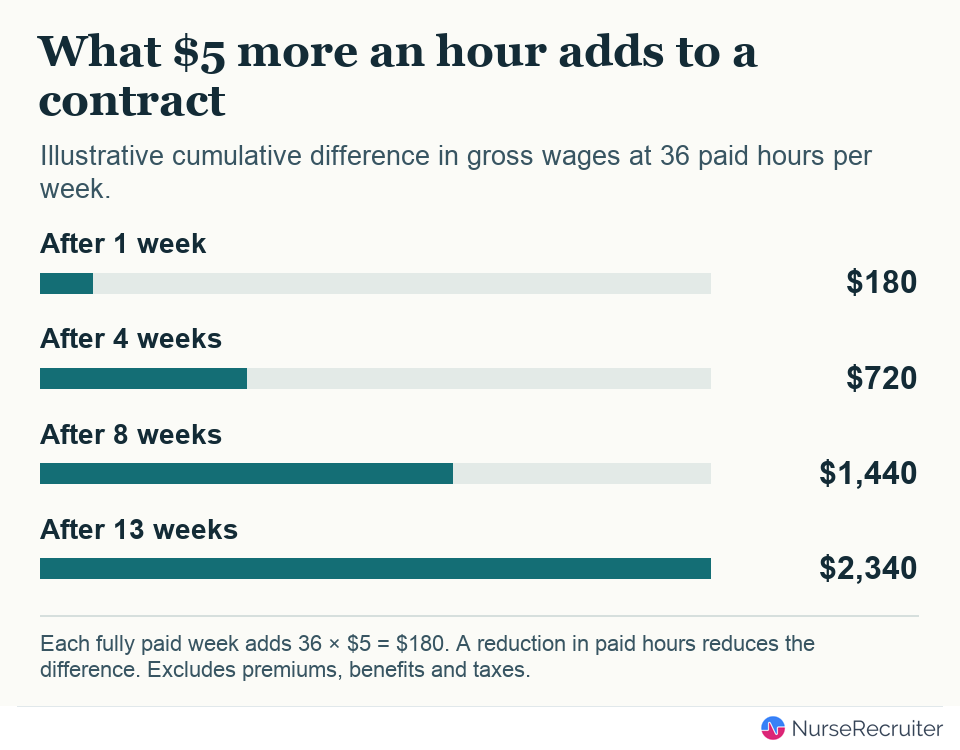
For a 13-week contract a $5 hourly difference applied to all 36 paid hours each week would change gross earnings by $2,340. This is an illustration; a change to guaranteed hours alters the calculation. An employer’s saving can arise elsewhere. In its 2024 study, GAO reported that representatives of one hospital estimated savings of at least 20% from operating its staffing agency internally. That is an employer cost comparison at one hospital, not a 20% reduction in traveler wages.
Comparing two assignments
Consider a nurse choosing between an eight-week rotation at a nearby hospital and an eight-week rotation requiring a temporary apartment. The base wage might be identical. For the second assignment, the written terms for mileage or airfare, lodging, required travel days, parking, and early reassignment become material. If a rotation ends after three weeks, who pays the remaining housing commitment? Can the nurse decline a replacement in another state? These are program terms to verify before accepting housing costs.
Clinical authorization also follows the work. Being oriented to one emergency department does not establish competency for every unit in the system. Confirm the receiving unit, any required local orientation, who approves competence for floating, and which license or practice privilege applies at the next site. The travel nursing licensure guide explains how the work location affects that last question.
Related articles
- How float pools cover multiple units
- Who employs the nurse on an agency assignment
- Comparing compensation across offers
- Licensing for assignments across state lines
Sources
- Emory Healthcare, internal travel nursing team and assignment terms (accessed 2026-11-13)
- Mayo Clinic, travel registered nurse program (accessed 2026-11-13)
- Southcoast Health, MTM Staffing program and registered nurse FAQ (accessed 2026-11-13)
- U.S. Government Accountability Office, Hospital Use of Supplemental Nurses, appendix IV (accessed 2026-11-13)
- VA Office of Nursing Services, Travel Corps FAQ, appointments, deployments and vouchers (accessed 2026-11-19)
- VA Careers, VA Travel Corps, February 17, 2026 (accessed 2026-11-19)
- UCHealth, Denver Metro OR float traveler, requisition 427124, October 6, 2026 (accessed 2026-11-19)
- UCHealth, inpatient behavioral health traveler, requisition 445957, November 10, 2026 (accessed 2026-11-19)