
A local contract nurse accepts a time-limited assignment within commuting distance. The agreement may be with a hospital or a staffing agency. A staff nurse and a local contractor can work on the same unit and drive home to the same neighborhood, yet have different employers, end dates, cancellation rights and benefits. A per diem nurse may work alongside both, accepting individual shifts rather than committing to a run of weeks. Nursing job boards such as NurseRecruiter list nursing jobs by specialty and location, but the written terms behind a listing determine which of these arrangements it is.
Three ways to work in the same city
In this fictional comparison, an experienced RN evaluates three offers on comparable adult units. All shifts are 12 hours. The figures below are invented to show how the terms interact. Gross base pay excludes differentials, overtime, taxes and the value of benefits.
| Written term | Hospital staff | Agency local contract | Hospital PRN pool |
|---|---|---|---|
| Commitment | Ongoing position, three shifts each week | 13 weeks, three shifts each week | Select available shifts. In this example the nurse accepts two this week. |
| Employer and base rate | Hospital, $42/hour | Agency, $54/hour | Hospital, $62/hour |
| Gross pay if all scheduled shifts are worked | 36 × $42 = $1,512 | 36 × $54 = $1,944 | 24 × $62 = $1,488 |
| Benefits in these offers | Health plan and paid vacation under hospital rules | Agency health coverage available on day 31 if eligible, no paid vacation in the offer | No employer health coverage or paid vacation in the offer |
| Housing | Nurse commutes from home | Same commute, no allowance or second lease | Same commute |
The PRN rate is highest, but two paid shifts produce less gross pay than either three-shift offer. In the contract column, 13 weeks is the assignment term. It does not establish pay through the end date if the facility ends the assignment early.
What one call-off costs
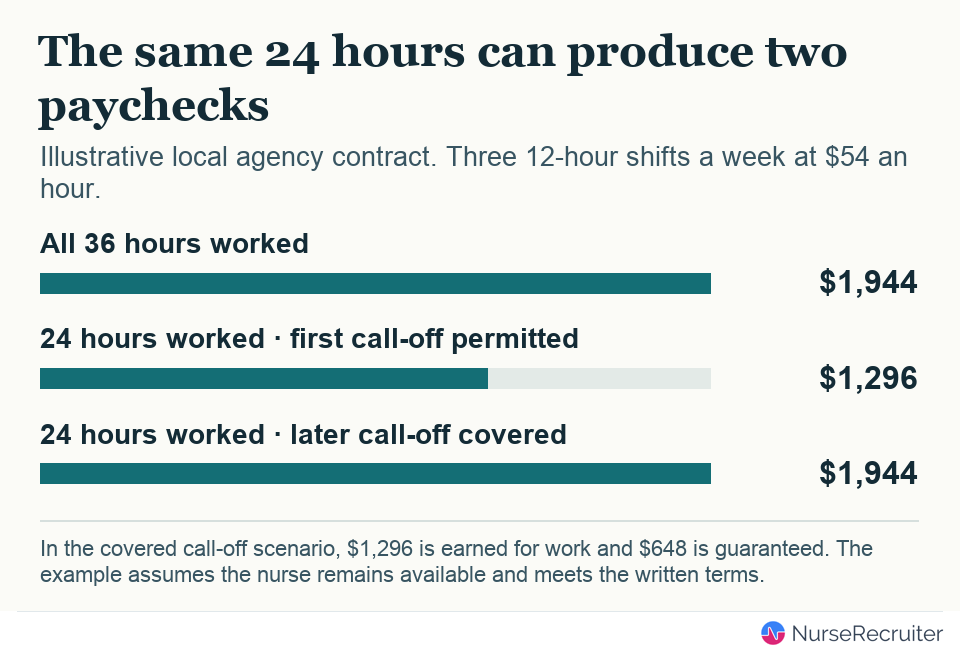
Suppose the local agreement guarantees 36 base-pay hours when the nurse is available, except for one 12-hour facility call-off per four-week block. It also says that the exception is unpaid and that a call-off beyond that allowance is paid at the base rate. These are invented terms, not standard contract language.
- First permitted call-off. The nurse works 24 hours and receives $1,296. The difference from a fully worked week is $648.
- Another call-off later in the same block. If the nurse again works 24 hours, remains available and meets the guarantee, the example pays $1,944: $1,296 for work plus $648 for the cancelled shift.
- One of two PRN shifts is cancelled. Under this example’s unpaid-cancellation policy, the nurse works 12 hours and receives $744. A different notice or cancellation-pay policy changes the result.
Get the facility call-off allowance, reset dates, notice window, make-up shift terms and treatment of orientation in writing. Ask whether declining a different unit or shift changes the guarantee. For staff offers, check the hospital’s low-census policy. For PRN work, check how shifts are confirmed and which notice policy applies.
Check who employs you and what ends with the assignment
The facility may assign patients while an agency issues pay statements and administers benefits. A hospital’s internal contract program may employ the nurse directly. Identify the employer of record, who can extend or cancel the agreement, and whom to contact if the assignment or unit differs on arrival. A local contract does not by itself make the nurse an independent contractor. The same employment-status question arises with per diem shifts.
For each offer, put these dates side by side: first paid orientation shift, health-plan eligibility, earliest possible end of the assignment, and end of benefits if the contract stops early. Ask for the employee contribution, paid-time-off terms, any required weekend or holiday commitment, and the written plan description where applicable. A quoted hourly premium does not show the value of coverage or the cost of a gap between assignments.
Commuting, housing and reimbursements
Separate each cash payment from expenses you would actually incur. In the example, all three nurses commute from the same home. The local offer provides no housing, so there is no housing allowance to add to its $1,944 week. If an offer does include housing or reimbursement, check who books it, whose name is on the lease, what documentation is required and who pays after an early cancellation.
An agency can set a distance rule for its own eligibility or pay policy. That rule does not decide federal tax treatment. The IRS generally locates a tax home at a person’s regular place of business and uses additional rules when there is no regular work location. Its away-from-home test also considers the time away and need for sleep or rest. Ask payroll how each payment is classified and use travel nursing tax guidance for the underlying distinctions.
Keep the dated offer, assignment confirmation, guarantee and benefits documents together. The parent travel nursing contract guide covers floating, early termination, repayment terms and extensions that also matter on local assignments.
Related articles
- Travel Nursing Contracts
- Travel Nurse Taxes
- How Per Diem Scheduling Works
- Per Diem Employment Status
Sources
- U.S. Government Accountability Office: Hospitals’ use of supplemental nurses, including temporary assignments and per diem arrangements (accessed 2026-11-12)
- Internal Revenue Service: Publication 463, tax home and travel away from home (accessed 2026-11-12)
- U.S. Department of Labor: health plan disclosures and summary plan descriptions (accessed 2026-11-12)
- 29 CFR 825.106: joint employment, including temporary placement arrangements (accessed 2026-11-12)