
An oncology nurse navigator is an RN with oncology knowledge who helps patients move through cancer evaluation, treatment, and follow-up. The service addresses barriers that can interrupt care between appointments or organizations. A patient navigator can come from several professional backgrounds. The nursing role adds clinical assessment, symptom-related escalation, and patient education within oncology nursing.
How much time goes to patients and to coordination?
A U.S. oncology navigation study covering November 2018 through April 2019 reported that navigators spent 60% of their time on patient-focused work and 40% on administrative activities. Cases stayed open for an average of 40 days. The participating programs included clinical and other navigators. For an oncology nursing team, the number of new referrals alone misses both follow-up on existing patients and the time required to coordinate their care.
Pay and employer comparisons
BLS does not publish pay for oncology nurse navigators. The table shows May 2025 BLS wages for all RNs in the two employer industries where navigators commonly work, across specialties and job titles. The hourly range spans the 25th to 75th percentiles. BLS excludes overtime premiums and employer-paid benefits.
| U.S. employer industry | Middle half of hourly wages | Hourly median | Annual median |
|---|---|---|---|
| General medical and surgical hospitals | $39.23–$57.21 | $48.18 | $100,210 |
| Outpatient care centers | $39.39–$61.54 | $47.77 | $99,350 |
When reviewing navigator openings, whether on a cancer center's own site or a nursing job board such as NurseRecruiter, compare the compensation with the actual caseload, outreach duties and coverage across clinics. A salaried position with phone follow-up between visits and an hourly infusion assignment measure working time differently. See comparing RN pay offers.
Work through the cancer pathway
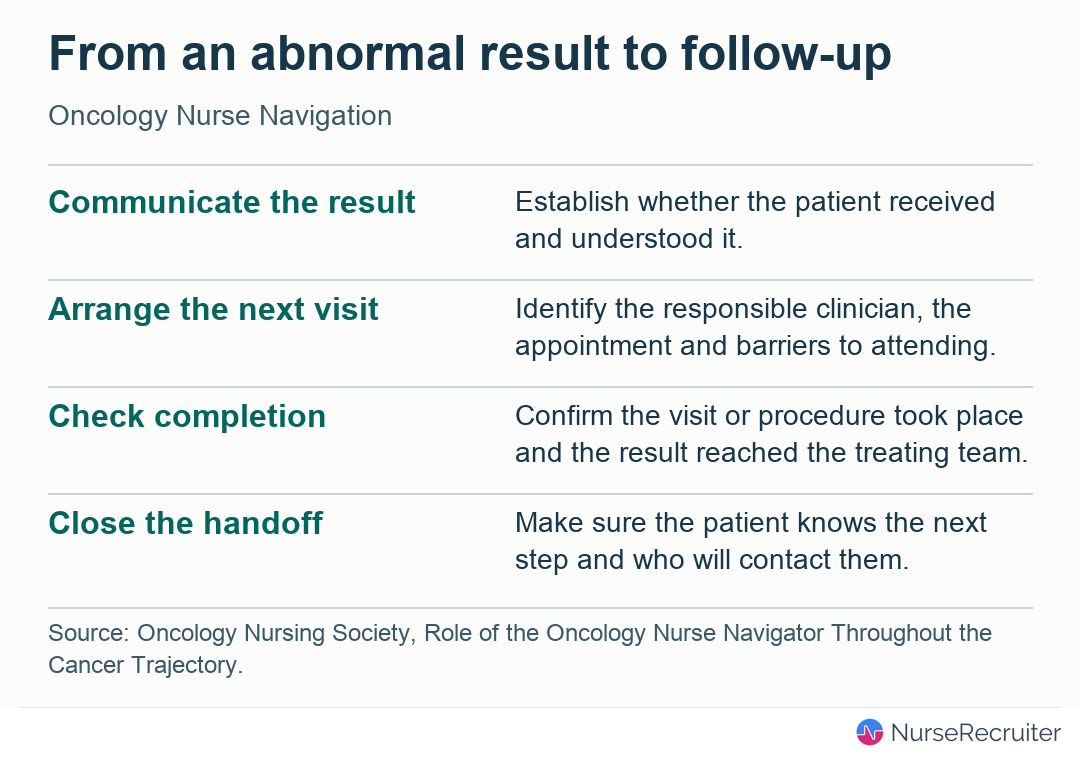
| Phase | Nursing and coordination work |
|---|---|
| Abnormal finding | Confirm communication with the patient, identify the clinician responsible for the next step and coordinate the diagnostic visit |
| Diagnostic work-up | Track pathology, images, investigations and specialist review; identify missing information or access barriers |
| Treatment | Reinforce the agreed plan, provide education, assess concerns within the nursing role, arrange clinical escalation and make sure the patient knows whom to call between visits |
| Continuing care or transfer | Hand off unresolved needs, confirm the receiving service and explain how the patient can reconnect with care |
Barriers differ in the response they need: an unreachable phone number, a competing work schedule, a transportation problem or the need for an interpreter each calls for a different fix. Closed-loop referrals distinguish an order or sent referral from a completed visit and a result received by the responsible team. Interpreters, financial counselors and social workers provide expertise that navigation services need to reach directly.
Clinical role and service boundaries
Navigation can also be delivered by other health professionals or trained nonclinical navigators; the title alone does not imply nursing assessment authority. Diagnosis and treatment decisions remain with the responsible clinicians.
Programs may be organized by disease site, treatment phase or population. A diagnostic service can hand off when treatment starts; another program can continue through treatment and follow-up. Entry criteria, discharge criteria and responsibility for re-entry define the active caseload.
Workload and results
An evaluation can measure time from abnormal finding to diagnostic resolution, diagnosis to attended treatment, or a recorded barrier to resolution. Each measure needs a starting event, eligible population and treatment of people who transfer care or are lost to follow-up. Results among completers alone do not describe everyone referred.
Workload includes new assessments, active follow-up, patients waiting on a service outside the program, repeated outreach, interpreted contacts and records retrieval. These count as work even when they produce no new appointment, and a total patient count omits the differences. ONS recommends workload and resources based on valid measures sensitive to navigation's contribution. Care coordination should be assessed by the work completed and responsibility transferred, not just calls attempted.
Certification
As of November 2026, the Oncology Nursing Certification Corporation lists an Oncology Certified Navigation Nurse (OCNN) credential as coming soon. Its general oncology credential, OCN, is available now. See OCN and the oncology credentials.
Related articles
- Oncology Nursing
- OCN and the Oncology Credentials
- Oncology Nursing Society
- Closed-Loop Referrals
- Care Coordination
Sources
- Oncology Nursing Society, role of the oncology nurse navigator (accessed 2026-11-18)
- Oncology Nursing Society, Oncology Navigation Standards of Professional Practice (accessed 2026-11-18)
- National Cancer Institute, patient navigator (accessed 2026-11-18)
- BLS, May 2025 industry-specific Occupational Employment and Wage Statistics (accessed 2026-11-18)
- BLS, May 2025 OEWS technical notes and wage definitions (accessed 2026-11-18)
- ONCC: current certification programs (accessed 2026-11-18)
- Academy of Oncology Nurse & Patient Navigators and partners, national navigation metrics study findings, 2019 (accessed 2026-11-19)