
Nurse practitioners may be paid for hours worked, through a fixed salary, or through a base plus incentives. A work-RVU agreement sets the employer’s payment per credited unit of clinical work. Payer contracts and fee schedules determine what the practice can collect for a service. A collections-based offer ties the nurse’s earnings to amounts the practice actually receives.
What the wage data measure
The U.S. Bureau of Labor Statistics reported a $132,300 median annual wage for nurse practitioners in May 2025. The median divides the estimated wage distribution for employed NPs in half. The $134,920 headline on the same occupational outlook page combines nurse practitioners, nurse anesthetists, and nurse midwives. The industry table on that page also combines the three occupations. Use the NP line when benchmarking an NP position, such as an opening found on NurseRecruiter or another nursing job board. A national median cannot establish the local rate for a pediatric, psychiatric, or emergency position. The main NP article separates state and employer-industry comparisons.
Published rankings can quote an older year. NurseRecruiter’s January 2026 report on the U.S. News Best Jobs ranking notes that the ranking’s $129,210 NP median reflected May 2024 federal wage data, a year before the figure above.
How offers produce different earnings
| Pay arrangement | What determines earnings | What the written offer should specify |
|---|---|---|
| Hourly or per shift | Paid hours or completed shifts | Shift length, charting time, call, callback, holidays, and minimum paid hours |
| Salary | A fixed amount for a stated appointment | Full-time equivalent, clinical sessions, administrative time, call rotation, and coverage of another clinician’s patients |
| Base plus productivity | A guarantee plus an amount earned under an incentive formula | Threshold, unit of credit, credit for shared encounters, measurement period, and payment date |
| Percentage of collections | An agreed share of money actually collected under the agreement | Whose services count, deductions, collection delays, and payment for work completed before leaving |
Medicare’s Physician Fee Schedule uses relative value units for clinician work, practice expense, and malpractice expense. A work RVU, often written wRVU, is the work component. An employer can use work RVUs to measure productivity and set its own dollar rate. The employer’s incentive rate and the Medicare fee schedule conversion factor serve different purposes.
A worked incentive
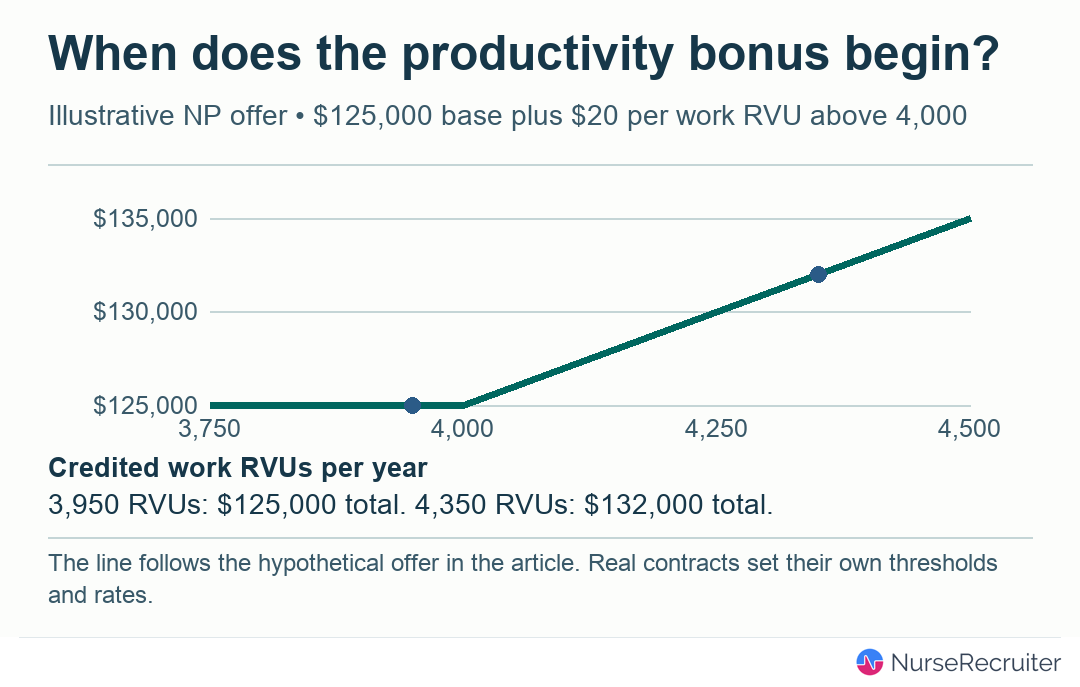
NurseRecruiter’s illustration uses a hypothetical offer guaranteeing $125,000 plus $20 for each credited annual work RVU above 4,000.
| Credited annual work RVUs | Units above the threshold | Incentive | Base plus incentive |
|---|---|---|---|
| 3,950 | 0 | $0 | $125,000 |
| 4,000 | 0 | $0 | $125,000 |
| 4,350 | 350 | $7,000 | $132,000 |
The calculation assumes the base is guaranteed and that no other adjustments apply. These are illustrative contract terms, not market rates.
Ask how a midyear start, leave, part-time schedule, or delayed credentialing changes the threshold. Identify the report that will show credited work and the process for correcting an attribution error. An offer can pay the same amount per work RVU yet produce different earnings if one clinician covers more inbox work, call, or patient follow-up outside billable visits.
The rest of the offer
Compare paid leave, retirement contribution, employer-paid liability coverage, continuing education time, and license and certification fees separately from cash earnings. Record who pays for coverage after departure if the policy is claims-made. Professional liability coverage and payer enrollment affect different parts of the offer.
Related articles
- Nurse Practitioner Salary by State
- Credentialing and Payer Enrollment for APRNs
- Professional Liability (Malpractice) Coverage for Nurses
- Negotiating a Nursing Job Offer
Sources
- Bureau of Labor Statistics, occupational outlook and May 2025 pay by APRN occupation (accessed 2026-11-18)
- Centers for Medicare & Medicaid Services, physician fee schedule and relative value components (accessed 2026-11-18)
- American Association of Nurse Practitioners, employment negotiations (accessed 2026-11-18)
- NurseRecruiter: Nurse practitioner is the best job in America again (accessed 2026-11-18). January 2026 report; ranking pay figure from May 2024 data.