
A nurse aide registry records qualification and specified findings of abuse, neglect or misappropriation of resident property. For Medicare- or Medicaid-participating nursing facilities, registry checks are part of hiring and assigning nursing assistants, including temporary and per diem staff.
Checks before work begins
Under 42 CFR 483.35(d), a covered facility generally must obtain registry verification before allowing someone to serve as a nurse aide. Two exceptions apply: a full-time employee in a state-approved training and competency evaluation program, or someone who can prove recent successful completion but has not yet appeared on the registry. The facility must follow up on the latter person's registration.
The facility must also seek information from every state registry it believes holds information about the person. A missing search result does not establish eligibility. Identity, prior names and the receiving state's requirements still need to be resolved.
Hypothetical example: an aide trained under one surname, worked in two states and now applies in a third. The facility reconciles identity through each state's official process, obtains the applicable records, then checks the receiving state's rules. A "no match" under one spelling is an unresolved search, not a clean record. An out-of-state listing and authorization to work in the receiving state are separate checks.
| Employment arrangement | Federal qualification requirement |
|---|---|
| Permanent full-time employee | The rule restricts work beyond four months without completed or otherwise recognized competency requirements; minimum competence rules also apply during those months |
| Temporary, per diem, leased or other nonpermanent worker | Must already meet the rule's competence and qualification requirements; the four-month provision is not an agency-staff training allowance |
| Recently qualified person awaiting registry entry | Proof of successful completion and facility follow-up on registration |
The facility must separately ensure that each aide can perform the skills needed for its residents' assessed care needs.
What the registry contains
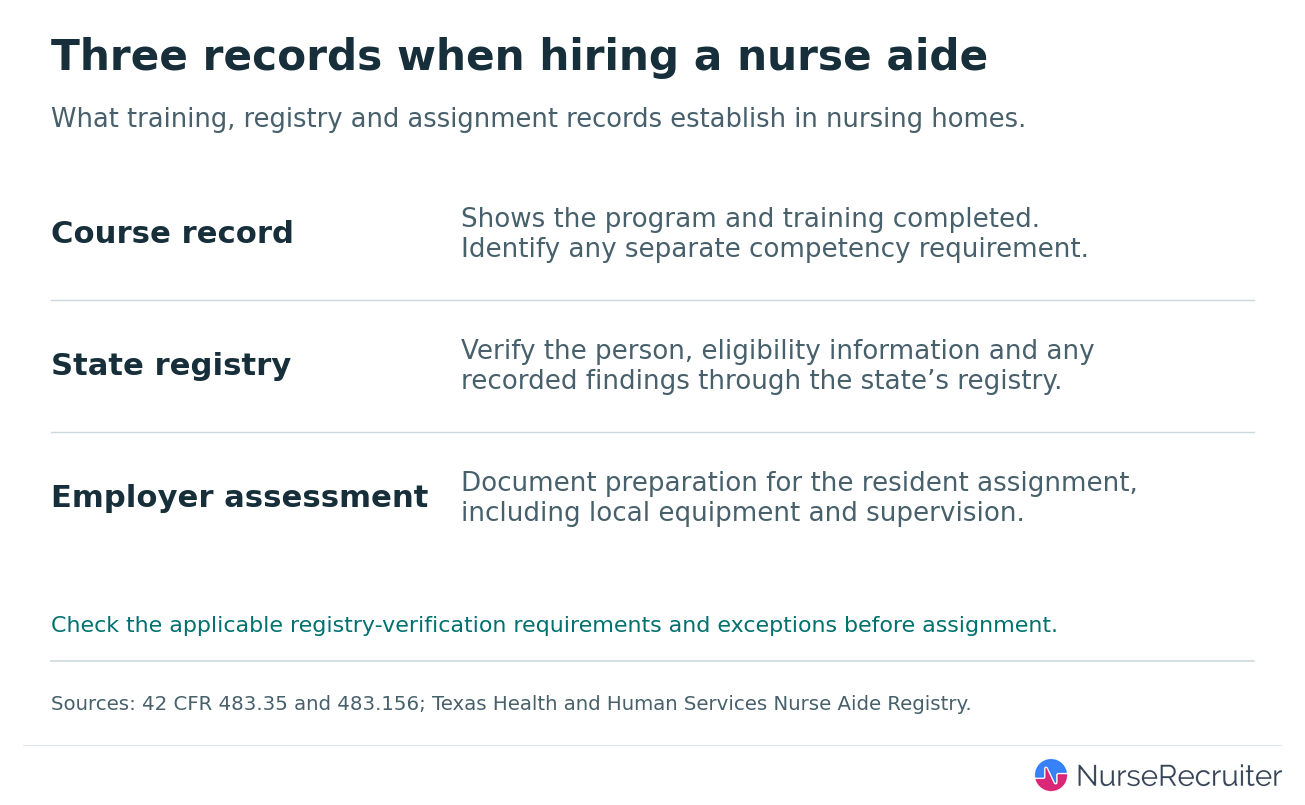
Under 42 CFR 483.156, the state remains accountable even if a contractor operates the registry. Records include identity and eligibility information. Only the state survey and certification agency may enter the specified adverse findings. A response containing a finding must also include an aide's disputing statement when one has been submitted under the rule. An allegation, a substantiated finding and an inactive listing have different meanings.
Inactivity, retraining and interstate moves
After 24 consecutive months without paid nursing or nursing-related services since the most recent training and competency program, 42 CFR 483.35(d)(6) requires a new training-and-competency program or a new competency evaluation. State procedures determine how employment and renewed eligibility are documented.
The separate registry rule requires removal of inactive entries after 24 consecutive months without nursing or nursing-related services, except entries containing documented adverse findings. Those findings are not erased by inactivity; the regulation specifies separate grounds for removing them.
States provide their own entry routes. Texas, for example, accepts reciprocity applications from aides with active certification in another state through TULIP, with required documents and a criminal-history check. The receiving state reviews and approves the application before issuing its certificate.
Ongoing employer responsibilities
Covered facilities must review every aide's performance at least annually and provide in-service education based on that review. A current listing does not establish familiarity with a facility's equipment, a specific resident's support needs or local reporting procedures; orientation and supervision address the actual assignment. RN and LPN/LVN licenses use a separate primary-source verification process. Broader facility obligations appear in nursing home staffing requirements.
Related articles
- Nursing Assistants
- Nursing Home Staffing Requirements
- Primary Source Verification of a Nursing License
- Supervision of Delegated Nursing Tasks
Sources
- eCFR, 42 CFR 483.35, nursing services (accessed 2026-11-18). Subsections (c) and (d).
- eCFR, 42 CFR 483.156, registry of nurse aides (accessed 2026-11-18).
- Texas Health and Human Services, becoming a certified nurse aide (accessed 2026-11-18). State examination and reciprocity routes.