
Mary Breckinridge founded the Frontier Nursing Service, brought nurse-midwifery to the United States, and proved in one of the poorest counties in the country that a system of nurses could beat the national maternal death rate several times over.
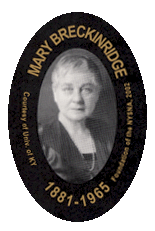 Mary Breckinridge
Two children
Breckinridge was born on February 17, 1881 in Memphis, Tennessee, into a political family — her grandfather John C. Breckinridge had been vice president, her father a congressman and minister to Russia.
Her first husband died of appendicitis in 1906. She entered the nursing school at St. Luke's Hospital in New York, trained for three years, and qualified as a registered nurse in 1910. She married again in 1912 and had two children. Her son, born in 1914, died in early childhood. Her daughter Polly, born prematurely in 1916, lived a few hours.
Everything Breckinridge did afterwards was aimed at children who did not have to die and at the mothers who bore them.
France
After the First World War she volunteered with the American Committee for Devastated France, running a child hygiene and visiting nurse service. Two things came out of it.
The first was a structure: a decentralized network of small outposts, each staffed by nurses who covered a defined district, rather than one central hospital that people had to reach. The second was a profession. The British and French nurse-midwives she worked alongside were trained to deliver babies and manage normal pregnancies on their own authority, and nothing like that existed in the United States.
Training and Kentucky
Since no American school taught it, in the autumn of 1923 she went to England and took the intensive course at the British Hospital for Mothers and Babies, qualifying with the Central Midwives Board.
She came home in 1925 and on May 28 founded the Kentucky Committee for Mothers and Babies, renamed the Frontier Nursing Service in 1928. She based it in Hyden, in Leslie County, Kentucky — a mountain county with no railroad, few roads, and the worst maternal death rate in the United States.
The design was the French one adapted to the terrain. Breckinridge built a chain of district nursing centers across roughly a thousand square miles, each covering the families within about six miles, so no patient was more than a couple of hours away by horse. The nurse-midwives rode circuits in all weather, did prenatal care, attended births at home, and referred the complicated cases to the small hospital at Hyden.
What it produced
By Breckinridge's death in 1965 the service had cared for nearly 58,000 patients and delivered more than 14,500 babies, with 11 maternal deaths.
That is a maternal mortality rate a fraction of the national average of the period, achieved in the poorest and least accessible part of the state, with nurses on horseback. It was the strongest evidence anyone had that nurse-midwifery worked, and it is the foundation the American nurse-midwife profession was built on.
Frontier Nursing Service staff formed the nucleus of the American College of Nurse-Midwives in 1929. The first American midwifery school opened at the Maternity Center in New York in 1932, founded by a nurse-midwife the FNS had certified. The service started its own school in 1939; it operates today as Frontier Nursing University.
Breckinridge published her memoir, Wide Neighborhoods, in 1952. She died on May 16, 1965. She was inducted into the American Nurses Association Hall of Fame in 1982 and the National Women's Hall of Fame in 1995.
Related
- Nurse midwifery
- Rural and frontier nursing
- Critical access hospitals
- Nursing in Kentucky
- History of nursing
- Notable nurses
Sources
- Wide Neighborhoods: A Story of the Frontier Nursing Service, Mary Breckinridge, 1952. Accessed September 9, 2026.
- How the Frontier Nursing Service began. Frontier Nursing Service. Accessed September 9, 2026.
- Mary Carson Breckinridge, for her training, family and the service's cumulative delivery and maternal mortality figures. Accessed September 9, 2026.
- ANA Hall of Fame inductees. American Nurses Association. Accessed September 9, 2026.
- American College of Nurse-Midwives. Accessed September 9, 2026.