
Florence Nightingale is the person who made nursing a profession rather than a job. She is also, less famously, one of the founders of applied medical statistics — the second achievement is what made the first one stick.
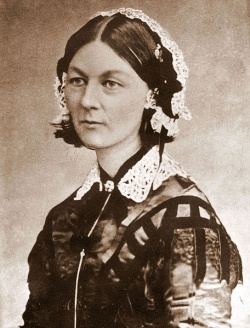 Florence Nightingale (1820–1910)
She was born on May 12, 1820 in Florence, then part of the Grand Duchy of Tuscany, to wealthy English parents who named her after the city. At a time when a woman of her class was expected to think about little beyond marriage and children, she turned down long-standing suitors and spent years pressing her family to let her train in nursing, which they regarded as work for servants.
Scutari
The Crimean War gave her the opening. In October 1854, following press reports of the state of the British military hospitals, she was asked to take a party of nurses to the Ottoman Empire. She and thirty-eight volunteers arrived in early November at the Selimiye Barracks at Scutari, across the water from Constantinople.
What they found was a barracks hospital built over a defective sewer, with almost no medicines, no clean linen, and men dying in far greater numbers of cholera, typhus, typhoid and dysentery than of their wounds. Nightingale organized supplies, food, laundry and record-keeping, and walked the wards at night, which is where the lamp comes from.
In March 1855 she called in the Sanitary Commission, which flushed the sewers and improved the ventilation. The death rate fell sharply afterwards. At the time Nightingale attributed the deaths mainly to malnutrition, inadequate supplies and overwork; it was only later, working through the figures at home, that she concluded the building itself had been killing the patients.
The statistics
That conclusion is the important one, and she proved it with numbers.
Back in Britain she assembled the mortality evidence for the Royal Commission on the Health of the Army. Her reports used a diagram of her own design — the polar area chart, since known as the Nightingale rose or coxcomb — to show month by month how much of the army's mortality had been preventable disease rather than battle injury. It was built to be understood by ministers and generals who would not read a table, and it worked.
The Army reformed its barracks and hospitals, and peacetime mortality in the forces fell. In 1858 Nightingale became the first woman elected a Fellow of the Royal Statistical Society. She went on to apply the same methods to hospital design and to public health in India.
The school and the book
In 1859 she published Notes on Nursing, written as a guide for household care but adopted as the foundation text of nursing curricula.
In 1860 the Nightingale Training School opened at St Thomas' Hospital in London, funded by a public subscription raised in her honor. It was the first school to treat nursing as a taught discipline with its own standards rather than an apprenticeship in obedience, and its graduates carried the model outward. Three American schools founded in 1873 — at Bellevue in New York, at Massachusetts General in Boston and at New Haven — were built on it. The school still exists, as the Florence Nightingale Faculty of Nursing, Midwifery and Palliative Care at King's College London.
During the 1870s Nightingale mentored Linda Richards, the first professionally trained American nurse, who came to England to study her methods and took them back to found nursing schools across the United States.
Honors and last years
Queen Victoria awarded her the Royal Red Cross in 1883. She was appointed a Lady of Grace of the Order of St John in 1904, became the first woman to receive the Order of Merit in 1907, and was given the Honorary Freedom of the City of London in 1908.
From 1857 onward she was frequently bedridden, and did most of her later work from her rooms in London. The illness was never diagnosed in her lifetime; the leading modern explanation is chronic brucellosis contracted in the Crimea. She died in London on August 13, 1910.
International Nurses Day is held on her birthday, May 12. The American Nurses Association's Nightingale Award is named for her.
Related
Sources
- Notes on Nursing: What It Is, and What It Is Not, Florence Nightingale, 1859. Accessed September 9, 2026.
- Florence Nightingale. National Army Museum, on the Crimean hospitals and the Sanitary Commission. Accessed September 9, 2026.
- Nightingale 2020: the bicentenary of our first female fellow. Royal Statistical Society. Accessed September 9, 2026.
- Florence Nightingale: the pioneer statistician. Science Museum, on the polar area diagrams. Accessed September 9, 2026.
- Florence Nightingale Faculty of Nursing, Midwifery and Palliative Care. King's College London. Accessed September 9, 2026.
- Florence Nightingale, for the Scutari chronology, honors and dates. Accessed September 9, 2026.