
Forensic nursing combines nursing care with work at the intersection of health and the legal system. Forensic nurses may assess injuries, document findings, collect material with consent and appropriate authority, coordinate follow-up, and testify about their work. A sexual assault nurse examiner (SANE) is one forensic nursing role. Other practice settings include care after interpersonal violence and, in some jurisdictions, death investigation. The role and legal authority depend on the appointment and jurisdiction.
Pay and service coverage
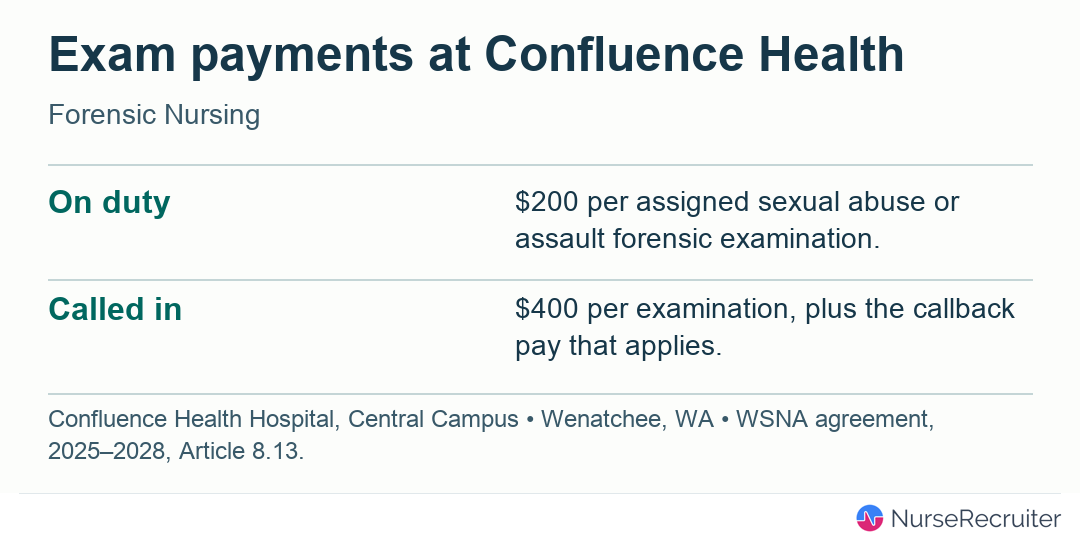
Under the 2025–2028 Confluence Health Central Campus agreement in Wenatchee, Washington, Article 8.13 pays:
| Assignment | Examination payment |
|---|---|
| On-duty nurse assigned a sexual abuse or assault forensic examination | $200 per examination |
| Nurse called in for the examination | $400 per examination, plus applicable callback pay |
These are payments under one hospital agreement, not national SANE wages. Total compensation also depends on the underlying RN wage, paid standby time, examinations completed and payment for documentation, follow-up and court appearances. Comparing RN pay offers explains how to compare these components.
Service models include dedicated examiner teams, on-call rosters and regional referral programs. When comparing SANE or forensic openings, whether found through a hospital program directly or a nursing job board such as NurseRecruiter, the assignment needs to identify activation and response requirements, travel between sites, advocate access, evidence storage, clinical backup and follow-up responsibility. A nurse covering several emergency departments needs a clear activation process and an identified clinician to assume care when needs exceed the examiner's assignment. A per-exam payment cannot by itself describe earnings during a low-volume on-call week.
SANE certification: the 2026 transition
SANE-A and SANE-P certification transferred from IAFN to ANCC in 2026. The former IAFN exam requirements should not be treated as a current application route.
| Item | Published transition arrangements |
|---|---|
| Credentials due to expire in 2026 | ANCC extended them to December 31, 2027 |
| Renewal and verification through ANCC | Available beginning January 1, 2027; renewal cycle is five years |
| Separate SANE-A and SANE-P initial exams | ANCC will not offer the former separate exams |
| New initial certification | An examination covering sexual assault nursing across the lifespan is expected in fall 2027 |
ANCC anticipates publishing the new eligibility requirements in summer 2027. Existing certificants can maintain their current credentials through renewal; earning the new credential will require meeting its eligibility criteria and passing its exam. The launch dates remain anticipated.
The Emergency Nurses Association received IAFN's continuing education and practice resources. Specialty education, supervised clinical preparation, employer competency requirements and national certification remain separate parts of practice preparation. An employer should specify the patient age groups served, the expected training and continuing competence, and the support available for case review and testimony. Emergency nursing experience alone does not establish competence in a medical forensic examination.
The medical forensic examination
In a sexual assault examination, urgent health needs, the patient’s account, consent, documentation, and possible evidence collection all require attention. A patient may want medical care and decline a particular examination step or collection. The examiner explains available choices, how information may be shared, and any limits imposed by applicable reporting law. Adult and adolescent protocols should not be used as a substitute for pediatric-specific protocols.
The U.S. Department of Justice’s national protocol addresses cooperation among health services, advocates, law enforcement, and laboratories. These participants have different responsibilities. An advocate supports the patient. The examiner delivers health care and documents the findings. A laboratory analyzes submitted material. Responsibility for investigating a possible crime belongs to the relevant authorities.
Nursing records and evidence
| Element | Purpose |
|---|---|
| Patient history | Record the patient’s account relevant to care, distinguish their own words from the clinician’s observations, and avoid guessing at facts the person could not provide. |
| Clinical findings | Describe what is observed and the care provided. The presence or absence of visible injury by itself does not settle what occurred. |
| Items collected | Follow the governing protocol for identification, packaging, storage, and documentation of transfer. A chain-of-custody record describes who handled an item. |
| Follow-up | Identify ongoing medical and support needs, referrals offered or accepted, and the patient’s preferred safe means of contact. |
A nurse who later testifies may need to distinguish what they personally observed, what the patient reported, and what an outside laboratory found. Precise documentation at the encounter makes those distinctions possible; nursing expert witnesses explains how testimony about one's own care differs from retained expert opinion. Trauma-informed communication and informed consent are fundamental to this work.
NurseRecruiter’s 2009 introduction to forensic nursing documents a persistent misunderstanding of the job: readers associated it with death investigation, although nurses also cared for living patients and documented evidence.
Related articles
Sources
- NurseRecruiter, What Is It Like To Be A Forensic Nurse? (published 2009-05-26, accessed 2026-11-19).
- Confluence Health and WSNA, 2025–2028 Central Campus agreement (accessed 2026-11-18) — Article 8.13, printed page 19; payments checked against the scanned original.
- ANCC, SANE-A/P renewals and the new certification (accessed 2026-11-18)
- ANCC, April 3, 2026 transfer announcement (accessed 2026-11-18) — Includes extension of credentials expiring in 2026.
- ENA, forensic nurses transition updates (accessed 2026-11-18)
- U.S. Department of Justice, adult/adolescent medical forensic examination protocol, third edition, September 2024 (accessed 2026-11-18)
- ANA and IAFN, Forensic Nursing Scope and Standards, second edition (accessed 2026-11-13)