
Neonatal transport nurses provide intensive-care nursing during interhospital transfer. The work includes retrieval of critically ill newborns and return of recovering infants to another hospital. Teams may travel by ground ambulance, helicopter or fixed-wing aircraft; neonatal transport is not synonymous with flight work.
Pay and transport premiums
NurseRecruiter compiled the following rates from Seattle Children's 2026–2029 RN agreement. The ratification schedule is in effect in November 2026; the next increase begins with the first full pay period after March 1, 2027.
| Experience label in the agreement | Wage step | Current base hourly rate | Rate after the March 2027 increase |
|---|---|---|---|
| Less than one year | 1 | $51.60 | $54.85 |
| Year one | 2 | $53.24 | $56.49 |
| Year five | 6 | $59.87 | $63.12 |
| Year nine | 10 | $66.52 | $69.77 |
These are rates for covered hospital RNs. They are not a separate national wage estimate for this specialty.
Article 10 adds specific transport provisions:
| Provision | Pay term |
|---|---|
| Critical Care Transport Team membership | $5 an hour premium |
| A covered transport nurse remains out of town on duty | Pay at the applicable rate continues until return to the designated base or relief from duty |
| Seattle Children's Airlift Team nurse on the qualifying transport assignment | $4 an hour Airlift premium under the flight or neonatal-transport conditions in section 10.12 |
The Airlift provision applies to the named Airlift Team role; it should not be assumed to cover every neonatal transport nurse or every hour on a roster. The agreement and actual assignment determine eligibility. Base rate, scheduled availability, time away from base and callback terms are separate parts of a transport offer. For a nurse who otherwise works a NICU shift, the offer also needs to say whether a retrieval falls within paid working hours or creates a second call obligation.
Team and service models
Rady Children's describes a neonatal team with a specially trained NICU RN and NICU respiratory therapist, in contact with an attending neonatologist. An NNP or physician can join when the infant's condition warrants. Its service uses ground and air transport and also returns recovering infants to referring hospitals.
Seattle Children's describes a NICU nurse and respiratory therapist accompanying newborn critical-care transports, with ongoing neonatologist contact. Its public service description reports more than 600 newborn transports each year. This is that program's stated volume, not a national workload standard or a count of nurse positions.
Neonatal nursing supplies the patient-care expertise. Flight and transport nursing adds portable equipment, communication with medical control and transfers between hospital and vehicle systems. Equipment power, oxygen capacity, access to the infant and the route's duration affect preparation.
Work through the transfer
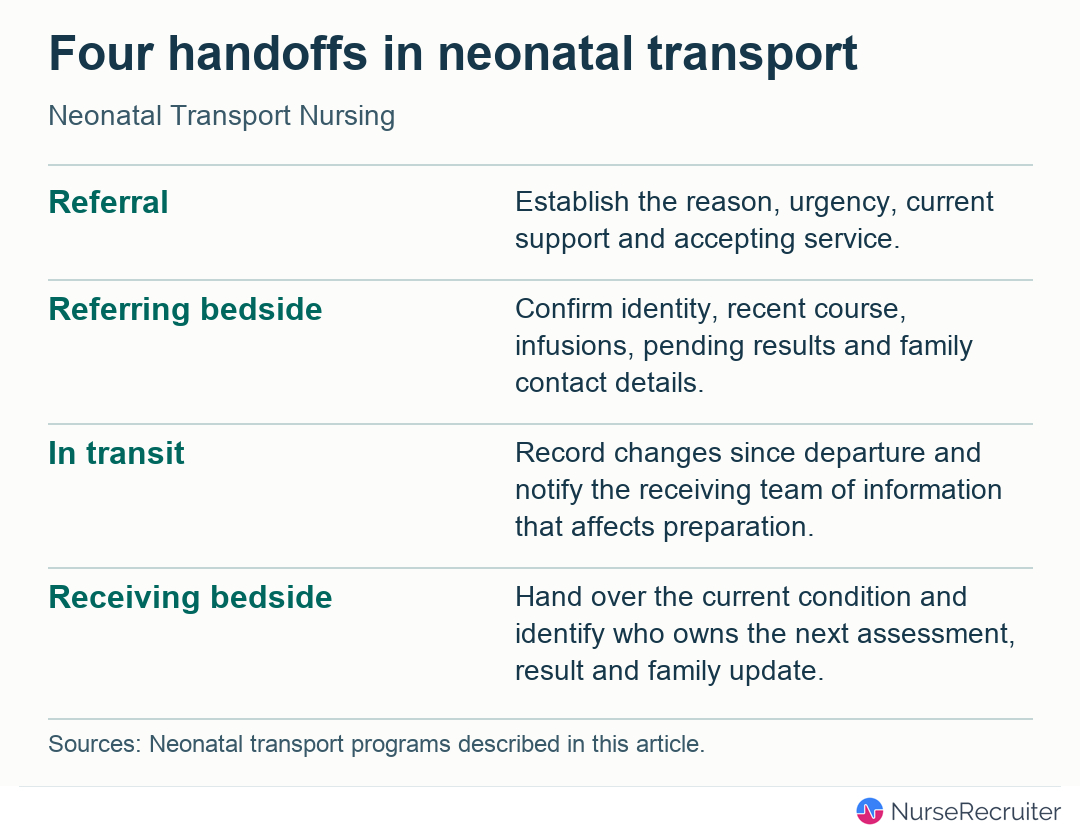
| Stage | Information and responsibility |
|---|---|
| Referral | Reason and urgency for transfer, current support and the accepting service |
| Referring bedside | Identity, recent course, current support and infusions, pending results and family contact details |
| In transit | Changes after departure, actions taken and updates that affect receiving preparations |
| Receiving bedside | Current condition, significant changes and responsibility for the next assessment, result and family update |
A scheduled return transfer can still require coordination of feeding, ongoing treatment and follow-up, and the family's expectations for the move closer to home can be central to the handoff. The receiving hospital needs the current plan even if it originally referred the infant. Handoff closes when responsibility is transferred, not when the vehicle arrives.
Deployment and coverage
A service may use dedicated transport staff or draw nurses from a NICU assignment. The second model requires coverage for the patients left on the unit as well as the transport itself. A combined neonatal and pediatric roster also requires competence for both populations. A NICU or transport posting found through a hospital's careers site or a specialty search on NurseRecruiter may not say which model applies, so the deployment arrangement is worth confirming before accepting an offer, along with the share of trips that are ground transfers and whether the work includes return transport.
The transport service establishes each crew member's authorized responsibilities, medical direction and equipment training. A procedure performed by the team is not automatically an RN responsibility. Orientation needs to cover the transport modes and equipment actually used, supervised deployment, equipment failure and transfer between systems. The role's duty roster should account for mobilization, the trip, handoff and return to base.
Related articles
- Flight and Transport Nursing
- Neonatal Nursing
- Neonatal Nurse Practitioners
- Obstetric and Neonatal Certifications
- Warm Handoffs Between Care Teams
Sources
- Seattle Children’s and WSNA, 2026–2029 RN Agreement (accessed 2026-11-18) — Articles 9 and 10; base wages and assignment-specific premiums.
- Neonatal Transport Team (accessed 2026-11-18) — Rady Children’s; crew, transport modes and return transfers.
- NICU Care Team and Critical Care Transport (accessed 2026-11-18) — Seattle Children’s; crew and stated annual newborn transport volume.
- The Neonatal Transport Team (accessed 2026-11-13) — Emory; retained service model source.
- Neonatal Transport (accessed 2026-11-13) — Emory; retained program description.