
Developmental disabilities nursing supports people with intellectual and developmental disabilities across the lifespan. Nurses work in residential and community services, schools, clinics and hospitals. The assignment combines clinical assessment with accessible communication, coordination across services and support for the person's participation in care.
Hospital workload and readmissions
A study of 2016 data from 595 acute care hospitals in California, Florida, New Jersey and Pennsylvania examined 39,558 stays by adults with intellectual or developmental disabilities. Each additional patient per nurse in the hospital’s average assignment was associated with 7% higher adjusted odds of readmission within 30 days. The researchers measured staffing at the hospital level. The finding does not set a residential caseload or establish what caused an individual readmission.
Pay and employment
NurseRecruiter compiled BLS May 2025 RN estimates for residential intellectual and developmental disability, mental health, and substance abuse facilities:
| Measure | RN employees in the combined industry |
|---|---|
| Employment | 20,550 |
| Hourly 25th percentile | $36.22 |
| Hourly median | $39.91 |
| Hourly 75th percentile | $46.58 |
| Annual median | $83,010 |
The industry combines several facility types and does not isolate nurses caring exclusively for people with developmental disabilities. It excludes self-employed workers and overtime premiums. School, hospital and clinic employees may belong to other industry groups.
Employment ranges from continuous bedside coverage to consultation across several homes. The number of sites, paid travel and documentation time, overnight call, backup for urgent questions, time to review hospital returns and responsibility for staff training determine workload alongside the caseload. Nurses searching NurseRecruiter for residential or community disability roles can check each posting for these terms, since similar titles can describe quite different workloads. These terms belong in pay comparisons.
Assignments across settings
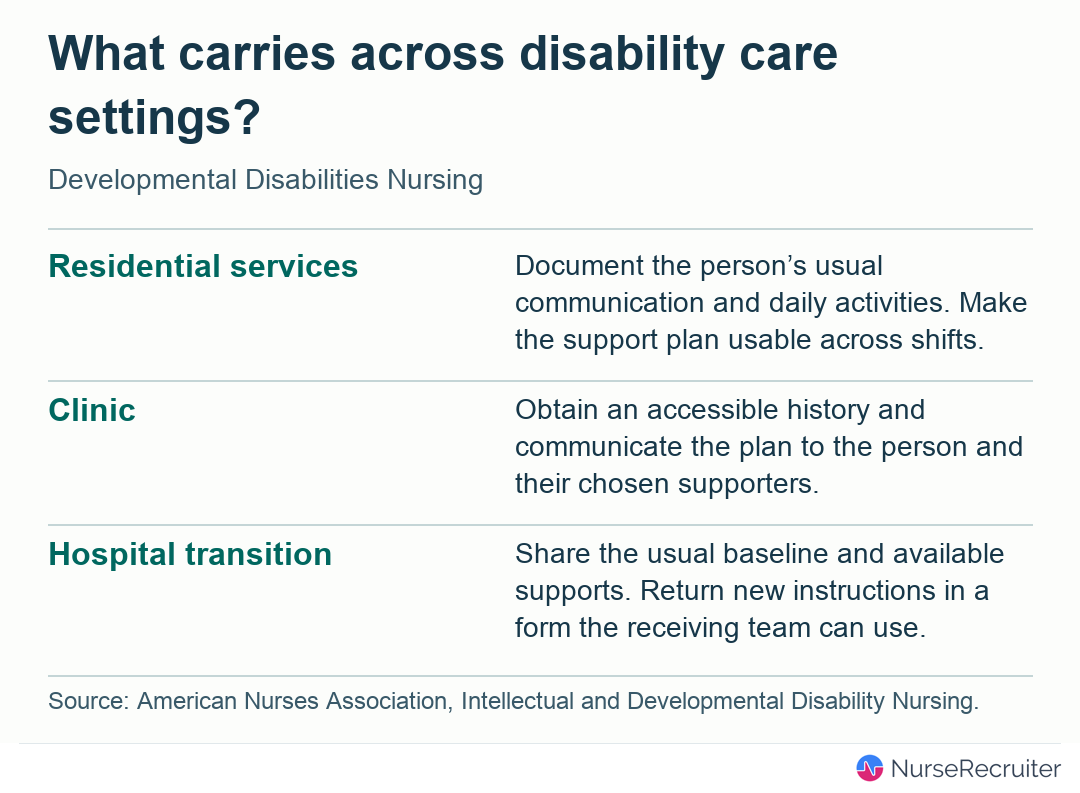
| Setting | Nursing responsibilities |
|---|---|
| Residential or community program | Assess changes, coordinate treatment and appointments, and maintain health supports that direct-support staff can use across shifts |
| Clinic | Obtain an accessible history, arrange preventive and follow-up care, and explain the plan to the person and their chosen supporters |
| School or education program | Coordinate health needs with the education team and support transitions between services |
| Hospital transition | Establish usual communication and function, identify available supports, and return clear medication and follow-up instructions to the receiving service |
The specialty includes coordination with housing, transportation, education and other services beyond conventional clinical referrals. Care coordination for people with disabilities describes those connections.
Assessment and communication
An intellectual disability and a developmental disability are not interchangeable terms. Neither diagnosis establishes the person's communication method, decision-making ability or current health needs.
Changes in eating, mobility, sleep or participation may be important observations. Comparing them with the person's usual pattern is more useful than labeling a change as “behavioral” without assessment. The record should distinguish direct observations, the person's account and information from supporters.
As a hypothetical example, a resident who usually joins breakfast has stayed in bed for two mornings. A useful assessment records the change from the person's own pattern, asks how they usually signal pain and identifies recent changes in health or routine. Writing only “behavioral” passes a conclusion to the next shift without the evidence behind it.
Vanderbilt's Communicate CARE guidance emphasizes addressing the person directly, adapting language and communication aids, allowing time to respond and asking whether supporters should participate. Communication access can require more than giving the same written instructions to a family member.
Delegation, consent and continuity
In a residence, nurses may train or supervise direct-support staff across several locations. Authorized tasks depend on state law, setting, individual needs and supervision. Training someone to perform a task does not transfer nursing assessment responsibility. New York OPWDD's 2019 Agency Protocol Manual, for example, addresses RN oversight, medication administration and delegated nursing in specific programs; it is a dated state framework, not a national delegation rule.
Nursing delegation and consent require separate decisions. A supporter may know the person well without having authority to consent for them. The nurse identifies how the person participates in the particular decision and who, if anyone, may act on their behalf.
A transfer record should carry the usual baseline, current medicines, communication method, mobility and eating supports, agreed contacts and outstanding follow-up. New instructions must reach the staff responsible for carrying them out, including after an emergency visit or hospital stay.
Related articles
- Care Coordination for People with Disabilities
- Communication Access for Patients with Disabilities
- Nursing Assignment and Delegation
Sources
- BLS, May 2025 industry-specific occupational estimates (accessed 2026-11-18) — RN occupation 29-1141; NurseRecruiter compilation from retained official tables.
- BLS, May 2025 OEWS methods (accessed 2026-11-18)
- ANA, Intellectual and Developmental Disability Nursing, third-edition scope chapter (accessed 2026-11-18)
- Vanderbilt Kennedy Center, Communicate CARE, updated May 2023 (accessed 2026-11-18)
- New York OPWDD, Agency Protocol Manual, February 8, 2019 (accessed 2026-11-18)
- Moronski and colleagues, nurse staffing and hospital readmissions for adults with intellectual and developmental disability, 2025 (accessed 2026-11-19)