
Dermatology nurses work in medical dermatology, phototherapy and procedural or surgical care for disorders of skin, hair and nails. Chronic-disease follow-up, a recurring phototherapy service and a Mohs surgery list create different nursing schedules, technical requirements and follow-up work.
How many stages a Mohs case takes
Counting patients alone understates the workload in a Mohs clinic. In a study of U.S. Medicare claims from 2012–14, the average across surgeons was 1.74 stages per case for the anatomical sites studied. Each additional stage keeps a patient in the clinic through another round of tissue removal and examination. For staffing, a clinic can track both cases started and stages completed, alongside repairs and postoperative calls.
Pay and employer setting
NurseRecruiter compiled these May 2025 BLS RN benchmarks for relevant employer industries. They cover RNs across specialties within each industry, rather than a separate wage series for this specialty.
| Employer industry | RN employee jobs | Hourly 25th percentile | Hourly median | Hourly 75th percentile | Annual median |
|---|---|---|---|---|---|
| Physicians’ offices | 232,420 | $36.25 | $40.87 | $49.17 | $85,000 |
| Outpatient care centers | 173,380 | $39.39 | $47.77 | $61.54 | $99,350 |
The middle half of reported wages lies between the 25th and 75th percentiles. OEWS wage estimates exclude overtime premiums and employer-paid benefits. See registered nurse pay for state and metropolitan comparisons.
An independent practice and a hospital-operated clinic need not use the same RN classification. Procedure overruns, telephone triage, travel between offices and postoperative calls can add work beyond booked appointments; the position's paid hours and coverage arrangements should account for those duties. When nurses compare dermatology openings on a job board such as NurseRecruiter, the employer type, scheduled hours and listed coverage duties show which of these arrangements a posting involves.
Medical, treatment and surgical assignments
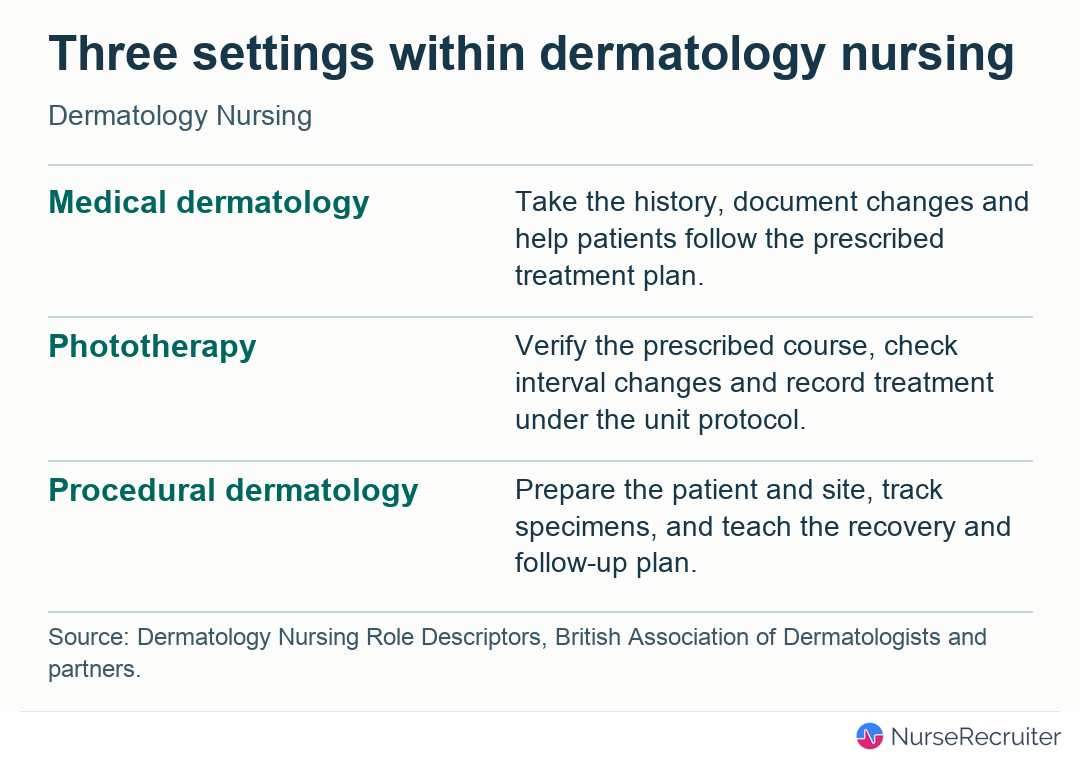
| Service | Characteristic nursing work |
|---|---|
| Medical dermatology | History and symptom assessment, treatment teaching, medication questions and follow-up of tests and clinician instructions |
| Phototherapy | Repeated treatment visits, checks for interval changes, delivery and recording of the prescribed treatment under the service's protocol |
| Procedural dermatology | Patient and site preparation, specimen identification, procedural assistance, dressings and recovery instructions |
| Mohs surgery | Care across staged tissue removal and examination, with possible repair after the tumor margins are assessed |
Phototherapy uses prescribed light treatment for selected skin conditions. A series of appointments creates continuing work between visits: treatment records, reported reactions and changes requiring clinician review. It is not interchangeable with cosmetic light treatment, and its delivery requires the service's training and authorization.
In Mohs surgery, tissue is removed and examined, with further removal if cancer remains. That staged process makes the end time less predictable than the length of an individual procedure. Nursing work includes maintaining the patient and specimen identification, care while results are pending, and preparation for repair or the next step. Day-end instructions should tell the patient how to get help with a concern after the office closes.
Biopsy follow-up also crosses several encounters. Specimen dispatch, pathology receipt, clinician review and communication of the follow-up plan are distinct tasks. The service needs a system that tracks the result through to action, not only a list of specimens sent.
These assignments overlap with ambulatory care, perioperative nursing, telephone triage and wound care. The proportion of procedure-room work, treatment visits and message management determines the actual job. A clinic should be able to say who teaches procedure-specific skills and who provides medical review between scheduled visits.
Dermatology certification
The Dermatology Nurse Certified (DNC) credential requires a current unrestricted U.S. or Canadian RN license, at least two years of dermatology nursing experience as an RN, and 2,000 hours of dermatology nursing work in the preceding two years. Eligible work can be in staff practice, administration, teaching or research. Certification lasts three years.
DNC is distinct from dermatology nurse-practitioner certification and from the legal authority or employer privileges for a particular procedure. A cosmetic, surgical or medical practice should specify the procedures within its RN role rather than assuming that the same title covers them all. Cosmetic injections, lasers and medical spa work, including the state rules on which nurses may perform them, are covered in aesthetic nursing. British dermatology nursing groups publish role descriptors organized by level of responsibility; they help compare the breadth of work, while U.S. practice authority follows the applicable jurisdiction.
Travel and per diem work
A travel contract covering several dermatology offices needs a site list and a description of the work at each office. A per diem procedure session raises a different question: who communicates biopsy results and handles patient calls after the session ends?
Related articles
- Ambulatory Care Nursing
- Perioperative Nursing
- Wound, Ostomy, and Continence Nursing
- Aesthetic Nursing
Sources
- May 2025 Occupational Employment and Wage Statistics (accessed 2026-11-18) — BLS; RN industry employment and wage percentiles, compiled by NurseRecruiter.
- DNC Certification (accessed 2026-11-18) — Dermatology Nurses’ Association; current eligibility and term.
- Mohs Surgery (accessed 2026-11-18) — American Academy of Dermatology; staged removal and examination.
- Phototherapy (accessed 2026-11-18) — AAD; prescribed treatment.
- Clinical Dermatology Nursing Role Descriptors (accessed 2026-11-13) — British professional role framework; used for work descriptions, not U.S. legal scope.
- Krishnan and colleagues, physician variation in Mohs stages per case, JAMA Dermatology, 2017 (accessed 2026-11-19)