
Clinical documentation integrity (CDI) is the work of making the health record accurately reflect the patient’s condition and care. A CDI specialist may be a nurse or a professional with another qualifying background. The specialist identifies missing specificity, inconsistent documentation, or a question about the clinical support for a documented condition. The treating provider supplies clinical clarification. The coding professional applies coding rules to the resulting record.
Pay by CDI role and appointment
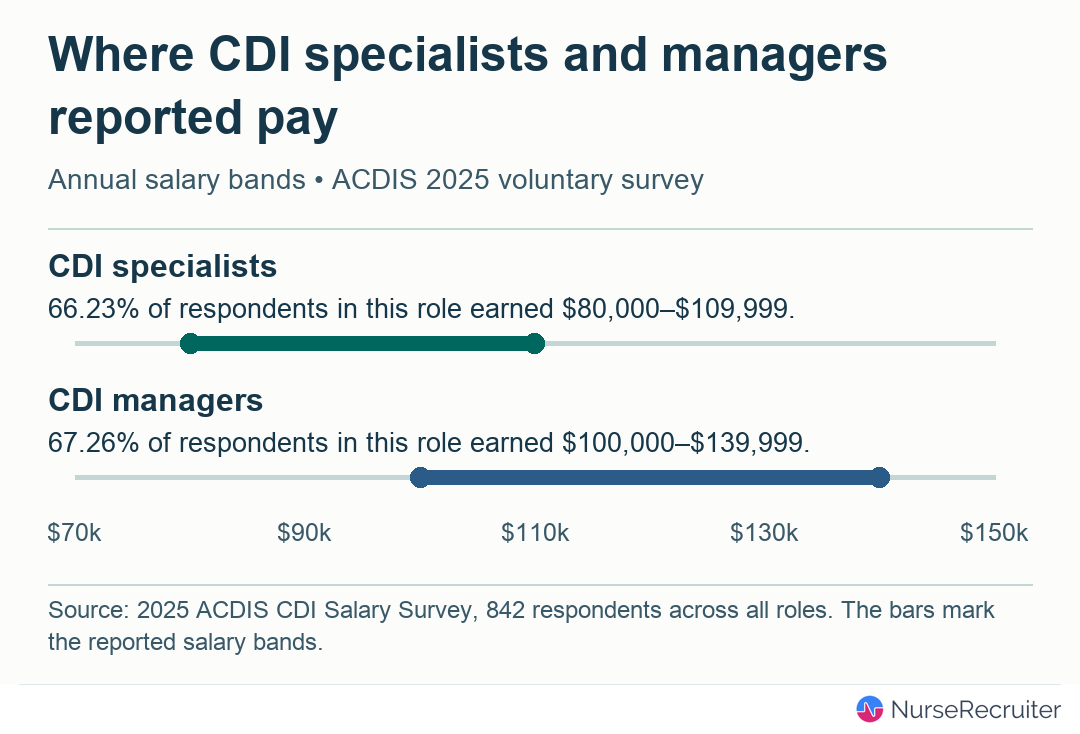
The Association of Clinical Documentation Integrity Specialists’ 2025 survey drew 842 responses from CDI professionals in multiple roles. Among responding CDI specialists, 66.23% reported annual salaries of $80,000–$109,999. Among responding CDI managers, 67.26% reported $100,000–$139,999. These are distributions among voluntary respondents within each title. They do not establish a national median, or a particular rate for an RN crossing into CDI.
NurseRecruiter calculates that a hypothetical salaried specialist earning $92,000 for 40 paid hours over 52 weeks has a scheduled-hour equivalent of $44.23. At the same annual pay and 36 paid hours per week, the equivalent is $49.15. Those examples assume all 52 weeks are paid. They do not convert a salaried role into an hourly position or determine overtime eligibility. Before comparing offers, whether found through a nursing job board such as NurseRecruiter or a hospital's own careers site, identify the actual FTE, required review and meeting time, weekend coverage, and whether the role includes auditing or supervision. How to compare RN pay offers shows why paid hours can change the value of a higher rate.
From chart review to a provider query
A reviewer reads across the record rather than pulling a single phrase from a progress note. Operative reports, consultants’ assessments, nursing observations, test results, and discharge documentation can describe different parts of the same encounter. A discrepancy may warrant a query, but a laboratory value or an automated suggestion alone does not establish a diagnosis.
For example, suppose two provider notes disagree about whether a condition was present on admission. A reviewer can cite the dated, relevant facts and ask the responsible provider to clarify the timing, including whether it cannot be determined. A monetary consequence, preferred answer, or unsupported diagnosis has no place in the question. If chronology in the existing record already resolves the issue under the applicable guidance, another query adds work without resolving an uncertainty.
The ACDIS and AHIMA joint guidance addresses written and verbal queries across settings. A compliant process preserves why the question was raised, the clinical evidence, the recipient, and the response under organizational policy. A lack of response and a provider stating that a determination cannot be made are different outcomes.
Working from home in clinical documentation
A remote documentation specialist may have little direct patient contact and still spend part of each day communicating with physicians and coders. The distinction matters to someone searching for “non-phone” nursing work. Ask how many cases need clarification, how queries are delivered and who follows up before a file closes. Remote chart review jobs compares a hospital CDI posting with abstraction and payer review roles.
Where nursing knowledge fits
An RN reviewer can recognize a significant change in a patient’s course and identify documentation that the treating clinician may need to reconcile. That expertise does not authorize the reviewer to add a diagnosis on the provider’s behalf. ICD-10-CM guidelines allow information from clinicians other than the responsible provider for specific items under defined conditions. Check the guideline for the individual item and reporting year before using nursing documentation to assign a code.
CDI intersects with documentation corrections, nursing data quality, and utilization review. It has a different decision to make from utilization review nursing, which evaluates matters such as medical necessity and level of care.
Evaluating a CDI program
A concurrent review can obtain clarification while the patient is still in the hospital. A retrospective review can examine the completed record, with different turnaround and provider-availability constraints. Programs can examine unresolved conflicts, repeat documentation problems, response time, and the quality of sampled queries. A high agreement rate or increased reimbursement cannot establish that the record became more accurate. A useful audit includes neutral responses and clarifications that decrease reported severity as well as those that increase it.
Related articles
- Documentation Corrections and Late Entries
- Nursing Data Quality
- Utilization Review Nursing
- Nursing Informatics
Sources
- ACDIS and AHIMA, Guidelines for Achieving a Compliant Query Practice, 2026 update (accessed 2026-11-18)
- CMS and NCHS, FY 2027 ICD-10-CM Official Guidelines for Coding and Reporting (accessed 2026-11-18)
- Association of Clinical Documentation Integrity Specialists, 2025 CDI Salary Survey, released 2026 (accessed 2026-11-18)