
A long-term acute care hospital (LTACH) transfer moves a patient to a hospital providing an extended course of hospital-level treatment. Medicare calls these facilities long-term care hospitals, or LTCHs. For nurses, the work combines hospital nursing with admission review, transfer coordination and planning for the next care setting.
Nursing work and pay
LTCH patients commonly have several serious medical conditions. Medicare lists respiratory therapy, head trauma treatment and pain management among services these hospitals may provide. The receiving hospital's actual services determine which nursing competencies and support staff are needed; the LTCH designation alone does not describe every unit.
Transfer work connects the sending hospital's discharge team with admissions staff and receiving nurses. The hospital discharge-planning rules require an evaluation of the patient's needs, service availability and access, plus transmission of necessary clinical information. That work includes checking whether a proposed destination can provide the care described in the referral.
For pay context, the May 2025 U.S. RN hourly median was $49.44 in specialty hospitals excluding psychiatric and substance abuse hospitals, compared with $48.18 in general medical and surgical hospitals. These BLS industry benchmarks cover broader groups than LTCH nurses and do not measure transfer-coordinator pay. They exclude overtime premiums, shift differentials and employer benefit costs. A nurse weighing an actual LTCH position, such as one found through NurseRecruiter's nursing job search, would compare that employer's posted rate, differentials and unit type rather than rely on these medians. LTCH units with many ventilated patients overlap with critical care nursing skills.
What the transfer must establish
Three questions are separate:
| Question | What it establishes |
|---|---|
| Does the patient need continuing hospital care? | The clinical reason for this level of care |
| Can this hospital meet those needs? | Acceptance based on the requested services, equipment and staffing |
| What coverage applies? | Payment arrangements and any unresolved authorization issues |
An available bed does not establish all three. The nursing handoff needs the current treatment plan, relevant changes, medication reconciliation and responsibility for outstanding results. A service that remains unconfirmed belongs in the transfer record, not just the sending team's conversation.
Medicare criteria that shape LTCH referrals
Medicare pays an LTCH its full standard rate only for discharges that meet patient criteria in 42 CFR 412.522; other cases are paid a lower "site neutral" rate. To qualify for the standard rate, the patient must be admitted directly after discharge from an acute care hospital, the case must not have a principal psychiatric or rehabilitation diagnosis, and one of two conditions must apply:
- the preceding acute hospital stay included at least three days in an intensive care unit, or
- the LTCH stay involves ventilator services for at least 96 hours.
These are payment rules, not clinical eligibility rules, but they explain why LTCH admissions staff ask about ICU days and ventilation when screening a referral. The sending team's record of ICU dates and ventilator hours should be accurate and easy to find.
What the 25-day definition means
The statutory LTCH classification generally requires an average inpatient length of stay greater than 25 days. This is a hospital-level average. It neither requires every patient to stay 25 days nor determines an individual's discharge date.
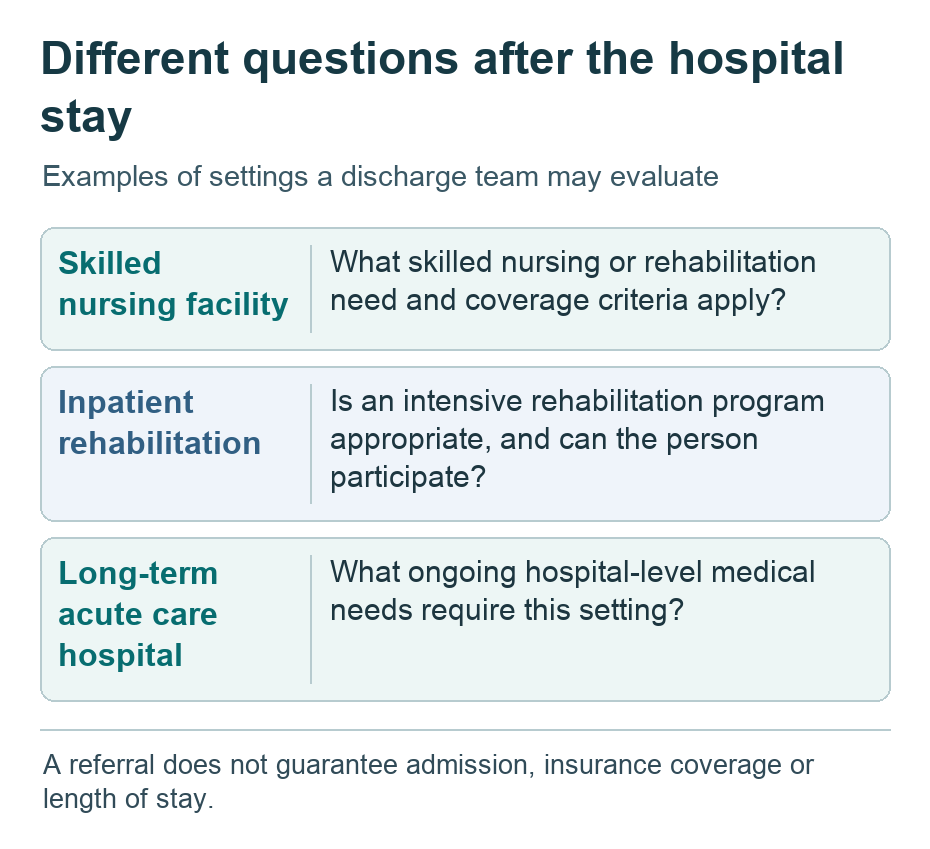
An LTCH is also different from a skilled nursing facility or inpatient rehabilitation facility. Medicare notes that many LTCH patients receive skilled nursing or custodial long-term care afterward. Discharge home is one possible destination, not an inherent outcome of the transfer.
Related articles
- Nursing discharge planning
- Skilled nursing facility transitions
- Inpatient rehabilitation transitions
- Care coordination
Sources
- Long-Term Care Hospital Services (accessed 2026-11-18) — Medicare; services and subsequent care settings.
- Long-Term Care Hospital Prospective Payment System (accessed 2026-11-18) — CMS; statutory classification and average length of stay.
- 42 CFR 412.522: LTCH site neutral and standard payment criteria (accessed 2026-11-18) — ICU-day and 96-hour ventilator criteria.
- 42 CFR 482.43: Discharge Planning (accessed 2026-11-18) — hospital discharge evaluation and information transfer.
- May 2025 RN Hourly Median: Specialty Hospitals (accessed 2026-11-18) — BLS OEWS.
- May 2025 RN Hourly Median: General Medical and Surgical Hospitals (accessed 2026-11-18) — BLS OEWS.
- May 2025 OEWS Technical Notes (accessed 2026-11-18) — BLS; occupational and geographic definitions and wage coverage.