
Trauma nurses care for injured patients in emergency departments, operating rooms, intensive care, inpatient wards and rehabilitation. Trauma program nurses instead coordinate case review, registries, education and improvement work across those services. The patient population is shared; the assignments and pay classifications differ.
Pay
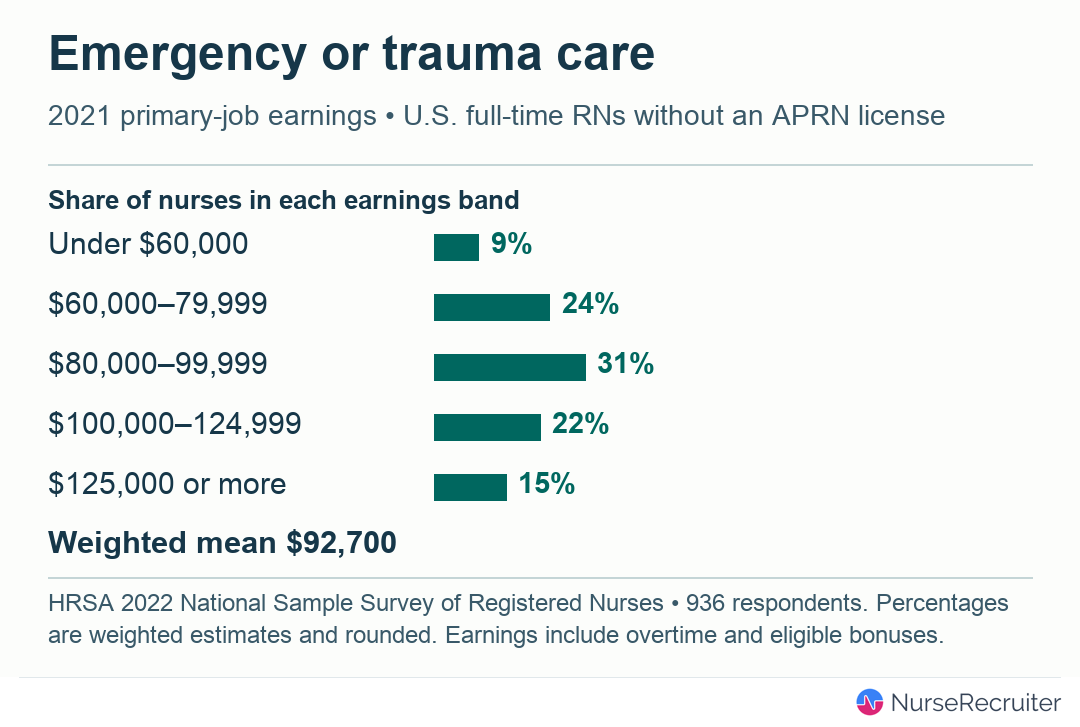
NurseRecruiter's analysis of HRSA's 2022 nursing survey found mean 2021 primary-job earnings of $92,700 for full-time RNs without an APRN license in emergency or trauma care. The sample contained 936 respondents, with an approximate 95% confidence interval of $89,100–$96,300. The category combines emergency and trauma work and cannot price them separately.
Earnings include overtime and bonuses other than sign-on bonuses. Individual earnings are capped at $250,000 in the public data.
BLS provides a separate May 2025 comparison for all RNs employed in U.S. general medical and surgical hospitals:
| Middle half of hourly wages | Hourly median | Annual median |
|---|---|---|
| $39.23–$57.21 | $48.18 | $100,210 |
This is an industry benchmark, not a trauma-only wage. It excludes overtime premiums, shift differentials and employer benefit costs. A bedside assignment and a trauma program management position can have different classifications; RN offer comparisons also distinguish scheduled work, standby and callback pay.
Scheduled and actual hours
In HRSA’s 2022 U.S. nursing workforce survey, among full-time RNs without an APRN credential who spent the largest share of their patient-care time in emergency or trauma care, 13.1% reported being scheduled for more than 40 hours a week, while 39% reported actually working more than 40 hours in their primary nursing job in 2021. The estimated share working more than 40 hours had a 95% confidence interval of 33.5% to 44.4%. This category includes the broader emergency workforce. Trauma-center records are needed to separate activation coverage from ordinary ED shifts. The specialty survey notes explain which hours count.
Clinical and program assignments
| Setting | Main work |
|---|---|
| Emergency or trauma receiving area | Prepare for activation, assess and monitor patients, document the sequence of care and coordinate transfer |
| Operating room and intensive care | Continue perioperative or critical care while carrying forward injury findings, procedures and outstanding tests |
| Ward and rehabilitation | Reassess recovery and function; coordinate therapy, equipment, education and discharge needs |
| Trauma program | Review cases and registry data, organize education, track improvement work and coordinate with the trauma medical director |
Handoffs between these units need to carry what was suspected as well as what was confirmed. A patient with several injuries may be unable to give a history on arrival; a later nursing assessment of pre-injury mobility, usual medicines or communication needs can change discharge planning after the emergency phase has ended.
The Society of Trauma Nurses describes the program manager as overseeing clinical, educational, administrative, financial, research and outreach activities. Its 2023 position recommends a BSN minimum, prefers a master's degree and identifies TCRN certification as one measure of competency. These are professional recommendations, not a universal licensing rule.
Trauma center levels
State or other empowered authorities designate trauma centers. The American College of Surgeons separately verifies resources and performance. A designation and an ACS verification can coexist, so identify the issuing body and level when comparing hospitals. ACS verification levels describe institutional capability:
| ACS level | Broad capability |
|---|---|
| I | Comprehensive trauma care and trauma-system leadership, with education and research responsibilities |
| II | Initial definitive care for a wide range of injuries and injury severity |
| III | Definitive care for mild to moderate injuries, plus initial management and transfer when needs exceed available resources |
Adult and pediatric verification are distinct. The level does not specify one nurse's patient assignment or case volume. For a job comparison, more useful figures are the unit's number of trauma activations, how coverage works overnight, where patients go when a required service is unavailable, and whether a dedicated trauma nurse keeps other patients during an activation. Transfer responsibilities connect trauma services with flight and transport nursing.
Specialty knowledge
BCEN's TCRN examination covers injury types, special populations, resuscitation, ongoing care, rehabilitation, transfer and professional practice. Certification is separate from a trauma course, employer orientation and the hospital's verification. A nurse moving from critical care can bring relevant experience and still need supervised preparation for a trauma-team role. CEN addresses emergency nursing more broadly.
NurseRecruiter's 2009 profile of operating-room nurse Louise Fang describes trauma work in Port Harcourt, Nigeria: supervising staff, preparing supplies and coordinating with emergency and intensive care teams. It is a historical account of her assignments, not a current MSF recruitment offer.
Travel and per diem work
For travel work, distinguish bedside coverage of trauma arrivals or an inpatient unit from a trauma-program position centered on registry work and performance improvement. Before a per diem shift, verify the assigned service, trauma-team role and who is available for escalation during that shift.
Related articles
Sources
- American College of Surgeons: Trauma Verification, Review and Consultation (accessed 2026-11-18).
- Society of Trauma Nurses: 2023 Trauma Program Manager Qualifications and Competencies (accessed 2026-11-18).
- BCEN: TCRN examination outline effective November 2025 (accessed 2026-11-18).
- BLS: May 2025 industry-specific Occupational Employment and Wage Statistics (accessed 2026-11-18).
- BLS: OEWS wage definitions (accessed 2026-11-18).
- HRSA: 2022 National Sample Survey of Registered Nurses and public-use files (accessed 2026-11-18).
- HRSA: 2022 survey questionnaire, primary job and earnings (accessed 2026-11-18).
- HRSA: public-use codebook and replicate-weight instructions (accessed 2026-11-18).
- NurseRecruiter: Louise Fang’s MSF nursing account, first published 2009 (accessed 2026-11-18).