
Moral distress arises when a nurse believes an action is ethically required but is constrained from taking it. The concern involves an ethical judgment and a barrier to action, such as an institutional decision or unavailable support. It differs from uncertainty about which course is right and from burnout, which concerns chronic workplace stress.
The American Association of Critical-Care Nurses' April 2025 position treats moral distress as an issue for institutions, leaders and clinicians together. The American Nurses Association's Professional Issues Panel on Moral Resilience completed a call for action, Exploring Moral Resilience Toward a Culture of Ethical Practice, in October 2017; it framed strengthening moral resilience as a way to address moral distress.
The concern and the barrier
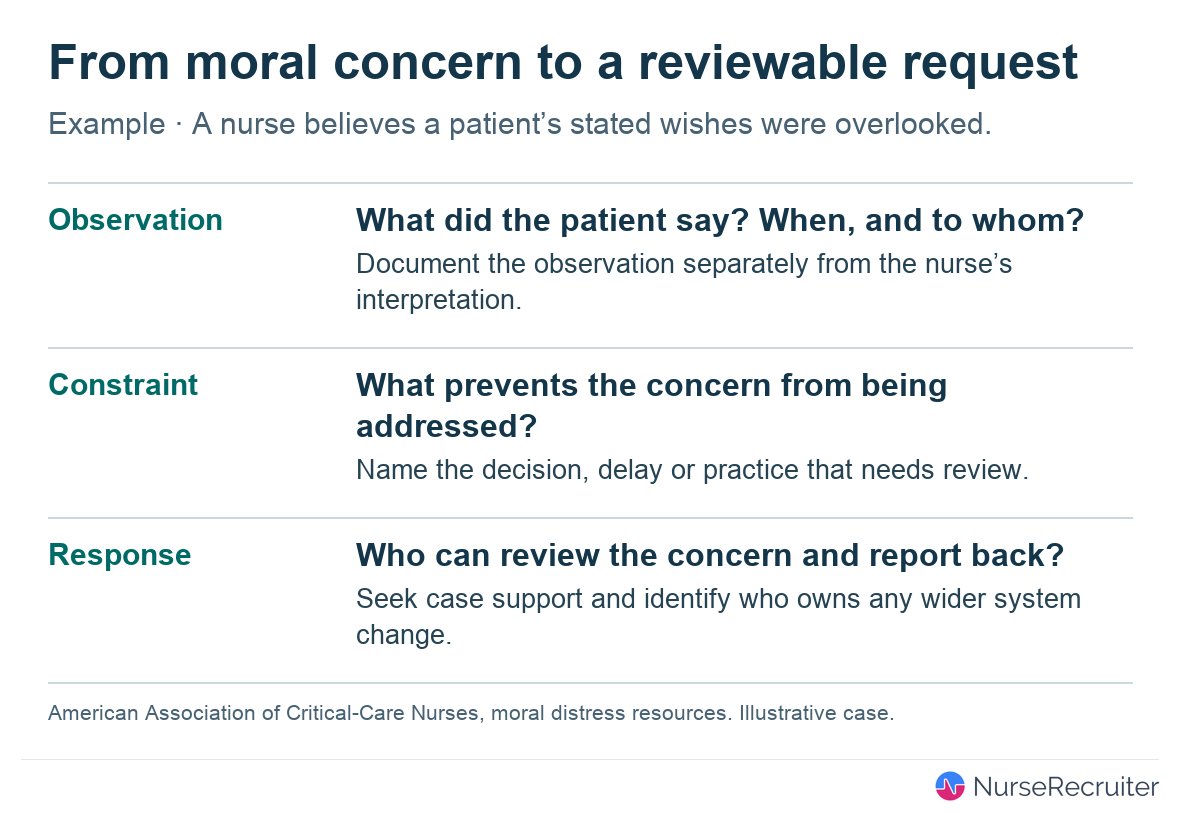
The illustrated example separates the patient's expressed preference, the nurse's interpretation and the barrier to reopening a decision. A review can then establish the facts, identify the decision-maker and consider the competing responsibilities. Notes prepared for that discussion belong in an approved, confidential channel rather than a personal system holding identifiable patient information.
Ethics consultation supports that deliberation. An individual clinician's distress identifies a concern for examination; it does not itself settle the ethical question.
NurseRecruiter’s 2009 discussion of moral distress gives historical context for the distinction between uncertainty about the right course and knowing what one believes should happen while facing a barrier to acting.
Organizational responsibilities
AACN recommends practical supports that include:
- Nurses participating as decision-makers on ethics committees.
- Accessible leaders, ethics support and forums for discussing goals of care.
- Interdisciplinary allocation processes when resources are scarce.
- Adequate protective equipment and attention to working conditions.
- Debriefing, counseling and other support for affected staff.
The recurring issue may require a policy or resource decision as well as support for the individual. NIOSH's Impact Wellbeing Guide similarly emphasizes changes in hospital operations and two-way communication with workers. Its approach extends beyond individual resilience training.
Case review and follow-up
A concise review identifies the unresolved decision, the person or group authorized to revisit it and the action or explanation returned to the team. Repeated concerns can inform shared governance and work-environment review.
Conscientious objection addresses a separate question: a clinician's objection to participating in particular care. Speaking up across hierarchies concerns communicating and escalating the issue.
Related articles
- Ethics Consultation in Healthcare
- Conscientious Objection in Nursing
- Speaking Up Across Professional Hierarchies
- Nurse Burnout
Sources
- NurseRecruiter, Ethical Dilemma in Nursing and Moral Distress (published 2009-04-24, accessed 2026-11-19).
- AACN: Moral distress in times of crisis (accessed 2026-11-18) — Position reviewed and updated April 10, 2025.
- NIOSH: Impact Wellbeing Guide (accessed 2026-11-18) — Hospital operational approach and two-way communication.
- American Nurses Association: Moral Resilience Panel (accessed 2026-11-18) — October 2017 call for action.