
An ethics consultation helps patients, families and clinicians examine uncertainty or disagreement about values and responsibilities in care. Consultants clarify the ethical issue and advise the people responsible for the decision; they do not automatically replace the patient, authorized surrogate or treating team.
The question and the participants
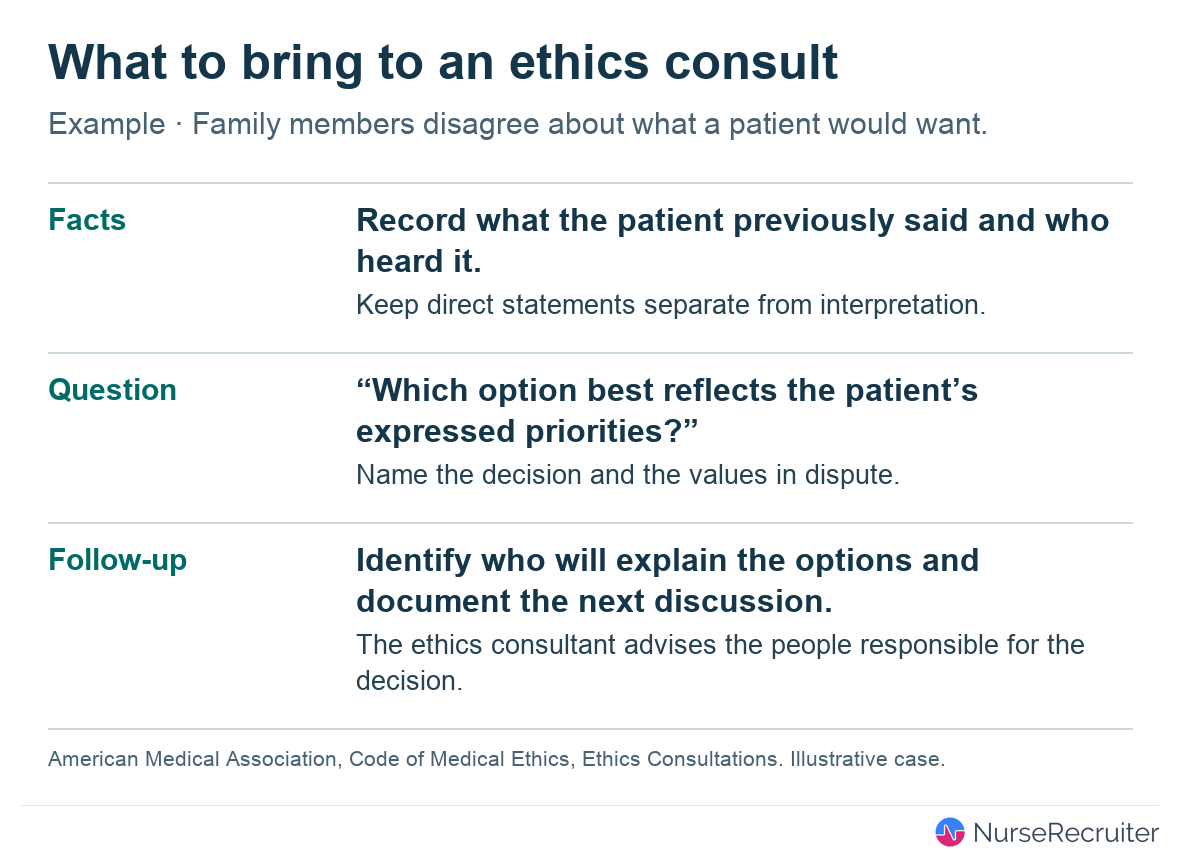
The request should identify the decision, its urgency, the patient’s expressed preferences, the participants and their roles, and the options already discussed. Relevant issues can include disagreement about treatment goals, interpretation of an advance directive, or uncertainty about a surrogate’s decision.
The AMA’s consultation guidance, written for physicians providing this service, calls for patient notification and agreement to participate when someone else requests the consultation. It also calls for respect when patients or families decline participation. Confidentiality, appropriate consultant training and documentation procedures are explicit parts of the guidance.
Local policy determines the request route and documentation process. An immediate safety problem still requires the appropriate clinical response; waiting for an ethics meeting is not a substitute for urgent care.
Nursing participation and nurse ethicists
Nurses can contribute observations from ongoing care, including the patient’s actual words, changes in understanding and concerns raised outside formal meetings. Those observations should be separated from assumptions about the patient’s final choice.
The American Association of Critical-Care Nurses, in its April 2025 statement on moral distress, recommends that nurses be included as decision makers on institutional ethics committees. It also recommends accessible ethics resources and interdisciplinary forums for discussing goals of care. This is the association’s recommendation, not a federal staffing requirement.
In NurseRecruiter’s March 2012 profile of nurse ethicist Lucia Wocial, her work at Indiana University Health included chart review, discussion with the patient, family, nurses and physicians, and follow-up with nurses. At that time, requests concerning treatment considered nonbeneficial were her most frequent consultation issue. The post describes her role then, rather than a current job description for every nurse ethicist.
Recommendations and follow-up
The AMA describes consultants as advisers and educators. Its guidance says participants should not be required to accept recommendations and that institutional stakeholders should explain their reasoning when they choose another course. The resulting record should distinguish the ethical analysis from the actual care decision and its responsible decision maker.
An ethics consultation can help with moral distress or conscientious objection, but it is not a legal ruling and does not guarantee agreement. Unresolved clinical, legal or safety questions still need their respective review routes.
Related articles
- Moral Distress in Nursing
- Surrogate Decision-Makers in Healthcare
- Advance Directives and Nursing Responsibilities
- Conscientious Objection in Nursing
Sources
- AMA Code of Medical Ethics: Ethics Consultations (accessed 2026-11-18).
- AACN: Moral Distress in Times of Crisis (accessed 2026-11-18).
- NurseRecruiter: A Nurse Ethicist Explains Her Specialty (accessed 2026-11-18) — March 2012 post summarizing an interview with Lucia Wocial; describes her role at that time.