
Private duty nursing provides sustained skilled care to an individual, often with a nurse assigned to one child or adult for a shift at home. It differs from an intermittent home health visit and from personal care supplied by an aide. Jobs depend on the patient's nursing needs, authorized services and the responsibilities assigned to an RN or LPN/LVN.
How many authorized hours get staffed?
In a 2018 study at one Midwestern U.S. children’s hospital, 38 families receiving pediatric palliative care consultations completed surveys about home nursing. The average gap between weekly home nursing hours allotted and received was 40 hours per family. Families reported staffing gaps more often at night. An agency can use its own authorized hours, filled hours and night-shift coverage to see where a child’s plan breaks down in practice.
Pay
NurseRecruiter's comparison of May 2025 BLS home-health industry wages provides context for RN and LPN/LVN positions:
| Occupation in home health care services | Median hourly wage |
|---|---|
| Registered nurse | $40.83 |
| Licensed practical or vocational nurse | $30.57 |
These figures cover the whole industry, including visit-based care. BLS does not publish a separate private-duty nursing wage. OEWS wages exclude overtime premiums, shift differentials and employer benefit costs. A payer's reimbursement rate or authorization is separate from the nurse's wage.
An assignment's compensation also depends on paid orientation, night or weekend differentials, cancellation terms and arrangements when a patient is hospitalized. The paid shift and required relief arrangements determine the actual work commitment.
Roles and settings
Federal Medicaid rules define private duty nursing as more individualized and continuous care than ordinarily available from visiting nurses or facility staff. Services are delivered by an RN or LPN under the beneficiary's physician's direction. States may cover the home, hospital or skilled nursing facility within that federal definition.
Ohio's Medicaid rule illustrates how state requirements narrow the service. It recognizes RNs and LPNs working at an RN's direction and covers care in the person's residence, with community accompaniment when medically necessary. Its residence definition excludes hospitals and nursing facilities. It also reserves specified tasks, including IV medication administration and central-line dressing changes, to RNs for this service. These are Ohio coverage requirements, not a nationwide RN/LPN task list.
Texas places its private duty nursing rules in a separate section of the Texas Medicaid home health nursing and private duty nursing handbook. One state's eligibility criteria, authorization period or covered settings do not carry over to another state's assignment, and private payment or commercial insurance can use different terms.
Agencies and independent nurses can provide Ohio private duty nursing if they meet the applicable provider requirements. The ordered care, authorized setting and scope of practice determine the assignment. A pediatric overnight position may center on monitoring while caregivers sleep; another assignment may include school or community activities when authorized. The care plan and employment agreement specify where the nurse is expected to work.
Shift responsibilities
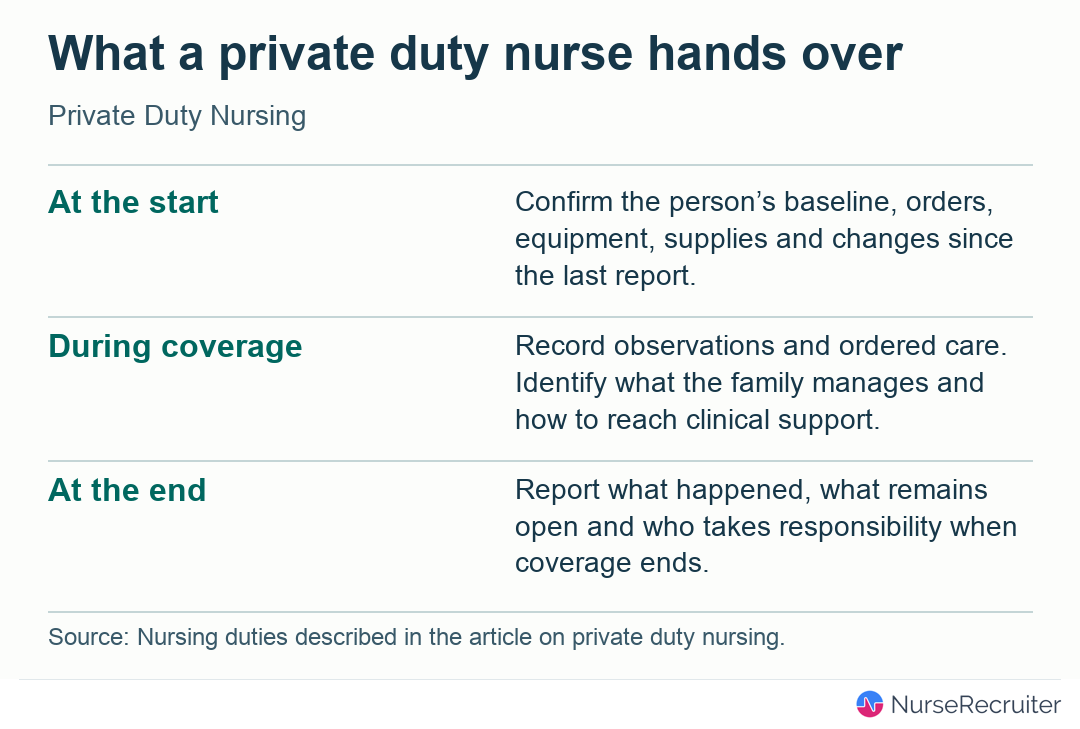
| Stage | Nursing work |
|---|---|
| Start | Review the person's baseline, changes since the previous report, current orders, equipment and supplies |
| During coverage | Provide and document ordered nursing care, assess changes and contact clinical support when needed |
| Handoff | Report care provided, unresolved needs and the person assuming responsibility when coverage ends |
For a case involving gastrostomy tube feeding, tell the next nurse how much of the scheduled feeding was delivered. For tracheostomy care, describe the person’s usual breathing, how they signal distress and who provides clinical backup.
Authorization of care hours and staffing those hours are separate decisions. An authorization does not name the nurse, guarantee the agency can fill every hour, or show that a particular RN or LPN is prepared for the case; the nurse still needs the current plan, orders, role-specific orientation and a contact who can resolve a discrepancy. The work plan identifies the assigned nurse, clinical backup, relief arrangements and responsibilities carried by the patient or family. Family-centered communication incorporates the family's knowledge of baseline function and routines while preserving the patient's preferences and privacy.
Related articles
Sources
- BLS: May 2025 industry-specific Occupational Employment and Wage Statistics (accessed 2026-11-18).
- BLS: May 2025 OEWS wage definitions (accessed 2026-11-18).
- 42 CFR 440.80: Private duty nursing services (accessed 2026-11-18).
- Ohio Administrative Code 5160-12-02: Private duty nursing service requirements (accessed 2026-11-18).
- Texas Medicaid Provider Procedures Manual: Home Health Nursing and Private Duty Nursing Services Handbook, May 2026 (accessed 2026-11-18).
- Measuring the Impact of the Home Health Nursing Shortage on Family Caregivers of Children Receiving Palliative Care, 2018 (accessed 2026-11-19)