
Cognitive impairment can affect attention, memory, word finding and the ability to follow a conversation. Nursing communication work includes adapting questions and instructions, involving the patient's chosen supporters and recording the approach that works.
Communication adjustments
The National Institute on Aging's Alzheimer's guidance describes difficulty maintaining a train of thought, understanding words and filtering background noise. Its recommendations can be adapted to the observed difficulty:
| Difficulty | Communication adjustment |
|---|---|
| Losing track of a long exchange | Slow the pace, reduce competing conversation and leave time for a response |
| Difficulty answering a broad question | Use a simpler choice or a yes/no question when helpful |
| Not understanding the first explanation | Rephrase it with different words |
| Difficulty recalling instructions | Provide clear written takeaway points in an accessible format |
| Limited spoken response | Attend to facial expressions and other nonverbal communication |
Check hearing and vision access as part of the exchange. Maintain adult language and address the patient, including when a companion is present. NIA's guidance cautions against a baby-like voice, talking about the person as though they are absent, and finishing every sentence for them. These adaptations support communication; they do not diagnose the cause of a cognitive change.
Patients, companions and decisions
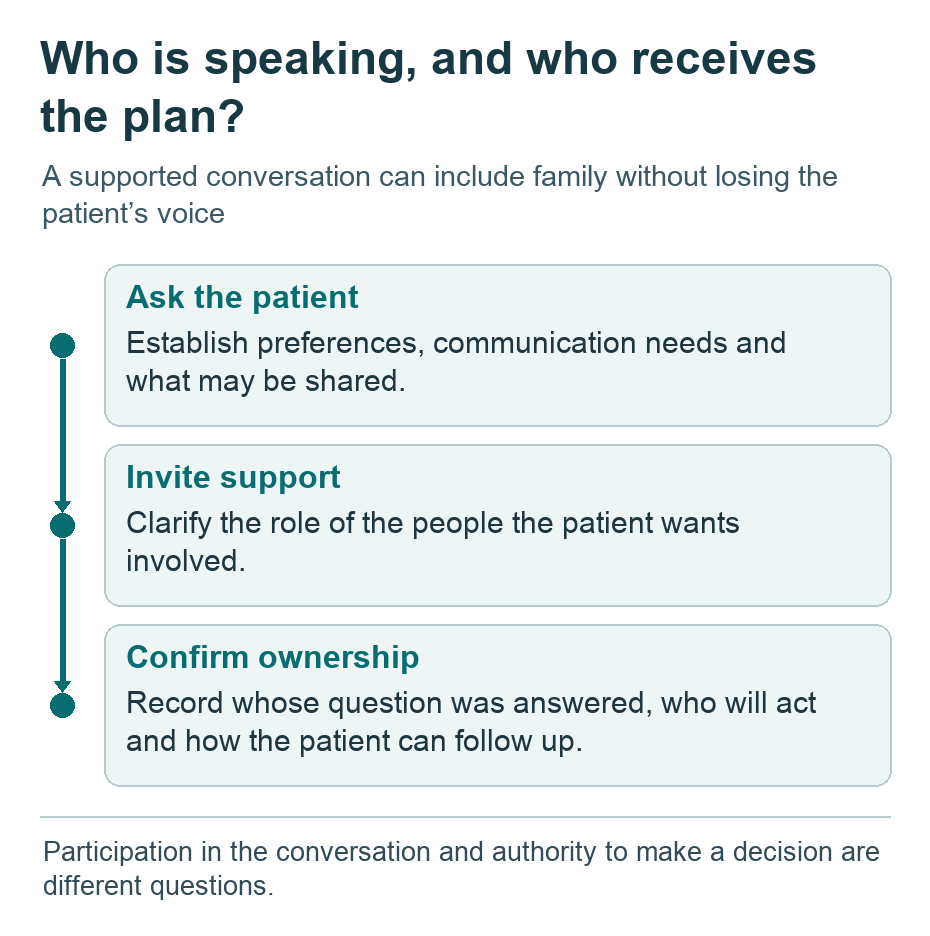
In family-centered communication, ask how the patient wants a companion involved and preserve opportunities for private conversation. A companion can supply observations, reinforce instructions or help arrange follow-up. Their presence alone does not confer authority to make healthcare decisions.
Record the patient's account separately from information supplied by others. A useful handoff describes the question or task, the response, the successful adaptation and the help still required. A note such as “Used a written appointment card; patient requested help arranging the visit” tells the next clinician more than an unexplained label about cooperation or understanding. The handoff can also identify who has agreed to receive appointment information or assist with follow-up.
For example, a caregiver may be able to coordinate an appointment while someone else needs to arrange the ride. Recording who accepted each task makes an unmet transport need visible.
Changes that need assessment
NIA recommends appropriate screening and diagnostic follow-up when cognition or memory changes. Possible causes include medication effects, metabolic or endocrine changes, delirium, depression and chronic conditions such as Alzheimer's disease. Record a change from the person's usual function rather than treating every unsuccessful conversation as dementia.
For broader communication methods and access responsibilities, see patient communication and communication access for patients with disabilities.
Related articles
- Family-Centered Communication
- Communication Access for Patients with Disabilities
- Decision-Making Capacity and Nursing Observations
Sources
- Communicating With Someone Who Has Alzheimer's Disease (accessed 2026-11-18) — National Institute on Aging; current indexed primary text, direct retrieval unavailable.
- Talking With Your Older Patients (accessed 2026-11-18) — National Institute on Aging; current indexed primary text, direct retrieval unavailable.
- National Institute on Aging, Assessing Cognitive Impairment in Older Patients (accessed 2026-11-18), current primary indexed text; direct retrieval returned 405.