
Communication with children in healthcare combines a developmentally appropriate explanation with a way for the child to ask questions and express concerns. In pediatric nursing, this includes preparing for procedures, working with caregivers and passing useful communication information to the next team.
Explanations and participation
Ask what the child already thinks will happen, for example: “Tell me what you think is going to happen next.” Use that answer to choose the explanation, rather than relying on age alone. Caregivers can describe familiar words, routines and communication methods while the nurse continues to address the child directly. A child who does not answer a spoken question may need more time or another method; silence is not evidence of understanding.
The American Academy of Pediatrics recommends honest explanations suited to the situation and the child's age. Preparation can identify who will be present, the equipment involved and the next steps. Avoid promises about pain or timing that the team cannot support, such as “nothing will hurt.” A hypothetical preparation statement that leaves room for questions: “First, we will look at the equipment together. Then the person doing the test will explain the steps. Tell me which part you would like us to explain again.”
NurseRecruiter's 2009 account by Rashmi Sharma describes a four-year-old who moved from asking whether his nurse had come to play to asking about his vital signs, leukemia treatment and participation in care.
Choices and communication support
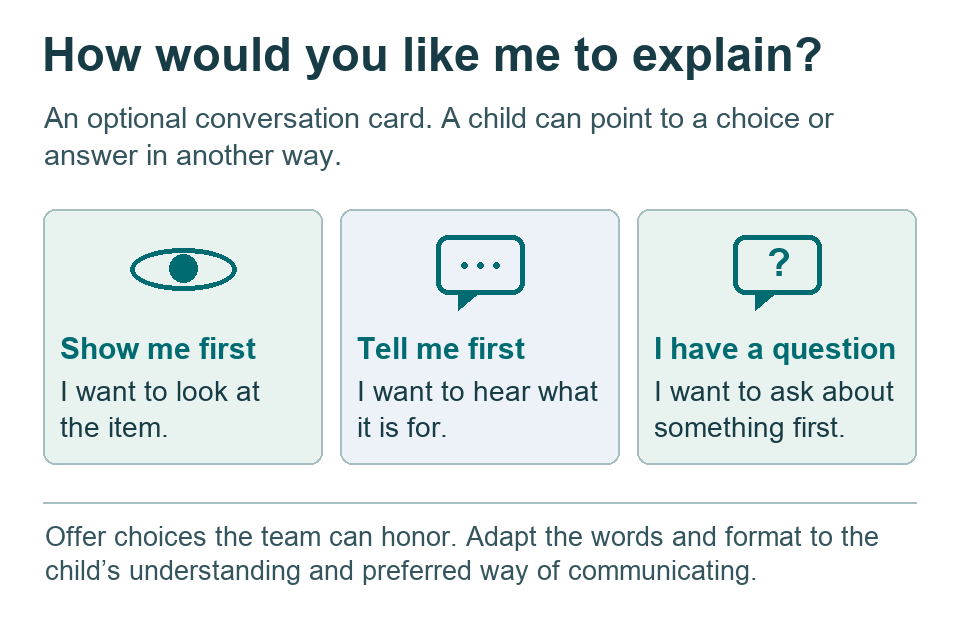
An optional conversation card. A child can point to a choice or answer in another way.
Offer choices the team can honor. Pictures, demonstration or the child's established augmentative communication method may support the exchange. Record the method that worked and allow time for a response.
Child life specialists have training in child development and help children understand and cope with illness, hospitalization and procedures. AAP describes their use of breathing exercises, counting and distraction during difficult procedures. Nursing and child life staff can coordinate preparation and explanations.
Caregivers, privacy and handoffs
Family-centered communication includes the caregiver's observations without replacing the child's account. AAP also recommends privacy for older children and teenagers whenever possible. Choices about explanation or comfort remain separate from consent and confidentiality requirements.
A handoff can identify what has been explained, the child's remaining questions, caregiver concerns and communication support to continue. Keep the child's own words distinct from a caregiver's interpretation. Update the explanation when the plan changes. Broader methods are indexed under patient communication.
Related articles
Sources
- 10 Things to Know Before Heading to the ER With Your Child (accessed 2026-11-18) — American Academy of Pediatrics; honest, age-appropriate preparation.
- What to Expect if Your Child Is Admitted to the Hospital (accessed 2026-11-18) — American Academy of Pediatrics, April 5, 2021; child life, available choices and privacy.
- Nurses On The Go: Rashmi Sharma (accessed 2026-11-18). NurseRecruiter, published 2009-10-26.