
Orthopedic nurses care for people with musculoskeletal injuries and conditions in hospital units, surgical services, clinics and rehabilitation. Assignments range from scheduled joint replacement to urgent fracture care, spine surgery and recovery after amputation. Patient mobility, permitted weight bearing, neurovascular assessment and discharge arrangements shape the work. There is no separate orthopedic nursing license or required course: RNs learn the specialty through orientation on an orthopedic, surgical or clinic service, and the ONC certification requires two years as an RN and 1,000 orthopedic nursing hours in the previous three years.
Pay and employer comparisons
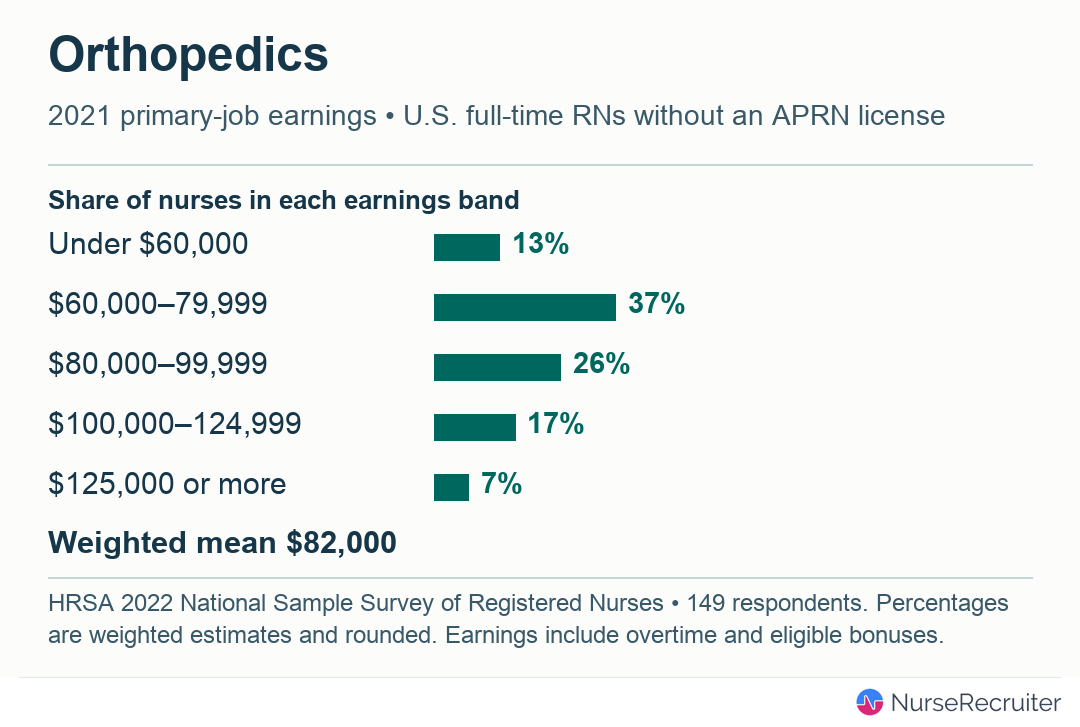
NurseRecruiter’s weighted analysis of HRSA’s 2022 National Sample Survey of Registered Nurses found that 149 respondents working full time in their primary nursing job, licensed as RNs without an APRN license, reported orthopedics. Their weighted mean primary-job earnings for 2021 were $82,000 (approximate 95% confidence interval $76,800–$87,300). Earnings include overtime and bonuses other than sign-on bonuses. The public data cap individual earnings at $250,000. Full-time status describes the primary job; annual earnings can cover less than a full year.
NurseRecruiter also compiled May 2025 BLS RN wages by employer industry. The hourly range below spans the 25th to 75th percentiles. These are all-RN industry figures, not specialty-specific rates. BLS excludes overtime premiums and employer-paid benefits.
| U.S. employer industry | Middle half of hourly wages | Hourly median | Annual median |
|---|---|---|---|
| General medical and surgical hospitals | $39.23–$57.21 | $48.18 | $100,210 |
| Outpatient care centers | $39.39–$61.54 | $47.77 | $99,350 |
An inpatient joint-replacement assignment, an ambulatory surgery role, and clinic triage can have different schedules within orthopedics. A search for orthopedic jobs on a board such as NurseRecruiter can return all three kinds of role, so include call and paid recovery coverage when comparing offers. See comparing RN pay offers.
Scheduled and actual hours
In HRSA’s 2022 U.S. nursing workforce survey, among full-time RNs without an APRN credential who spent the largest share of their patient-care time in orthopedics, 23.4% reported actually working more than 40 hours in a typical week in their primary nursing job in 2021. The estimated share working more than 40 hours had a 95% confidence interval of 12.5% to 34.2%. For an orthopedic floor, discharge teaching and shift handoff can compete for the same last hour. Rostered and actual hours reveal different pieces of that workload. The specialty survey notes explain which hours count.
Work by service
| Service | Main nursing work |
|---|---|
| Joint replacement | Prepare patients for surgery; assess recovery, pain and the wound; coordinate mobility, prescribed precautions and discharge teaching |
| Fracture and trauma care | Assess changes in pain, movement, sensation and circulation; manage ordered immobilization and wound care; escalate new findings |
| Spine surgery | Monitor neurological changes, support movement within the prescribed plan and coordinate brace use and recovery teaching |
| Amputation and rehabilitation | Provide wound and residual-limb care, assess pain, support adaptation and coordinate therapy and equipment |
| Orthopedic clinic | Prepare for procedures, manage follow-up and wound concerns, support cast care and communicate changes between visits |
Neurovascular checks after a fracture or under a cast matter because of acute compartment syndrome, a medical emergency that usually follows a severe injury such as a broken bone and can also be caused by casts and tight bandages. Its classic sign is pain more intense than the injury itself would explain; numbness or paralysis are late signs that usually indicate permanent tissue damage. Treatment is surgical (fasciotomy), so the nurse's role is early recognition and immediate escalation.
After hip replacement, AAOS lists blood clots in the leg veins or pelvis as one of the most common complications, alongside infection, dislocation, bleeding and nerve or blood-vessel injury. Patients may be asked to take precautions when sitting, bending or sleeping, usually for the first six weeks, and some go home the same day rather than staying at least one night.
Perioperative nursing, medical-surgical nursing, neuroscience nursing and rehabilitation nursing cover overlapping assignments. The postoperative plan must identify the actual procedure and restrictions; “orthopedic patient” is not enough to determine safe movement or the observations due.
Travel and per diem work
Travel orthopedic assignments can be compared by their case mix: scheduled joint replacements, trauma admissions and postoperative spine care lead to different daily work. For a per diem shift, ask about mobility assistance, access to therapy staff and how discharge teaching is divided on that day.
Urgent hip fracture and planned replacement
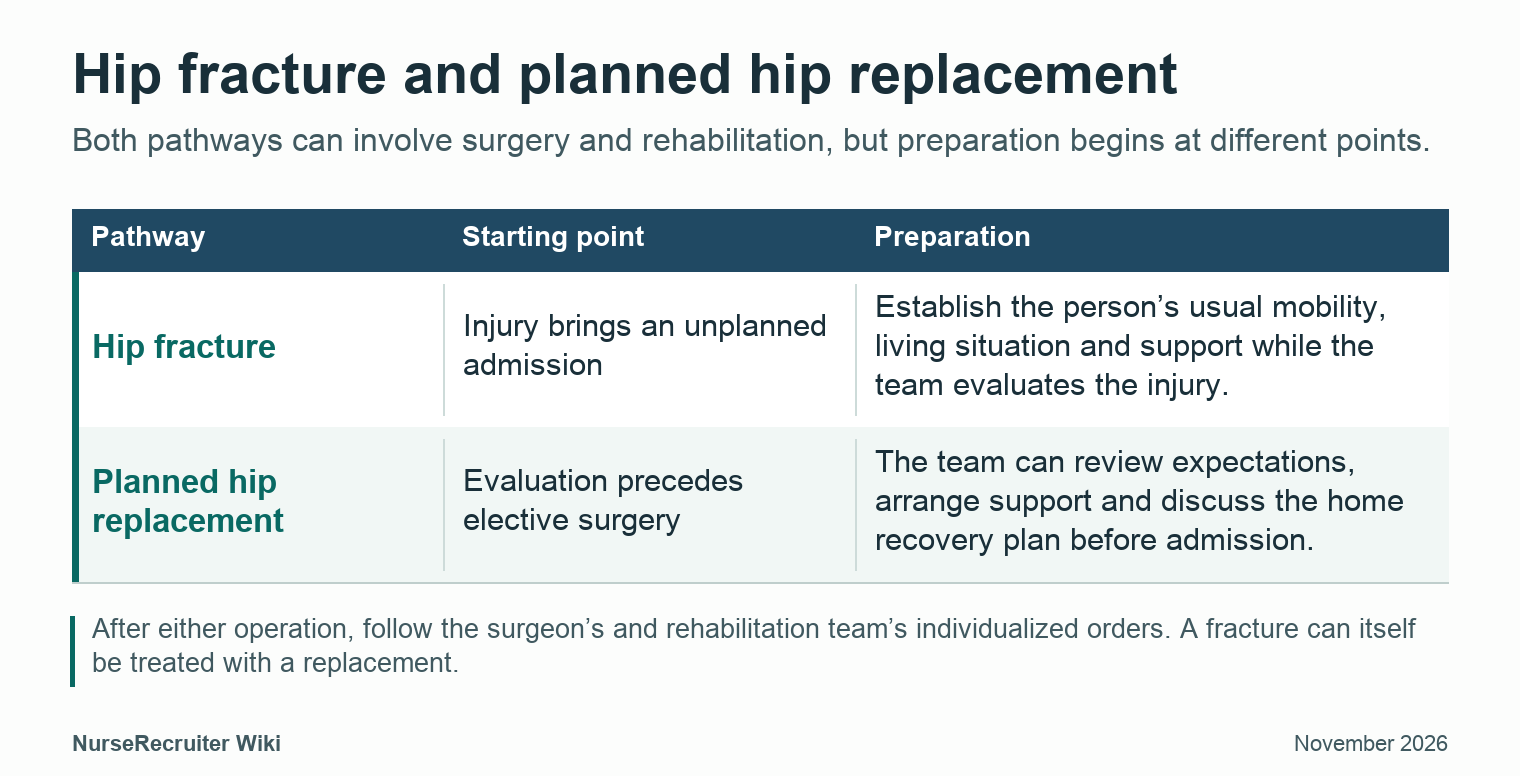
Planned joint replacement allows assessment, equipment and home support to be arranged before admission. An urgent fracture can interrupt an existing care arrangement and reveal needs that were not previously documented. AAOS recommends interdisciplinary hip-fracture care, including attention to nutrition, pain, falls and cognitive problems. Its guideline summary supports surgery within 24–48 hours of hospital admission, getting patients up and moving as soon as possible (early movement lowers the chance of a blood clot), and care that minimizes increased disorientation in patients with dementia or other cognitive problems. Nurses coordinate these needs with surgery, medicine, therapy and discharge services.
For an older adult, the handoff needs the person's usual mobility and cognition as well as the postoperative findings. Gerontological nursing and discharge planning address those continuing needs. Equipment and available help with transfers affect both the patient's discharge and the physical demands of the assignment.
Orthopedic credentials
The Orthopaedic Nurses Certification Board offers distinct certification routes:
| Credential | Main eligibility distinction |
|---|---|
| ONC | RN certification: two full years of RN experience and at least 1,000 orthopedic nursing hours in the previous three years; no BSN requirement |
| ONP-C | NP certification: graduate NP preparation, three years of RN/APRN experience, at least 2,000 advanced-practice hours in the previous three years and current NP work with musculoskeletal patients |
| ONC-A | Portfolio assessment: three years of RN experience, a qualifying graduate degree and at least 2,500 musculoskeletal nursing hours since completing the graduate degree, or within the last three years if the degree is older |
Each route has licensing and education rules. ONC-A can recognize direct care or supporting work such as education and management; it does not by itself confer nurse practitioner authority. For other specialties and their credentials, see nursing specialties.
Related articles
Sources
- May 2025 Occupational Employment and Wage Statistics (accessed 2026-11-18) — BLS; RN industry wage comparisons compiled by NurseRecruiter.
- May 2025 OEWS Technical Notes (accessed 2026-11-18) — Wage definitions and survey scope.
- 2022 National Sample Survey of Registered Nurses Public Use Files (accessed 2026-11-18) — HRSA; weighted 2021 primary-job earnings calculated by NurseRecruiter.
- 2022 NSSRN Questionnaire (accessed 2026-11-18) — Clinical specialty and primary-job earnings questions.
- 2022 NSSRN Public Use Documentation (accessed 2026-11-18) — Codebook and successive difference replicate-weight instructions.
- ONC Exam Eligibility (accessed 2026-11-18) — Experience, licensure and education rules.
- ONP-C Exam Eligibility (accessed 2026-11-18) — NP preparation and experience.
- ONC-A Advanced Certification by Portfolio (accessed 2026-11-18) — Graduate preparation, experience and portfolio route.
- Hip Fractures in Older Adults: Plain Language Summary (accessed 2026-11-18) — AAOS; interdisciplinary recovery, surgery timing and early mobilization.
- Total Hip Replacement (accessed 2026-11-18) — AAOS; preparation, complications, precautions and recovery.
- Compartment Syndrome (accessed 2026-11-18) — AAOS; causes, warning signs and emergency treatment.