
The federal Nurse Corps Loan Repayment Program pays toward qualifying nursing education debt for registered nurses, APRNs and nurse faculty. An initial two-year service contract covers 60% of the qualifying balance; an approved third year adds 25% of the original balance. The award is taxable.
Award amounts
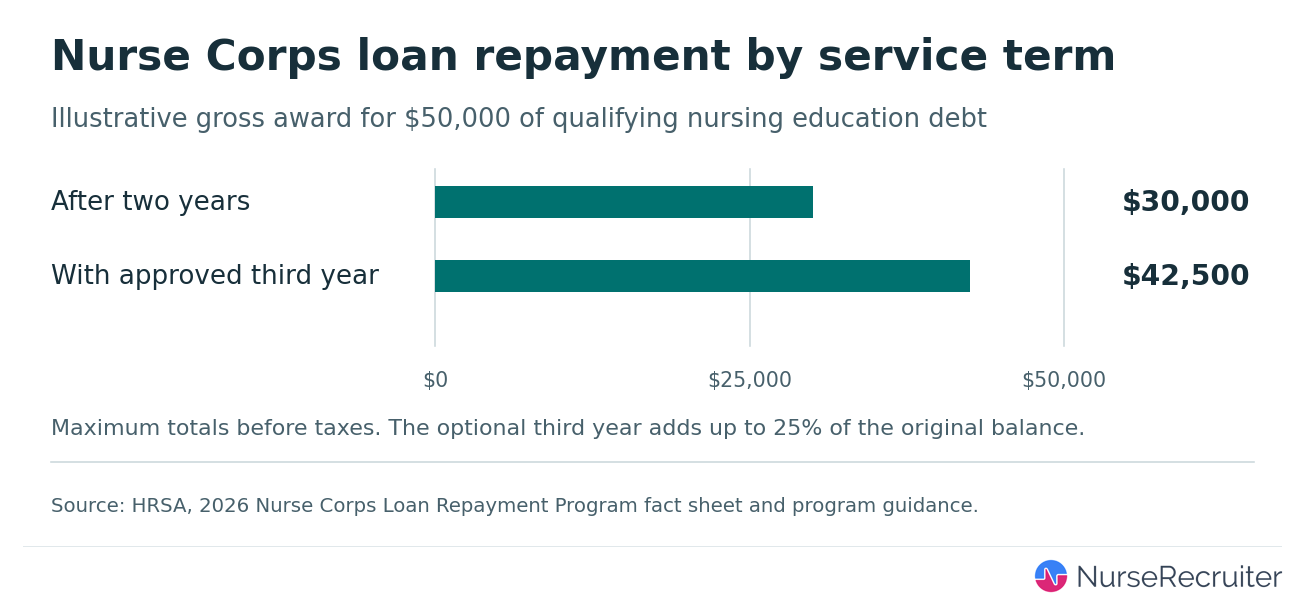
NurseRecruiter's illustration applies HRSA's percentages to a hypothetical $50,000 qualifying balance: $30,000 over the first two years, plus $12,500 for an approved third year, totaling $42,500 before taxes. The third year requires a separate continuation award. Federal income and employment taxes reduce the amount available for loan payments.
Eligible jobs and loans
Clinical participants must hold scheduled full-time RN or APRN jobs at an eligible Critical Shortage Facility (CSF). A CSF is a qualifying facility located in, designated as, or serving a primary care or mental health Health Professional Shortage Area. Faculty participants must work full time at an eligible accredited nursing school.
An employer's vacancies or recruiting claims do not establish that a site qualifies. Eligibility attaches to the facility where the nurse actually serves, and a health system with several hospitals and clinics can employ a nurse at one address while the nurse practices at another; the service site named in the award documents is the one that counts.
The 2026 guidance excludes employment through nurse staffing agencies and travel agencies, self-employment, and work on an as-needed basis. Per diem, on-call and as-needed float or pool shifts do not qualify merely because they total 32 hours in a week.
Applicants must have completed the nursing degree associated with the debt at an accredited U.S. or territorial school. They must be U.S. citizens, U.S. nationals or lawful permanent residents and meet licensing requirements. The program evaluates the specific loans, appointment and service site. HRSA gives funding preference based on financial need; a job's eligibility does not guarantee an award.
On March 31, 2026, facilities accounted for 4,832 of HRSA’s 8,789 primary-care shortage designations. The remaining designations applied to geographic areas or population groups. A nurse evaluating an offer can check the designation for the individual worksite.
Service requirements
| Service option | Work required under the 2026 guidance | Verification |
|---|---|---|
| Clinical RN or APRN at a CSF | At least 32 scheduled hours a week for at least 45 weeks per service year, including at least eight hours of direct patient care each week | Participant and site contact verify service every six months |
| Nurse faculty | Full time as defined by the employer, for at least nine months per service year | Participant and school contact verify service every six months |
Service begins when the HHS Secretary or designee countersigns the contract. Earlier employment does not count. Participants cannot switch between clinical and faculty service during either the initial contract or its continuation. Transfers require prior approval. Excess absences can extend the service end date; the contract and guidance for the participant's award year govern.
The 2026 guidance also bars overlapping service obligations from specified other repayment, scholarship and employer programs. Participants must immediately report forgiveness received through Public Service Loan Forgiveness (PSLF), other education-loan repayment funds without a service obligation, or the elimination of all qualifying debt.
Application cycles and other funding
As checked November 18, 2026, new applications for the 2026 award cycle are closed. Current participants whose initial contracts end September 30, 2026–March 31, 2027 can apply for continuation; HRSA extended that deadline to November 30, 2026, at 7:30 p.m. Eastern.
The Nurse Corps Scholarship Program pays eligible education expenses before the service obligation. The Nurse Faculty Loan Program instead lends through participating schools and cancels debt after qualifying faculty service. These differ in application route, tax treatment and work requirements; the education-funding comparison summarizes the main programs.
Related articles
- HRSA Health Professional Shortage Area Data
- Nursing Scholarships and Loan Repayment
- Nurse Faculty Loan Program
Sources
- HRSA, Nurse Corps Loan Repayment Program (accessed 2026-11-18).
- HRSA, fiscal year 2026 application and program guidance (accessed 2026-11-18), eligibility, service, transfers and repayment coordination.
- HRSA, service requirements and corrected continuation deadline (accessed 2026-11-18).
- HRSA, Nurse Corps Scholarship Program (accessed 2026-11-18).
- HRSA quarterly HPSA report, Table 3 (rolling link) (accessed 2026-11-18)