
Nurse officers in the U.S. Public Health Service Commissioned Corps hold a uniformed-service commission and work in nursing or other qualifying public health assignments. The Corps appoints the officer; the receiving agency supplies the position and daily mission. A commissioned RN and a civil-service RN can work in the same IHS clinic under different pay and appointment systems.
Basic pay and other compensation
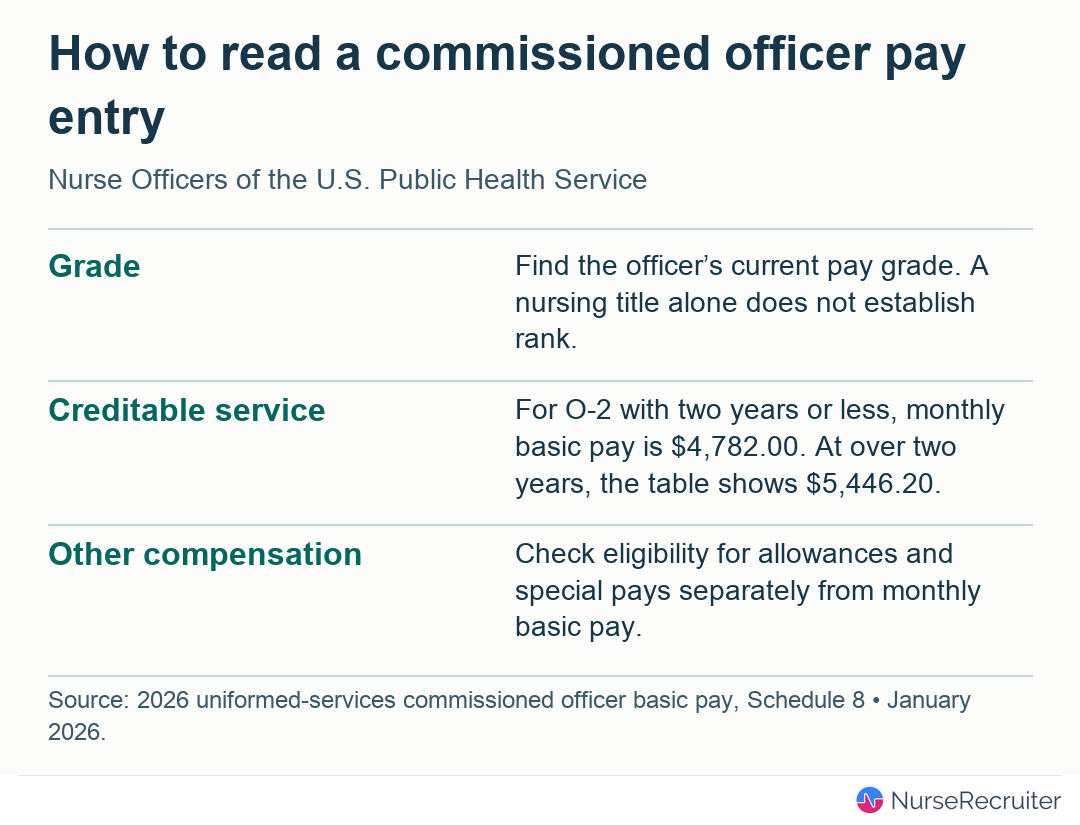
NurseRecruiter compiled these O-2 examples from the January 1, 2026 uniformed-services pay table. They apply to an officer holding that grade with the stated creditable service; a nursing title alone does not establish rank.
| O-2 creditable service | Monthly basic pay | Twelve months at that rate |
|---|---|---|
| Two years or less | $4,782.00 | $57,384.00 |
| Over two years | $5,446.20 | $65,354.40 |
The annual column is NurseRecruiter's calculation of monthly basic pay × 12, assuming a full year at the same rate. Allowances and authorized special pays are separate. A civilian salary range or VA nurse locality schedule cannot establish an officer's compensation.
Separate O-1E–O-3E rates can apply to officers with more than four years of qualifying prior active enlisted or warrant-officer service.
The appointment's grade, service credit and duty location determine the relevant pay comparison. An allowance linked to one duty station may change on reassignment. These examples do not predict a nurse's appointment grade or promise advancement on a particular date.
Commission, duty station and clinical role
| Element | What it establishes |
|---|---|
| Commission | Officer status, rank and service obligations |
| Duty station | The receiving agency and workplace |
| Position and privileges | Clinical care, program management or other assigned professional work within the officer's qualifications |
A higher rank does not confer an advanced practice license or clinical privileges. An IHS assignment also differs from direct Tribal employment or civil service, even if the duties appear similar.
Clinical schedules coexist with readiness and possible deployment for public health missions. At a January 20, 2010, briefing on the Haiti earthquake response, HHS reported more than 270 medical personnel in Port-au-Prince, including nurses and other professionals from the Commissioned Corps and the National Disaster Medical System. NurseRecruiter's contemporary coverage also described volunteer efforts. The home agency's daily nursing work and the Corps' service obligations are both parts of the appointment. Commissioned public health service is distinct from a nurse commission in an armed service.
Professional qualification and selection
IHS's nurse-officer guidance lists a qualifying BSN, or an eligible MSN for an applicant without a qualifying nursing bachelor's degree, an unrestricted RN license and NCLEX passage. Commissioning also requires professional, medical and security review. These are separate from meeting a particular clinical position's requirements.
NIH illustrates the agency-selection stage. A serving officer or professionally boarded applicant may seek a courtesy referral for a position. NIH specifies a current personnel order for an active-duty officer and medical and professional boarding notifications for a call-to-active-duty candidate, plus the required resume and supporting records. The referral does not guarantee a job or confer civil-service status.
Selection for a funded agency position and appointment to the Corps are separate decisions. The official appointment and assignment establish the start date and duty station. Military nursing compares the Corps with the Army, Navy and Air Force nurse corps; federal civilian nursing covers civil-service nursing at IHS, NIH, the Bureau of Prisons and other agencies.
Related articles
Sources
- 2026 monthly basic pay for commissioned officers, Schedule 8 (accessed 2026-11-18)
- 42 U.S.C. § 210, Public Health Service officer pay and allowances (accessed 2026-11-18)
- IHS nurse-officer qualifications (accessed 2026-11-18) — Used for nursing credentials and review requirements; older age and service-count statements on the page are not used.
- NIH Commissioned Corps referrals and documentation (accessed 2026-11-18)
- USPHS nurse category recruitment presentation (accessed 2026-11-13) — Earlier source for commissioning and deployment context.
- White House press briefing on the U.S. government response to the Haiti earthquake, January 20, 2010 (accessed 2026-11-18) — HHS count of medical personnel in Port-au-Prince.
- How to help Haiti? Send in the Nurses (accessed 2026-11-18). NurseRecruiter, published 2010-11-28.