
Lactation consultants assess infant feeding, work with families on feeding plans, and coordinate follow-up. The International Board Certified Lactation Consultant (IBCLC) credential certifies competence in lactation care. An RN license and the IBCLC credential are separate qualifications. Some hospitals hire for a position that requires both. A person can also qualify as an IBCLC through an eligible pathway without becoming a registered nurse.
How many people hold the credential?
The certifying body counted 21,185 IBCLCs in the United States and its territories on January 22, 2026, including 3,065 in California. This count covers credential holders from several professional backgrounds. For a hospital recruiting an RN–IBCLC, the pool narrows to those who also have the RN license and experience the role requires.
Pay benchmarks for RN–IBCLC positions
BLS doesn't publish pay for lactation consultants or RN–IBCLCs. NurseRecruiter compiled these May 2025 BLS benchmarks for all registered nurses in two employer industries:
| Employer industry | Hourly 25th percentile | Hourly median | Hourly 75th percentile | Annual median |
|---|---|---|---|---|
| General medical and surgical hospitals | $39.23 | $48.18 | $57.21 | $100,210 |
| Physicians' offices | $36.25 | $40.87 | $49.17 | $85,000 |
These rows describe RNs across specialties. They do not measure non-RN lactation-consultant earnings, independent consulting fees or a separate IBCLC wage premium. BLS excludes overtime premiums and employer-paid benefits.
A hospital may classify an RN–IBCLC on its staff RN scale or use a dedicated consultant classification. The written appointment determines whether consults, documentation and follow-up are protected duties or are added to a bedside assignment, and whether certification attracts additional pay. Comparing RN pay offers covers the effect of paid hours and premiums.
Consultation and follow-up
An initial consultation brings together a feeding history, the parent’s goals, observation of a feeding when appropriate, assessment, and an agreed follow-up plan. The consultant documents findings, communicates them with the family and relevant clinicians, and refers concerns that require another professional’s assessment. The professional scope includes education and support across the course of lactation as well as assessment of feeding difficulties.
An inpatient assignment may serve several postpartum rooms and a neonatal unit during one shift. Discharge creates a practical boundary: determine who will review the feeding plan and who the family can contact later. An outpatient clinic may instead book longer assessments and see the same family over several visits. Coverage for weekends, urgent referrals, interpreters, and patients outside the main maternity unit changes the workload in either setting.
RN and consultant responsibilities
An RN–IBCLC role combines nursing responsibilities with lactation consultation. An IBCLC without an RN license has a different legal basis for practice. The credential does not grant nursing licensure, prescribing authority or every procedure that another profession may perform. Professional scope of practice, referral arrangements and employer responsibilities remain relevant.
A consult-only assignment and a bedside postpartum assignment with additional consults require different coverage. The patient population, travel between units or clinics, repeat visits, after-hours contacts and responsibility for the ordinary bedside assignment define the workload. Postings also differ on whether IBCLC certification is required at hire or must be earned by a stated deadline.
IBCLC eligibility pathways
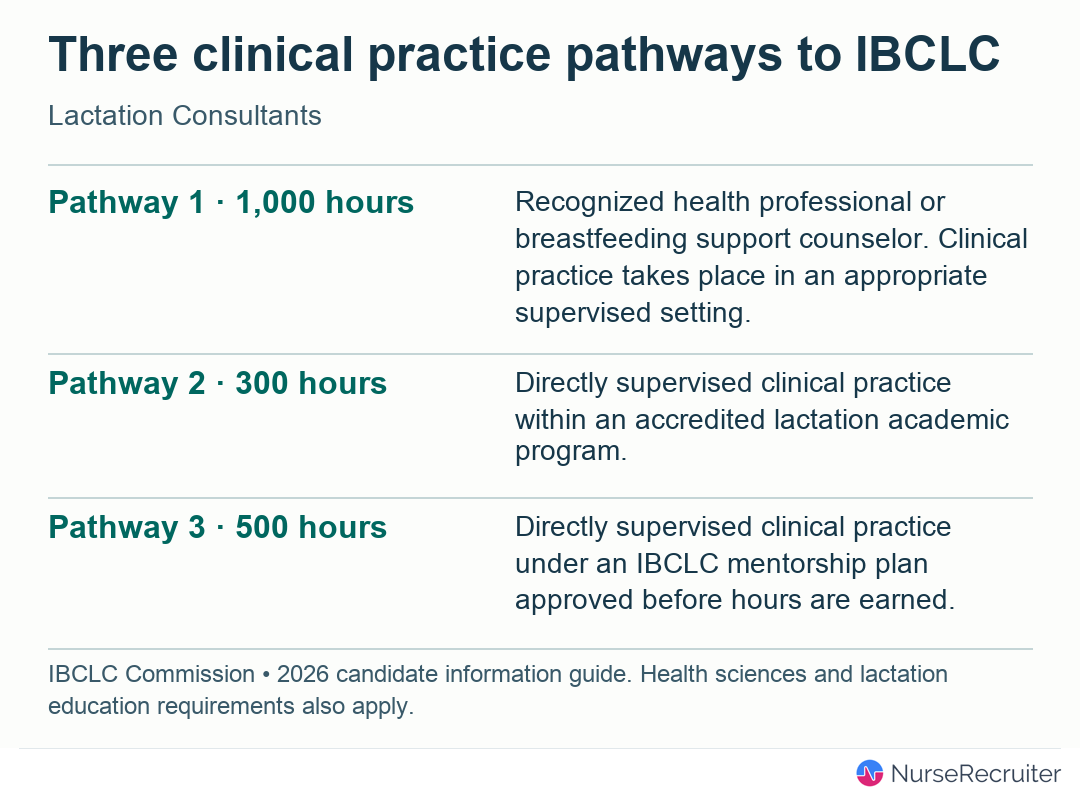
The October 2026 candidate guide requires the appropriate health-sciences background plus 90 hours of lactation education, including two hours on the WHO Code, and five hours of communication education. It offers three routes to clinical experience:
| Pathway | Required lactation-specific practice |
|---|---|
| 1: Recognized health professional or breastfeeding support counselor | 1,000 hours in an appropriate supervised setting; direct IBCLC supervision is not required for this route |
| 2: Accredited lactation academic program | 300 hours, directly supervised by an IBCLC in good standing |
| 3: Preapproved IBCLC mentorship | 500 hours, directly supervised under the approved plan |
The education and qualifying practice hours must fall within the five years before examination application. Pathway 3 approval must precede the clinical hours. Applicants also attest to the code of conduct. An RN's total maternity shift hours do not automatically equal qualifying lactation-practice hours.
Related articles
Sources
- May 2025 Occupational Employment and Wage Statistics (accessed 2026-11-18) — BLS; RN industry wages compiled by NurseRecruiter.
- Choosing a Pathway to the IBCLC (accessed 2026-11-18) — IBCLC Commission.
- Candidate Information Guide, October 2026 (accessed 2026-11-18) — Current education, clinical-practice and pathway requirements.
- Scope of Practice for IBCLCs (accessed 2026-11-18) — Professional scope effective December 2018.
- IBLCE, certified IBCLCs by U.S. state and territory, January 2026 (accessed 2026-11-19)