
A Clinical Nurse Leader (CNL) is a graduate-prepared registered nurse who coordinates care and evaluates outcomes for a defined patient group. The role combines direct clinical work, communication across disciplines, and improvement of care processes. CNL preparation does not confer APRN licensure or prescriptive authority.
Pay for clinical nurse leader assignments
NurseRecruiter compared two 2026 VA clinical nurse leader schedules, both for registered nurses in series 0610, assignment Q4, grade 02. These are annual basic-pay amounts at specified steps.
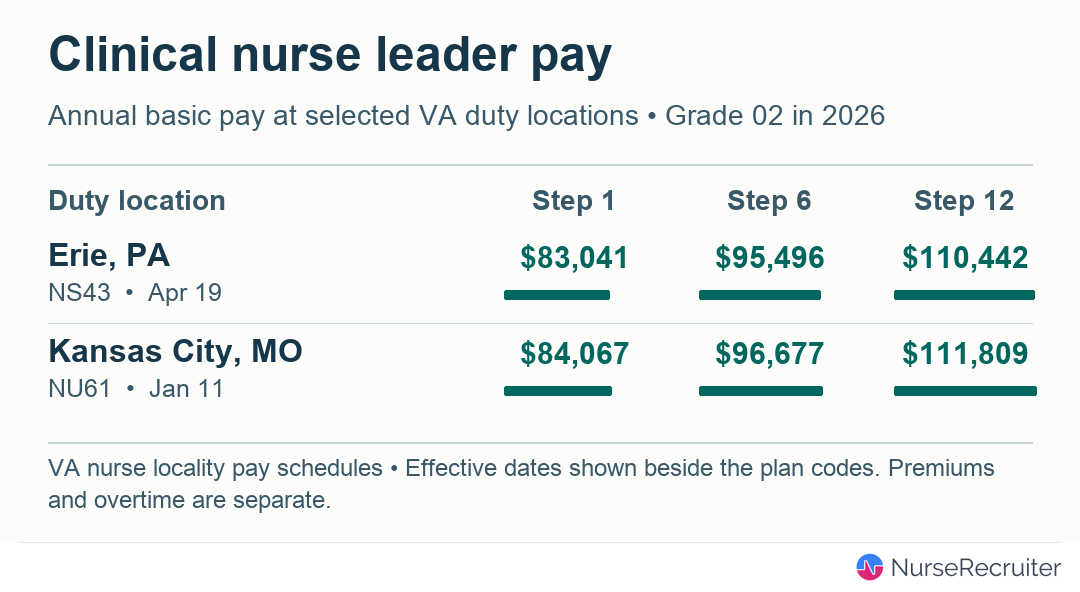
| VA duty location | Station / pay plan | Effective date | Step 1 | Step 2 | Step 6 | Step 12 |
|---|---|---|---|---|---|---|
| Erie, Pennsylvania | 562 / NS43 | April 19, 2026 | $83,041 | $85,532 | $95,496 | $110,442 |
| Kansas City, Missouri | 589 / NU61 | January 11, 2026 | $84,067 | $86,589 | $96,677 | $111,809 |
The vacancy’s station, duty location, assignment, grade, and starting step determine which schedule applies. Premium pay and benefits are separate. VA nursing pay explains these schedules.
For broader context, the May 2025 national RN median was $46.90 an hour, or $97,550 annually. BLS does not separate CNLs in that occupation-wide estimate. A clinical leadership position classified on an RN scale is also different from a management position carrying personnel and budget responsibility.
Work across a patient group
The CNL’s work follows a group of patients across disciplines and services. It can include identifying shared risks, coordinating complex care, applying evidence to practice, and measuring whether a change improves delivery.
| Area of work | Example of the CNL’s contribution |
|---|---|
| Care coordination | Resolve gaps between nursing, pharmacy, therapy, and the next care setting |
| Clinical risk | Review patterns across a patient group and bring unresolved risks to the relevant team |
| Evidence in practice | Work with clinical specialists and staff to introduce and assess a care-process change |
| Outcome measurement | Define the eligible population and measure the result consistently over time |
For example, a CNL investigating incomplete discharge handoffs could track the proportion of eligible discharges with a confirmed transfer of information. Counting staff trained would measure teaching activity, not whether the handoff occurred. Care coordination measures and quality improvement describe those different uses of data.
CNL, charge nurse, manager, and CNS
| Role | Primary responsibility |
|---|---|
| Clinical Nurse Leader | Integrate care for a patient group and evaluate clinical processes and outcomes |
| Charge nurse | Coordinate assignments, patient flow, and escalation during a shift |
| Nurse manager | Direct unit operations, supervise staff, and manage staffing and budgets |
| Clinical nurse specialist | Practice in an APRN role with specialist graduate preparation and authority under the relevant jurisdiction |
An employer may combine duties or use “clinical leader” as a local title, so a search for CNL openings on a nursing job board such as NurseRecruiter is only a starting point for reading each posting's duties. The actual position needs a defined patient group, clinical responsibilities, access to data, and authority to implement changes. Direct reports, routine charge coverage, and a management budget are separate features of the job, not consequences of holding CNL certification.
Education and certification
The American Association of Colleges of Nursing published updated master’s and doctoral CNL competencies in 2025. The framework describes clinical leadership, assessment of population needs, coordination, evidence, and outcomes; doctoral expectations extend the scope of analysis and leadership.
The Commission on Nurse Certification administers CNL certification. The credential requires eligible CNL education and passing its examination. A degree, RN licensure, and certification are separate records; an employer’s deadline for certification should identify which must be documented at appointment.
Related articles
- Clinical Nurse Specialists
- Nursing Management and Leadership
- Quality Improvement
- Measuring Care Coordination
Sources
- AACN, Clinical Nurse Leader role and distinctions from management and APRN practice (accessed 2026-11-18)
- AACN, 2025 Clinical Nurse Leader master’s and doctoral competencies (accessed 2026-11-18)
- Commission on Nurse Certification, CNL certification (accessed 2026-11-18)
- U.S. Department of Veterans Affairs, 2026 nurse locality schedules, series 0610 (accessed 2026-11-18)
- BLS, registered nurses, national employment and pay (accessed 2026-11-13)