
Burn nursing spans emergency assessment, intensive care, surgery, rehabilitation and outpatient recovery after thermal, chemical, electrical and other burn injuries. The assignment can involve respiratory support and intensive monitoring, wound and graft care, pain management, or longer-term mobility and scar concerns; temperature, nutrition and psychological recovery also shape the work. A burn ICU job and an outpatient burn-clinic job therefore have different workloads and coverage needs.
Pay
BLS does not publish pay for burn nurses specifically. NurseRecruiter compiled this May 2025 BLS RN benchmark for general medical and surgical hospitals. It covers RNs across all specialties in that industry.
| Employer industry | RN employee jobs | Hourly 25th percentile | Hourly median | Hourly 75th percentile | Annual median |
|---|---|---|---|---|---|
| General medical and surgical hospitals | 1,902,960 | $39.23 | $48.18 | $57.21 | $100,210 |
The middle half of reported wages lies between the 25th and 75th percentiles. OEWS wage estimates exclude overtime premiums and employer-paid benefits. See registered nurse pay for state and metropolitan comparisons.
A hospital scale may cover both burn nurses and other staff RNs. The employer's grade, experience credit, shift premiums and call-back provisions determine the actual offer. The BLS industry estimate cannot establish a separate burn-nursing premium.
Burn-center activity
The American Burn Association's 2025 Burn Injury Summary Report describes 32,993 reported cases in 2024 and 162,799 cases over 2020–2024, contributed by 114 burn centers in 38 states and the District of Columbia. These are participating-center registry figures, not a count of every U.S. burn injury or a count of nursing jobs.
The figures describe a specialty concentrated in dedicated services. Staffing requirements still depend on the center's patient acuity, age range, intensive-care capacity and mix of inpatient and outpatient work.
Work across the service
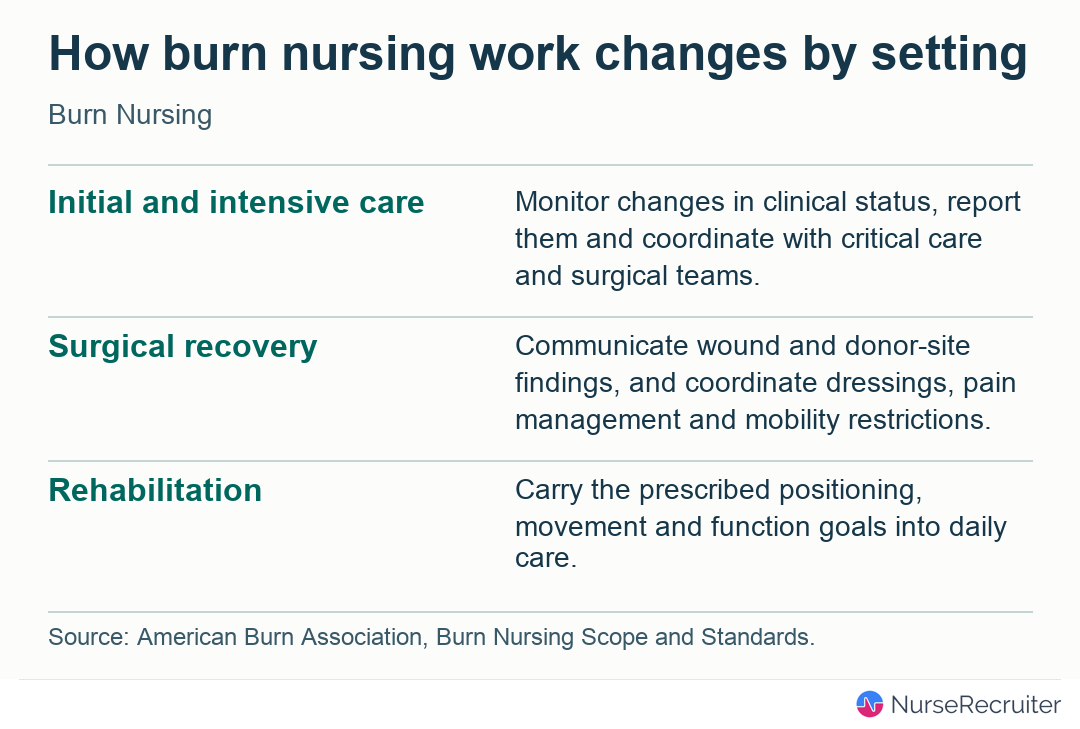
| Assignment | Nursing work |
|---|---|
| Acute and intensive care | Ongoing assessment, response to changes in clinical status, prescribed treatment and coordination with critical-care and surgical teams |
| Surgery and inpatient recovery | Wound and donor-site assessment, dressings, pain management and the prescribed graft or mobility restrictions |
| Rehabilitation | Positioning, movement and functional goals coordinated with physical and occupational therapy |
| Outpatient follow-up | Healing and functional assessment, wound-care teaching, scar-care follow-up and referral of new concerns |
Rehabilitation can begin during the acute stay. Dressing care, analgesia, positioning and therapy need a coordinated schedule; they are not separate stages that always wait for the preceding one to finish. The nursing handoff carries the graft and donor-site information, recent procedures, functional restrictions and next review plan. The patient's tolerance of care and ability to take part in therapy can matter as much to the next shift as the appearance of a wound.
Discharge work includes arranging dressing supplies, identifying who can provide care, coordinating follow-up and telling the patient whom to contact between appointments. Return to work or school, altered appearance and persistent movement limitations can extend recovery beyond wound closure. These tasks overlap with wound care, home health and outpatient nursing.
Specialty preparation
The American Burn Association publishes nursing competencies and a 2025 scope-and-standards document. A nurse moving from critical care still needs validated burn-specific skills, including wound care and recovery across the service's levels of care.
BCEN awards the Certified Burn Registered Nurse (CBRN) credential. Its current eligibility requires an unrestricted RN license in a listed jurisdiction or an accepted equivalent; two years of specialty practice is recommended, not required to sit for the exam. The nurse's certification is separate from a burn center's institutional verification. BCEN also awards the CEN for emergency nurses.
A role that rotates between ICU, inpatient recovery and clinic requires competence for each assigned setting. The staffing plan and orientation should identify which levels of care the position actually covers. When comparing burn openings, whether on a hospital's careers page or a nursing job board such as NurseRecruiter, the posting and interview are where to confirm which of those settings a position includes.
Related articles
- Critical care nursing
- Rehabilitation nursing
- Wound, ostomy and continence nursing
- CEN certification
- Nursing certification boards
- Registered nurse pay
- Wound Assessment and Dressing Changes
Sources
- May 2025 Occupational Employment and Wage Statistics (accessed 2026-11-18) — BLS; RN industry employment and wage percentiles, compiled by NurseRecruiter.
- Burn Care Quality Platform and Burn Injury Summary Report (accessed 2026-11-18) — ABA; public summary of 2025 report with 2024 and 2020–2024 cases.
- Burn Care Registered Nurse (accessed 2026-11-18) — ABA; settings and work.
- 2025 Burn Nursing Scope and Standards (accessed 2026-11-18) — ABA; publication announcement.
- Burn Nursing Competency Performance Criteria (accessed 2026-11-13) — ABA, 2021; retained dated competency document.
- CBRN Certification Process (accessed 2026-11-18) — BCEN; RN license requirement and recommended experience.