The Methodist Dallas killings and what a workplace violence report can measure
By Jo · · Working Conditions, Workplace Violence Facebook LinkedIn Email
NurseRecruiter editorial update, November 11, 2026.
On October 22, 2022, Jacqueline Pokuaa and Katie Annette Flowers were killed at Methodist Dallas Medical Center. Our original article appeared the following month, before the criminal trial. In November 2023 the Dallas County district attorney reported that a jury convicted Nestor Hernandez of capital murder and that he received a life sentence without parole. The Texas Fifth Court of Appeals affirmed the judgment on November 7, 2025.
The court record answers what happened in that case. It does not establish how often healthcare workers face violence or whether a safety measure would have prevented these deaths. Those questions require different evidence.
Read the historical measure accurately
A Bureau of Labor Statistics fact sheet published in 2020 examined 2018 data. It reported 10.4 nonfatal intentional injuries by another person per 10,000 full-time workers in private healthcare and social assistance, compared with 2.1 across private industry. These were cases involving days away from work.
The definition matters. This comparison describes an industry and a specific injury measure. It is not a count of all threats or verbal abuse, a finding about nurses alone or a measurement of every public-sector workplace. It also does not describe the current year.
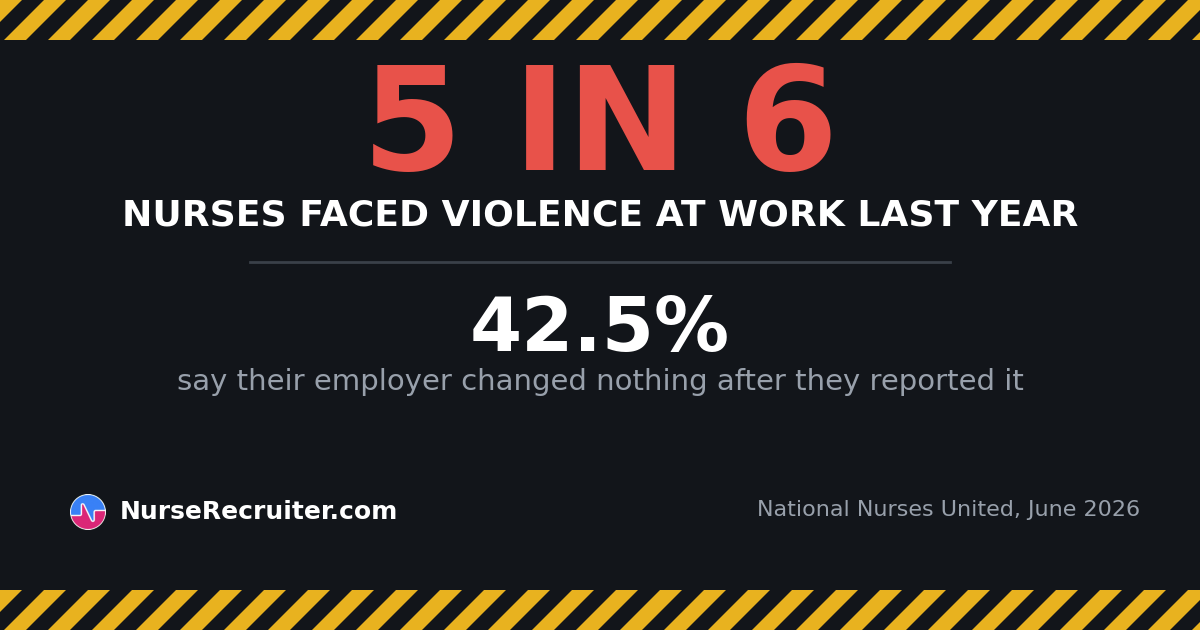
Before combining another survey or statistic with it, check the population, time period, question and outcome. A percentage of respondents who recall abuse cannot be treated as interchangeable with an injury incidence rate. Several troubling figures do not automatically form one comparable trend.
Ask what the response looks like on a real shift
For a workplace violence reporting system, trace what happens between a threat being reported and an action being recorded. Use a recent example the organization can discuss without disclosing patient or employee information unnecessarily.
- Getting immediate help: How does a nurse summon assistance, and who responds on the shift and unit in question?
- Reporting afterward: Where is an incident recorded, who receives it and how does the reporter know it reached the responsible person?
- Following up: What support is offered, how are continuing concerns escalated and who communicates the response to affected staff?
- Changing the work: How are reported concerns considered when reviewing the environment, staffing arrangements, visitor procedures, equipment or staff preparation?
- Checking the change: What evidence will the team use to decide whether its chosen action helped, and when will it review that evidence?
These are discussion questions, not a substitute for the facility’s emergency procedures or a complete prevention standard. During an immediate threat, use the applicable emergency response process rather than this article as instructions.
Separate training, equipment and accountability
If a proposed response is a course, ask which task it prepares staff to perform and what organizational support accompanies it. If it is an alarm or another piece of equipment, ask how staff learn to use it, how it is maintained and what response follows activation.
Do not treat completing a course or purchasing a device as proof that the whole problem has been resolved. Ask what happened after implementation and what remains uncertain. Keep the discussion focused on improving the system rather than assuming the harmed worker failed to prevent the incident.
Keep the record useful
Bring a short record to the next safety meeting: the concern, the action agreed, the person responsible, the date for review and any unresolved question. Seek a way for staff to see what changed after concerns were raised.
The original article discussed bills and advocacy campaigns active in 2022. For a present-day legal or policy decision, consult the relevant current authority and the organization’s policies. A historical proposal is not evidence that a requirement now applies.