What a 2011 EHR Study Found About Nurses’ Care Ratings
By Jenna Fischer · · Working Conditions Facebook LinkedIn Email
NurseRecruiter editorial update, November 11, 2026.
A study revisited from our 2012 archive. An early investigation of electronic health records asked how nurses rated care in hospitals with and without a basic EHR. That question is more specific than the original headline’s promise of better patient outcomes.
What the researchers examined
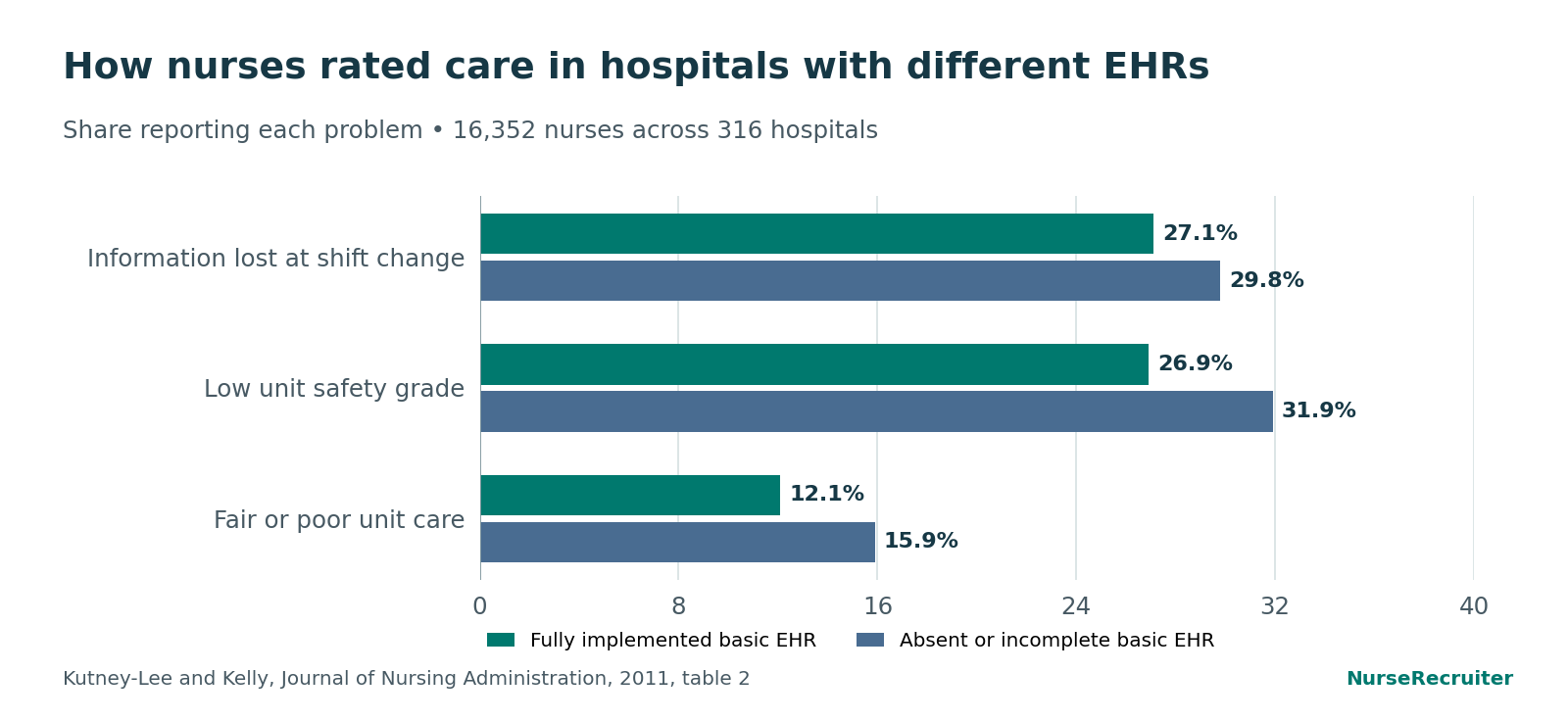
These unadjusted survey percentages describe nurses’ reports. The number answering each item varied. The comparison group included hospitals that had implemented only part of a basic EHR. Kutney-Lee and Kelly, Journal of Nursing Administration, 2011, table 2.
Ann Kutney-Lee and Deena Kelly’s paper appeared in the Journal of Nursing Administration in November 2011. It analyzed nurse and hospital survey data from 16,352 nurses in 316 hospitals across four states. The authors described the design as a cross-sectional secondary analysis. Read the authors’ abstract.
Nurses at hospitals with a fully implemented basic EHR reported safety and quality problems less often than nurses at hospitals with no EHR or a partially implemented basic EHR. These were nurse-assessed outcomes, not a direct measurement of every patient’s result.
What the finding can tell us
The association gave researchers a reason to examine how electronic records might support care. It did not establish that adopting an EHR by itself caused the difference between the hospitals.
The distinction matters when reading a technology headline. Ask what was measured, who supplied the information, which organizations were compared and whether the study design can establish cause and effect.
This historical study is also not a current count of hospitals using electronic records. Its finding concerns the relationship between EHR use and nurses’ assessments in the hospitals studied.